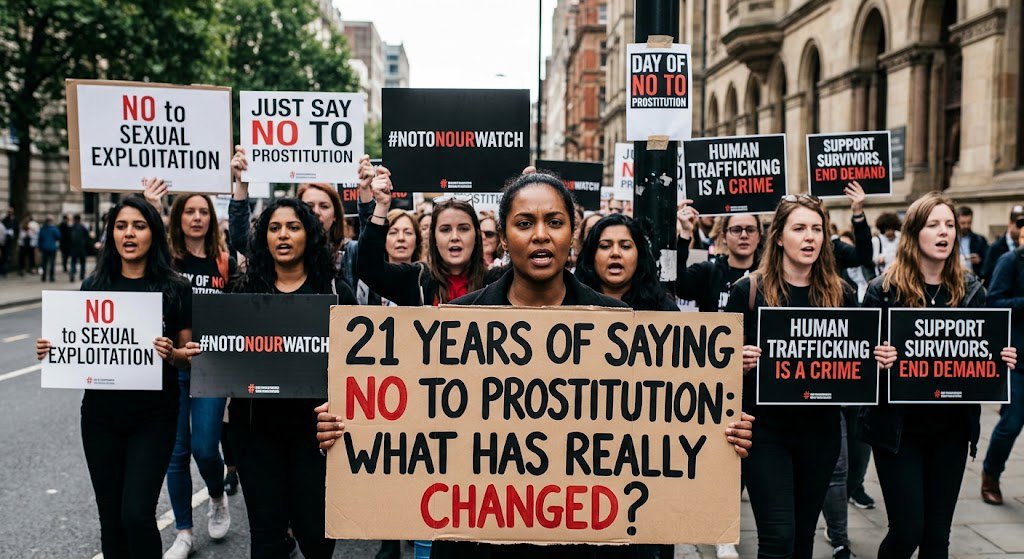
DAVAO CITY(October 6) — For 21 years, Davao City has been saying no to prostitution and the exploitation of women and girls.
But as another International Day of No to Prostitution is observed on Oct. 7, advocates are asking a harder question:
What has really changed?
The Day of No to Prostitution began in 2005 as a campaign to raise public awareness about prostitution, exploitation and violence against women and children.
In Davao City, the advocacy has continued through Proclamation No. 7, which declares Oct. 7 as the International Day of No to Prostitution in the city, with women’s organizations, civil society groups and the City Government’s Integrated Gender and Development Division (IGDD) working together.
Over the past two decades, laws have been passed, programs established, services strengthened and institutions created to protect women and children from exploitation.
Yet prostitution and sexual exploitation remain.
What has changed, advocates say, is increasingly how exploitation happens.
Lawig Bubai and Talikala, which monitor and work with women and girls affected by exploitation, have observed the growing use of social media, messaging applications and online payment systems to recruit women and girls and arrange transactions.
During the pandemic alone, 108 women and girls were documented as using online platforms in connection with transactions, according to Lawig Bubai’s monitoring.
The shift online makes exploitation easier to conceal and potentially harder to detect.
It also exposes a disturbing range of ages.
Lawig Bubai’s organized members range from a 9-year-old girl to a 76-year-old woman.
The 67-year age gap represents different generations, but advocates say it points to the same continuing problem: women and girls remain vulnerable to exploitation.
The presence of a 9-year-old is particularly alarming, serving as a reminder that children still need protection from abuse, exploitation and trafficking.
At the other end of the spectrum, the 76-year-old member shows that the struggle for women’s dignity, rights and protection does not belong to one generation alone.
For Lawig Bubai chairperson Lory Pabunag, the real measure of progress cannot simply be the number of laws passed or programs created.
Real change, she said, should mean fewer children falling victim to exploitation, faster access to protection and justice, better services for survivors, more opportunities for women to live with dignity and earn a livelihood, and stronger accountability for those who exploit them.
That means shifting the focus from asking what victims did to questioning who profits from their exploitation, who facilitates it and whether institutions are responding effectively.
Lawig Bubai and women survivors, advocates, partners and supporters continue to challenge the idea that exploitation should be treated as a normal part of society.
Women and children should not be blamed for the exploitation they experience, Pabunag said.
Poverty and difficult circumstances should never be used as justification for exploiting them.
The 21st year of the advocacy, she said, should therefore be more than another commemoration.
It should be a point to examine what has been achieved over the past two decades—and what government, communities, families, businesses, media, civil society, and men and women still need to do to prevent exploitation and protect the rights and dignity of women and girls.
Twenty-one years of saying no.
Twenty-one years of raising awareness.
And 21 years of asking the same question:
Has anything really changed?
As long as women and children remain vulnerable to exploitation, advocates say, the answer cannot simply be measured by laws on paper.
The challenge is to make protection, justice, dignity and opportunity real in their everyday lives.
No to prostitution.
No to exploitation.
Yes to dignity, protection, justice and opportunity.