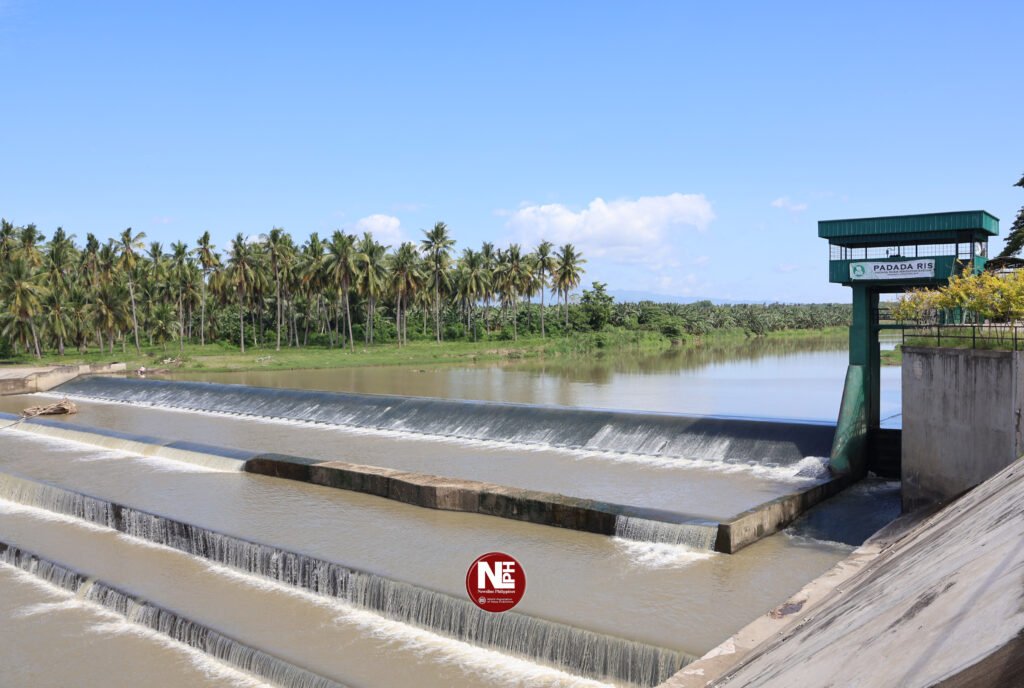
Padada RIS. Photo courtesy: National Irrigation Administration
MANILA (December 30) — After years of stalled projects, cost overruns, and public distrust, the National Irrigation Administration (NIA) is ending 2025 claiming a turnaround: a top governance rating, major dam projects nearing completion, and a push toward AI-driven irrigation management.
But as the agency touts reforms and modernization, questions remain over whether these gains mark a lasting institutional shift—or a fragile rebound that still demands close public oversight.
Governance rating up, but trust remains conditional
NIA’s headline achievement this year is an “Excellent” 89.58-percent score in the Corporate Governance Scorecard of the Governance Commission for GOCCs (GCG)—its highest rating in a decade and a 13.87-point jump from 2024.
The score reflects improvements in procurement rules, board practices, and internal controls. Still, governance experts caution that scorecards measure systems and compliance, not necessarily long-term performance on the ground.
For irrigators who have lived with unfinished canals and non-functional dams, the real test is whether reforms prevent a return to ghost projects once political attention fades.
Big dams, big claims—and bigger risks
NIA’s pivot toward multi-purpose dams—irrigation combined with flood control and energy—responds to climate realities. But such projects also carry higher financial and environmental stakes.
The Union Water Impounding Dam in Cagayan and the Jalaur River Multi-Purpose Project Stage II in Iloilo are presented as proof that dams can protect communities as well as farms.
Yet watchdog groups continue to flag concerns common to large-scale water projects: land acquisition delays, downstream impacts, and ballooning costs once construction accelerates.
JRMP-II, for instance, required a ₱5.9-billion supplemental budget—a reminder that even “flagship” projects can strain public funds if timelines slip or designs change midstream.
Small projects deliver—but scale remains a question
NIA points to projects like the Calunasan Small Reservoir Irrigation Project in Bohol as evidence that smaller, localized systems may offer better value for money. The project now supports 400 families and allows double-cropping.
The question policymakers face is whether these high-impact but limited-coverage projects will remain the exception—or finally become the model in an agency long associated with mega-infrastructure.
Mindanao irrigation framed as peacebuilding—needs proof
In Mindanao, NIA highlights progress on the Malitubog-Maridagao Irrigation Project Stage II, linking irrigation access to reduced conflict in former combatant areas.
While development experts broadly agree that livelihoods matter for peace, critics warn against oversimplifying armed conflict. Without parallel investments in land tenure security, market access, and local governance, irrigation alone may not deliver the stability being claimed.
Solar pumps cut costs, but sustainability unclear
The rollout of more than 180 solar-powered irrigation systems is among NIA’s most tangible wins in 2025, cutting fuel costs and shielding farmers from diesel price shocks.
However, past rural electrification and pump programs show that maintenance and technical support—not installation—often determine success. Without long-term funding for repairs and IA capacity-building, even solar systems risk falling into disuse.
AI command center: leap forward or digital gap?
NIA’s Command Center, powered by AI-driven weather data from Tomorrow.io, promises predictive planning and fairer water distribution.
But technology analysts warn that data-driven systems only work if local irrigation offices—and farmers—can actually act on the information. In areas with weak connectivity, limited training, or understaffed field units, high-tech dashboards may struggle to translate into timely decisions.
Bigger 2026 budget raises stakes
With a ₱45.07-billion budget approved for 2026, NIA now has more resources—and less room for excuses. The expanded re-fleeting program and new equipment aim to address chronic canal neglect, a long-standing grievance among farmers.
For watchdogs, the coming year will be decisive: whether funds are spent transparently, equipment is equitably deployed, and projects are completed without last-minute cost increases.
The bottom line
NIA’s 2025 gains suggest reform is possible—even in agencies long dogged by inefficiency. But credibility will not be secured by ratings, technology launches, or ribbon-cuttings alone.
For farmers and taxpayers alike, the real measure of success is simple and unforgiving: water delivered on time, projects that last, and public money spent without waste.
If NIA sustains that standard beyond 2025, the turnaround may hold. If not, the agency risks proving that reform, like irrigation, can dry up without constant vigilance.



 is ending 2025 claiming a turnaround)