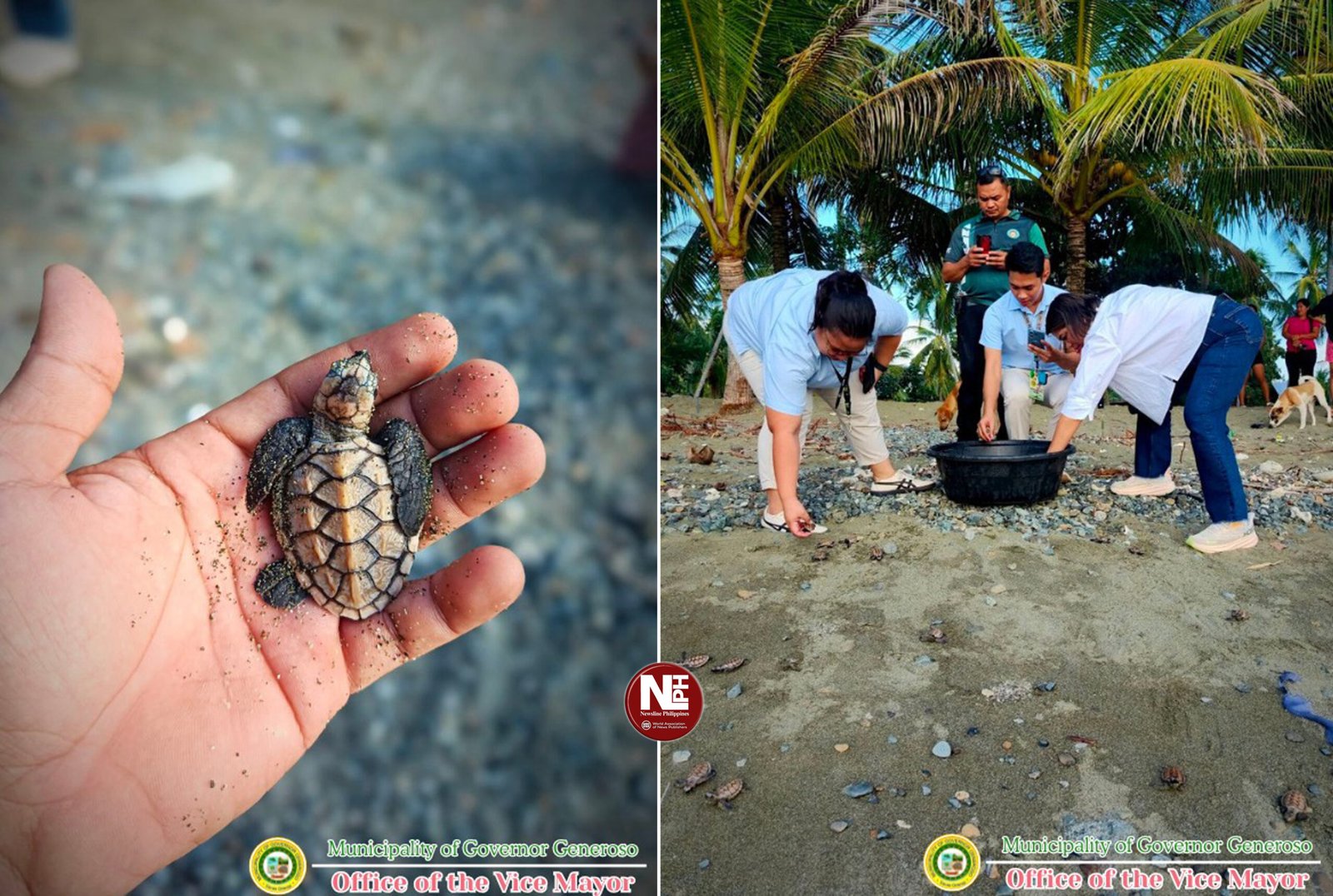
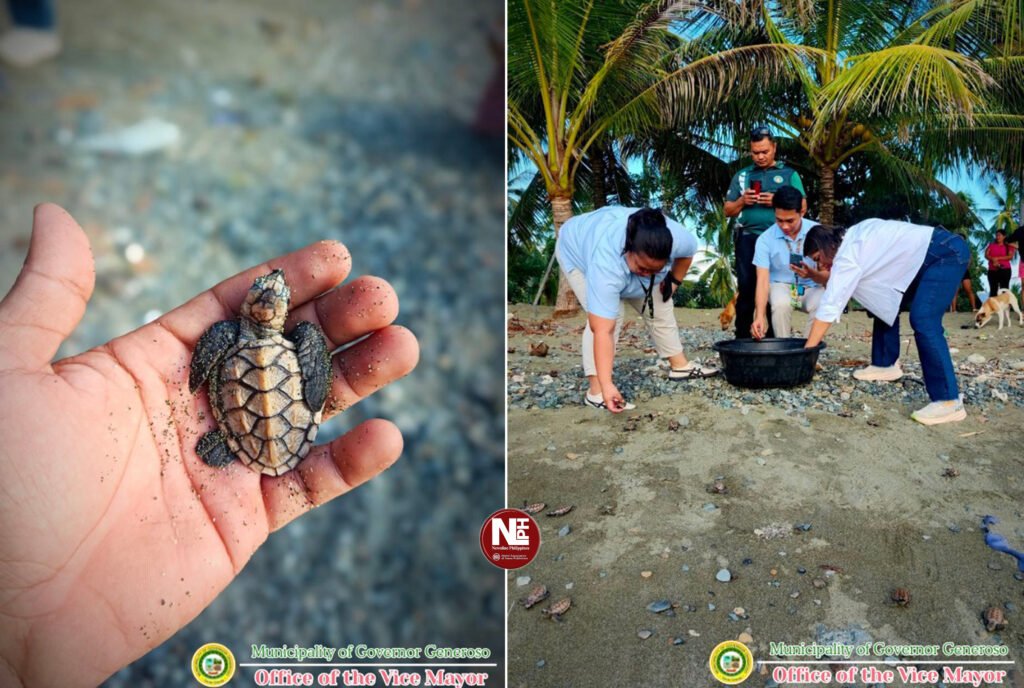
Photo courtesy: Vice Mayor Xz May "Pinky" Inojales
Photo courtesy: Vice Mayor Xz May “Pinky” Inojales
GOVERNOR GENEROSO, Davao Oriental (January 24) — The release of 108 Hawksbill sea turtle hatchlings along the shores of Barangay Poblacion has highlighted how local conservation efforts are helping protect reef ecosystems, migratory marine species, and climate resilience in one of the country’s most biologically rich coastal provinces.
Residents, fisherfolk, volunteers, and local officials gathered at dawn in Purok 12 to witness the hatchlings make their way to the sea—an event environmental experts say reflects the condition of the surrounding marine environment.
According to the Department of Environment and Natural Resources (DENR), the Hawksbill sea turtle is a critically endangered species, with studies showing that fewer than 1 in 1,000 hatchlings typically survive to adulthood due to predation, habitat loss, and climate-related threats. This makes every successful nesting and release significant for species survival.
Marine biologists note that Hawksbills are closely tied to coral reef health. Unlike other sea turtles, they feed primarily on reef sponges, helping maintain coral diversity and balance. Their presence is therefore considered a biological indicator of healthy reef systems.
The Bureau of Fisheries and Aquatic Resources (BFAR) said community-protected coastal areas, including Marine Protected Areas (MPAs), play a crucial role in improving reef condition. BFAR monitoring data from similar protected sites in eastern Mindanao show that live coral cover can increase by 10–30 percent within five to ten years when fishing pressure and destructive activities are reduced.
Environmental officers involved in the activity said the successful hatching suggests that nearby coral reefs and seagrass beds—key habitats for juvenile turtles—remain functional despite rising sea temperatures and stronger typhoons.
Davao Oriental lies along a recognized marine migration corridor, where sea turtles travel long distances between nesting beaches and feeding grounds. Marine biologists explained that hatchlings released in Governor Generoso are expected to migrate across Philippine waters and into the Pacific, guided by ocean currents. Many may return after 20 to 30 years to nest near the same beaches where they were born, a process known as natal homing.
For local fisherfolk, this science is reflected in daily life.
“Kung mobalik ang pawikan, pasabot buhi pa ang among dagat,” said a fisherman who has spent decades fishing the waters of Governor Generoso. “Kung lig-on ang bahura, lig-on pud among panginabuhian.”
Healthy reefs and seagrass beds also serve as natural coastal defenses, reducing wave energy by up to 90 percent in some reef systems, according to marine science studies cited by DENR. Local officials said these ecosystem services are now embedded in the municipality’s Disaster Risk Reduction and Management (DRRM) framework, recognizing environmental protection as a frontline climate adaptation strategy.
Vice Mayor XZ May Inojales, speaking for the local government, said conservation efforts are guided by science and community participation.
“Ang pagpanalipod sa coral reefs ug marine species dili lang environmental advocacy,” the Vice Mayor said. “Kabahin kini sa among disaster preparedness, food security, ug climate resilience programs. Kung lig-on ang ekosistema, lig-on usab ang komunidad.”
The municipality continues to strengthen its MPAs and coastal management policies, enforcing fishing regulations and protecting nesting sites. The recent release of Soft Shell Sea Turtles in the same waters was cited by DENR and BFAR as another positive indicator of improving marine conditions.
Environmental advocates also highlighted the involvement of children and youth in the hatchling release, noting that early exposure to conservation science helps build long-term stewardship of Davao Oriental’s marine biodiversity.
As the last hatchlings disappeared beneath the waves, the event carried a message grounded in both science and community action: protecting reefs and migratory species is essential to climate resilience and coastal survival. In Governor Generoso, local conservation efforts are helping sustain marine ecosystems that connect the municipality to the wider biodiversity of Davao Oriental—and the Pacific beyond.