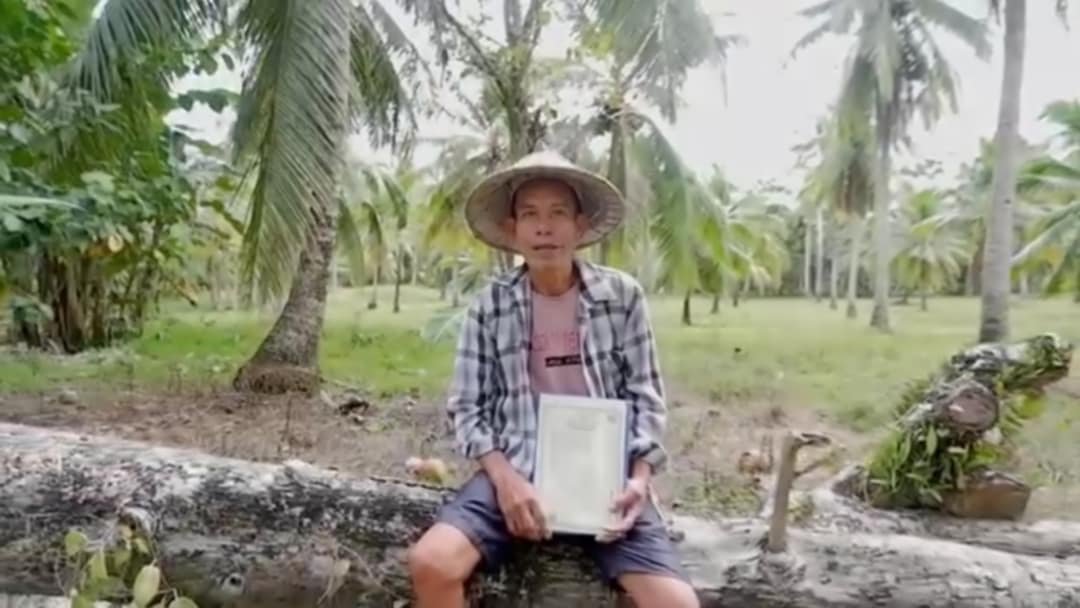
ZAMBOANGA CITY(February 20) — For 52 years, Levi Chavez cultivated land that fed his family but did not legally belong to him.
He was 18 when he first gripped a plow in Barangay Tambalan, Olutanga. Beside his father, under the punishing sun, he cleared fields and planted coconut seedlings with the belief that one day the land would carry his name.
That day came when he was 70.
After more than five decades of waiting, Levi — now fondly called Tatay Levi — received his land title as an Agrarian Reform Beneficiary (ARB) from the Department of Agrarian Reform (DAR).
“Sa sulod sa 52 ka tuig, nalipay ko’g dako nga naabut na g’yud ang akong titulo, akong kaugalingon g’yud nga ngalan,” he said.
(After 52 years, I am deeply grateful and happy to finally hold the land title under my own name.)
For Levi, the title is more than paper. It is security. It is dignity. It is protection against displacement.
But his story also raises a pressing question: why did it take more than half a century?
Farming Without Ownership
For decades, Levi worked land he could till but not legally defend.
He planted coconuts as his father advised. He nurtured them patiently, waiting years for them to bear fruit. When they did, the income — P14 per kilo at first, later P20 — helped send his children to school.
Between coconut harvests, he grew mung beans, corn, and vegetables. Every crop meant survival.
“Kung dili amomahon ang tanum, minos g’yud ang ani,” he would say.
(If you neglect what you plant, the harvest will be small.)
But while Levi did not neglect the land, the system moved slowly.
Land reform in the Philippines has long promised redistribution and ownership security for tenant farmers. Yet bureaucratic backlogs, land valuation disputes, documentation gaps, and overlapping claims have often delayed titles for years — sometimes decades.
For ARBs like Levi, waiting is not abstract. It means living with uncertainty: Can someone contest the land? Can creditors pressure a sale? Can heirs secure inheritance without paperwork?
Reform on Paper, Delays on the Ground
The Comprehensive Agrarian Reform Program (CARP), launched in 1988, aimed to transfer land ownership to farmers nationwide. Millions of hectares have since been distributed.
But Levi’s 52-year wait underscores a common reality in rural communities: land distribution does not automatically mean immediate titling.
Administrative processes — from land surveys to issuance of Certificates of Land Ownership Award (CLOAs) and eventual individual titles — can stretch across administrations.
DAR officials say reforms are ongoing to streamline processing and reduce backlog. Levi himself expressed gratitude that he received his title without paying a single peso.
“Nagpasalamat kog dako sa DAR nga nadawat nako anang titulo nga wala gyud bisan piso koy nabayad,” he said.
(I sincerely thank DAR for granting me this land title without me having to pay even a single peso.)
His gratitude is genuine. But systemic reform is measured not only in ceremonies — it is measured in timelines.
Ownership as Protection
Now that his title bears his name, Levi says no one can claim the small parcel passed down from his parents.
“Karon kay naa na koy titulo, nalipay ko’g dako, kay wala nay maka babil sa akong gamay nga angkon gikan sa akong ginikanan.”
(Now, I have peace of mind knowing that no one can take away the small property I inherited from my parents.)
He urges fellow ARBs not to sell or mortgage their land during hardship.
“Hinaot nga katung nakadawat ug titulo dili ibaligya o prenda ang inyong yuta. Ampingan gyud ninyo.”
His advice reflects another challenge: many agrarian reform beneficiaries, once titled, face economic pressure that pushes them to pawn or sell land — sometimes informally — undermining the very purpose of redistribution.
Land ownership without sustained agricultural support, access to credit, post-harvest facilities, and stable markets can leave farmers vulnerable.
A Life Rooted in Soil
Levi dreams of a time when farmers no longer need to buy rice from stores because their own harvests are enough — enough to eat, enough to trade, enough to sell.
He smiles at the thought of sharing “tuba” from coconuts during good seasons — small celebrations born of steady harvests.
His life traces the arc of agrarian reform itself: hope, delay, perseverance, and eventual recognition.
But if justice delayed is justice diminished, then the real reform question remains:
How many other farmers are still waiting?
Levi carved furrows into the earth for more than five decades before the government carved his name into a title.