DAVAO CITY (February 26) — Workers and domestic helpers in Davao Region will see slightly higher earnings starting March 13 after the Regional Tripartite Wages and Productivity Board XI approved new minimum wage adjustments aimed at easing the pressure of rising living costs.
The approved wage orders, affirmed by the National Wages and Productivity Commission and reported by the Department of Labor and Employment (DOLE), grant a ₱20 to ₱30 daily increase for minimum wage earners and a ₱500 monthly adjustment for kasambahay across the region.
Small steps amid economic pressures
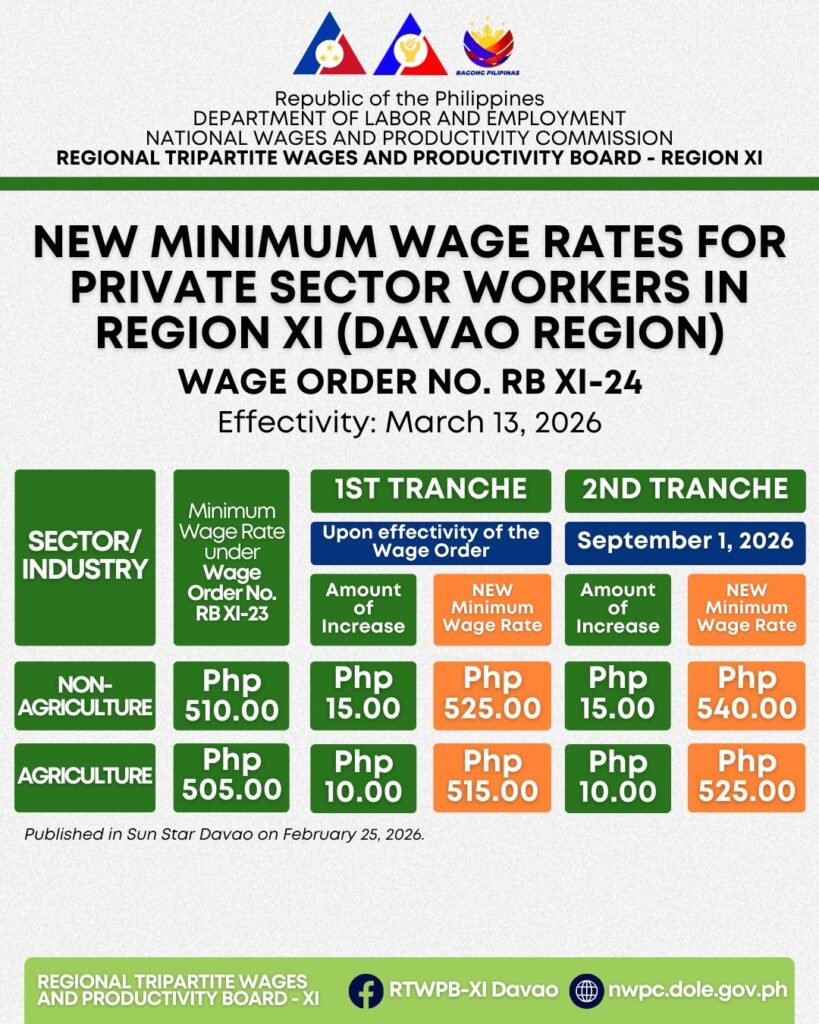
Under Wage Order No. RB XI-24, workers in the agriculture sector will receive a ₱20 daily increase, while those in the non-agriculture sector will get ₱30.
The increase will be implemented in two stages — the first upon the wage order’s effectivity and the second on Sept. 1, 2026.
Once fully implemented, the daily minimum wage will rise to ₱525 for agricultural workers and ₱540 for non-agricultural workers, equivalent to about ₱13,693.75 and ₱14,085 monthly, respectively.
The adjustment is expected to benefit an estimated 66,772 minimum wage earners in the region.
While labor groups have long called for larger wage hikes, officials said the adjustment reflects the consensus-based tripartite system that balances workers’ welfare with business viability.
Domestic workers to receive higher pay
Domestic workers, or kasambahay, will also see pay increases under Wage Order No. RB XI-DW-04.
Those employed in chartered cities and first-class municipalities will receive a ₱500 monthly increase, while kasambahay in other municipalities will get adjustments that raise the regional minimum monthly wage to ₱6,500.
The order covers both live-in and live-out domestic workers, with about 64,111 individuals expected to benefit.
The policy reinforces protections under the domestic workers’ law, which sets minimum standards for pay and working conditions for household helpers.
Exemptions for small and affected businesses
Retail and service establishments regularly employing fewer than 10 workers may apply for exemption from the wage increase until May 11.
Businesses affected by natural disasters or human-induced disruptions may also seek temporary exemption.
Meanwhile, micro enterprises certified under Republic Act 9178 remain outside the minimum wage coverage, provided they hold valid certification from the Department of Trade and Industry.
Governance balance between workers and employers
The wage adjustment reflects the region’s tripartite labor governance framework, where government, labor, and employer sectors jointly deliberate wage policy.
Although the increase is relatively modest, officials said it aims to provide incremental relief for workers while preserving employment stability in Davao Region’s growing but cost-sensitive business environment.
For thousands of households, the new wage order represents a small but tangible improvement in daily earnings — a policy move that keeps the delicate balance between economic competitiveness and worker protection.