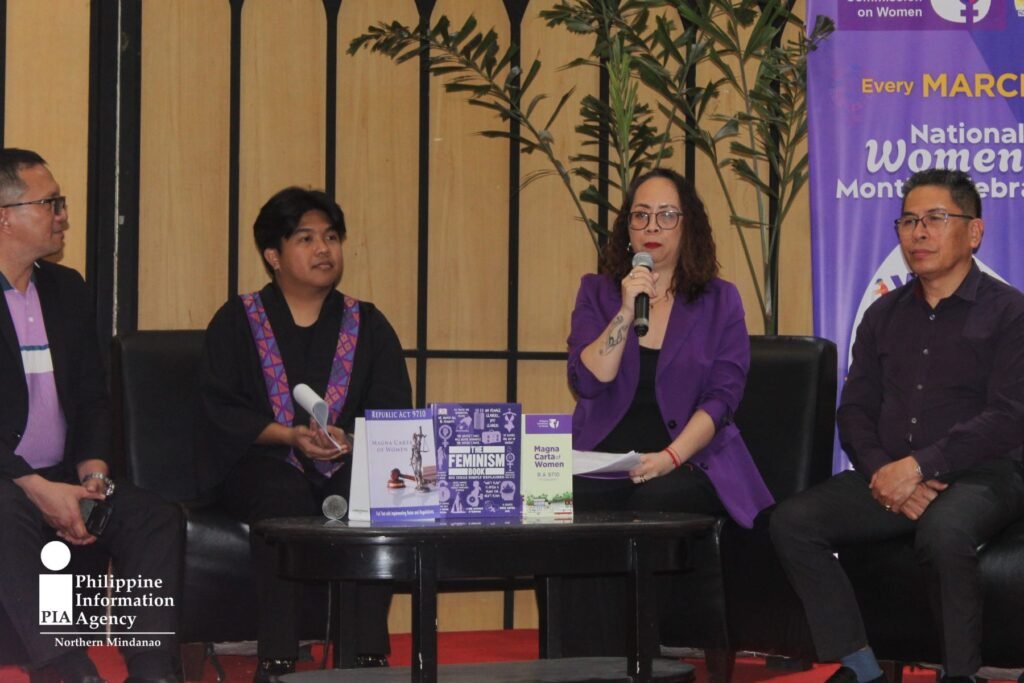
CAGAYAN DE ORO CITY (March 31) — Gender equality in the Philippines has no shortage of policies. The problem, officials say, is making them real where it matters most: in remote barangays, far-flung communities, and among those who rarely feel government programs at all.
That gap is now front and center, as the Philippine Commission on Women (PCW) ramps up efforts to bring gender and development (GAD) initiatives closer to the ground in Northern Mindanao.
“We have to really localize,” said PCW Executive Director Nharleen Santos-Millar. “These concepts can sometimes appear technical. They must be felt… down to the barangay level.”
The push reflects a persistent disconnect: while national frameworks on gender equality are firmly in place, translating them into lived realities — especially for marginalized sectors — remains uneven.
For Commission on Population and Development-10 Regional Director Neil Aldrin Omega, the issue is as much about access as it is about policy.
Programs exist, he said — but often fail to reach communities with limited infrastructure. In areas without stable electricity or internet, traditional, face-to-face engagement still matters. “Services should be brought closer,” Omega stressed, rather than expecting residents to travel long distances.
The PCW’s strategy hinges on embedding gender programs within local systems — working with local governments, schools, and community groups to make initiatives culturally sensitive, inclusive, and participatory.
That approach is anchored in the commission’s North Mindanao Field Office, its first outside Metro Manila, established in 2021 to cover Regions 9, 10, and 13. From there, the Philippine Commission on Women coordinates with stakeholders to implement the Magna Carta of Women at the grassroots level.
For PCW-North Mindanao GAD officer Hamilcar Chanjueco Jr., localization is not just a technical shift — it is a political one.
“We need to understand who our stakeholders are, especially those in the most marginalized communities, so that programs truly respond to their needs,” he said, emphasizing a whole-of-government approach.
The effort is also becoming a communications challenge. To bridge awareness gaps, the Philippine Information Agency (PIA) is partnering with PCW to roll out localized GAD messaging — from e-magazines to video content and broadcasters’ guides — aimed at making gender issues more accessible and less abstract.
“This is the beauty when government agencies are not operating in silence,” said PIA-10 Regional Head Franklin Gumapon.
Still, the test lies beyond forums and frameworks. As agencies double down on coordination, the question remains whether localization efforts can overcome long-standing barriers — geography, resources, and awareness — to ensure gender equality is not just policy on paper, but something felt in the country’s most distant communities.