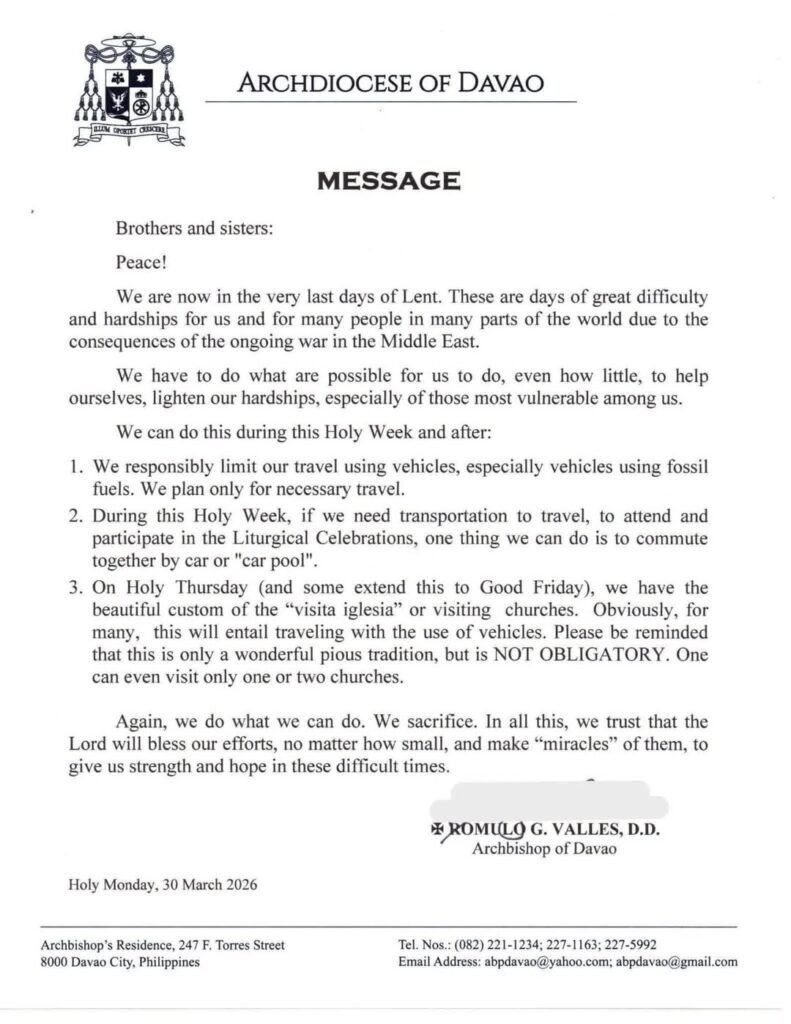
DAVAO CITY (April 3) — The Holy Week appeal of Romulo G. Valles for Catholics to “limit travel” and embrace small sacrifices underscores a growing reality: even religious traditions are being reshaped by economic pressure.
Framing restraint as a moral response, Valles urged the faithful to reduce movement, carpool, and scale down Visita Iglesia plans—recommendations that mirror coping strategies long adopted by ordinary Filipinos grappling with rising fuel prices.
The Archbishop cited the ongoing conflict in the Middle East, which has disrupted global oil supply and driven up transportation costs, making even customary Holy Week practices more expensive.
But beyond spiritual guidance, the message reflects a broader gap: the burden of adjustment continues to fall on individuals, with calls for sacrifice filling in where structural relief remains limited.
Traditionally marked by visits to seven or more churches, Visita Iglesia is now being reframed as a more restrained, localized act of devotion. Church officials emphasized that the practice is not obligatory—an acknowledgment of present constraints.
The Davao City Tourism Operations Office, for its part, promoted a curated list of churches to encourage a “meaningful” yet less travel-intensive observance.
Still, the shift raises a lingering question: as faith adapts to crisis, how much of the sacrifice is spiritual—and how much is economic necessity?