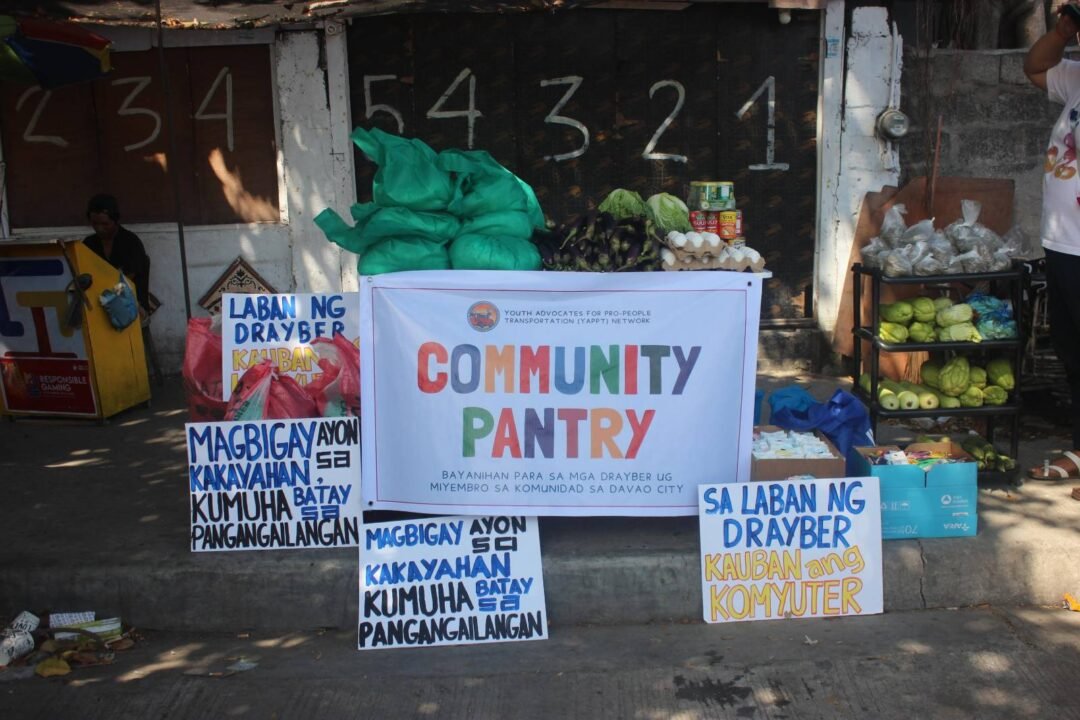
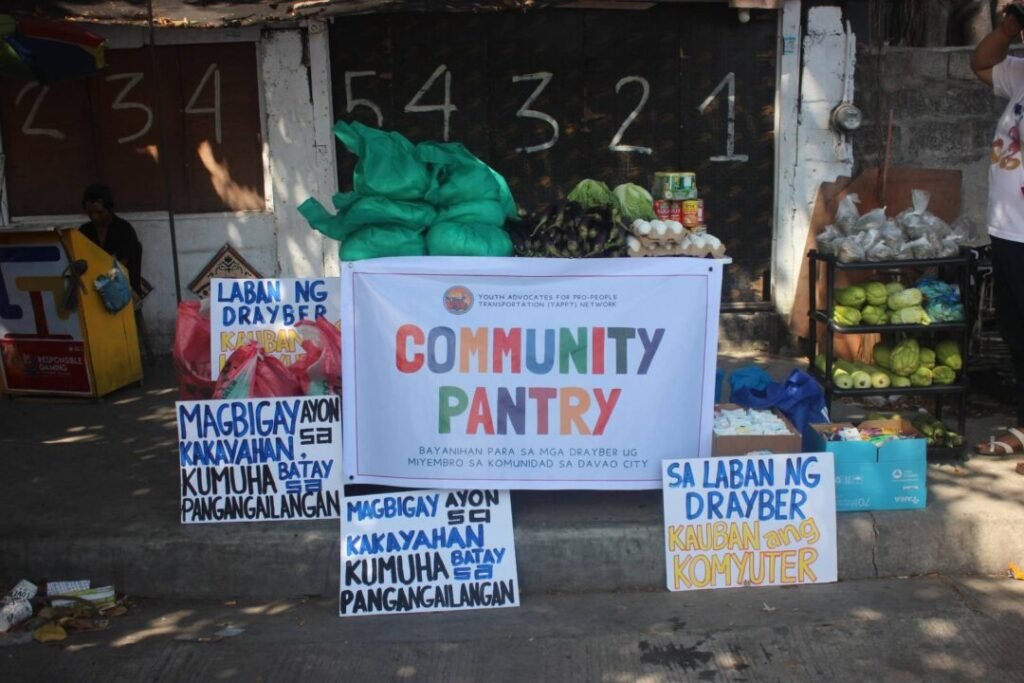
Community volunteers set up a community pantry on April 1 at Bonifacio Corner Mabini to provide food aid for the Davao City transport sector. Photo credits to Youth Advocates for Pro-People Transportation
Community volunteers set up a community pantry on April 1 at Bonifacio Corner Mabini to provide food aid for the Davao City transport sector. Photo credits to Youth Advocates for Pro-People Transportation
DAVAO CITY(April 6) — As fuel prices surge and earnings collapse, a youth-led community pantry for jeepney drivers in Davao City is doing more than handing out food — it is exposing what organizers say is a widening gap between public need and government response.
Launched on April 1 by the Youth Advocates for Pro-People Transportation Network, the initiative provides basic goods to drivers whose daily income has been steadily eroded by rising fuel costs.
But even its organizers admit the effort is a stopgap.
“Temporary lang ni nga alibyo,” said YAPPT spokesperson Marlou Engreso, underscoring that while the youth can mobilize quickly, their resources are limited — and the scale of the crisis demands more than volunteer-driven relief.
“If the youth can step up, what more those with greater resources, like the government?” he added.
The pantry has become both a lifeline and a quiet indictment.
Jeepney drivers — long considered the backbone of public transport — now reportedly take home as little as P200 to P500 a day, with fuel expenses consuming more than half of their earnings. With another round of price hikes expected this April, the situation is likely to worsen.
For many, the math no longer works.
Recent transport strikes in the city reflect growing frustration, with drivers demanding tax relief on fuel, fare increases, and broader state intervention to stabilize prices. Their calls — from removing VAT and excise taxes to imposing stronger regulation on the oil industry — point to structural issues that go beyond temporary price spikes.
Yet in the absence of immediate policy relief, it is civil society — not the state — filling the gaps.
Community pantries, first popularized during the pandemic, are re-emerging as crisis responses, but their return signals something deeper: the normalization of emergency solutions for what are essentially systemic economic problems.
By relying on donations and volunteerism, initiatives like YAPPT’s risk becoming a substitute for, rather than a supplement to, institutional support.
The group itself acknowledges this tension, calling for broader participation while also backing policy demands such as fare hikes and fuel price controls.
The latest projected increases — including a possible P1.15 per liter hike in diesel — are linked to ongoing geopolitical tensions in the Middle East, adding another layer of volatility to an already fragile situation for drivers.
But for those on the ground, global factors offer little comfort.
What remains visible is the daily grind: longer hours, shrinking take-home pay, and now, queues at community pantries.
As the crisis deepens, the question raised by the youth group lingers — not just as a challenge, but as a measure of accountability:
If small, volunteer-driven groups can mobilize relief, what is holding back those with the power to deliver lasting solutions?