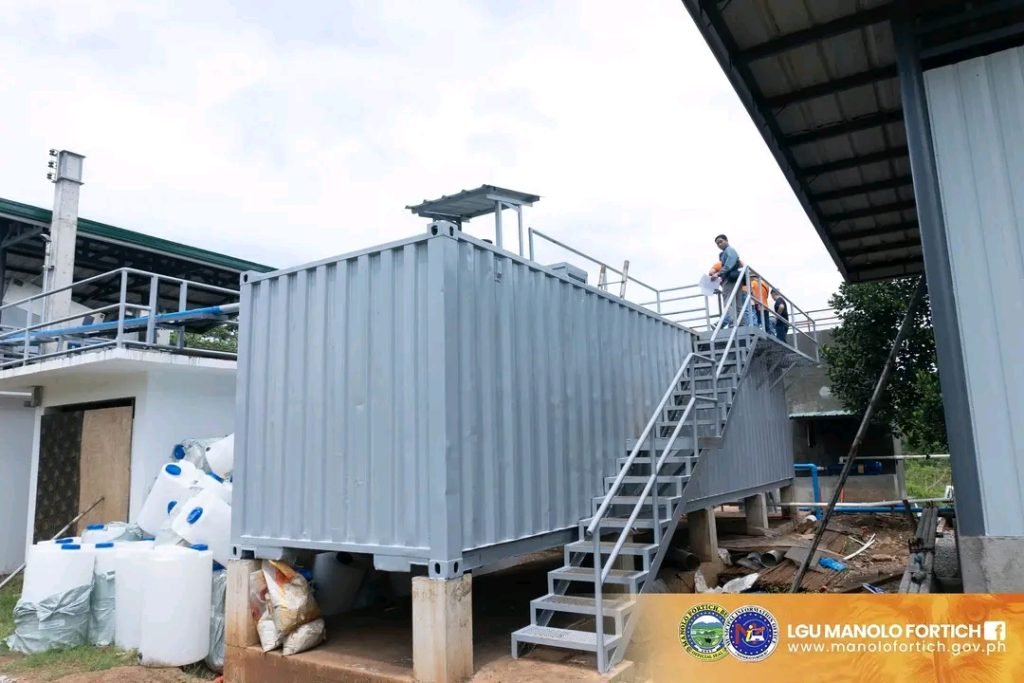
MANOLO FORTICH, Bukidnon (April 7) — A P23.9-million septage treatment plant (STP) in Barangay Alae is nearing completion here, positioning Manolo Fortich as a testing ground for whether local governments can close the Philippines’ long-standing sanitation gaps.
At 85 percent complete, the facility—set to open by May 2026—will become Northern Mindanao’s first LGU-owned septage treatment plant, a shift from the more common model of private or water district-led wastewater management.
The project aligns with the mandate of the Department of Environment and Natural Resources (DENR) under the country’s water quality framework, which requires local governments to establish systems for treating domestic wastewater.
But the urgency behind the project goes beyond compliance.
Despite decades of policy, sanitation infrastructure in the Philippines remains severely limited: only about 10 percent of wastewater is treated, while just a small fraction of households are connected to sewer networks.
Untreated septage—waste from septic tanks—continues to flow into rivers and groundwater, contributing to pollution and public health risks, including waterborne diseases.
Local officials say the Manolo Fortich facility directly addresses that gap.
Project contractor Green GAIA Technology Development and Construction OPC began construction in June 2025, with structural works now complete and installation of piping systems and a generator set underway, according to project in-charge Charles Ian Paborada.
Commissioning is expected to begin soon.
Municipal Environment and Natural Resources Officer Sharon Tacbobo described the plant as a “tangible shield” for local water systems, noting that it will treat domestic wastewater before it contaminates nearby rivers.
The project also supports the environmental agenda of Mayor Rogelio Quiño, particularly efforts to link public health outcomes with environmental protection.
Yet experts note that infrastructure alone may not be enough.
Studies of septage systems across Philippine cities show that success depends not just on facilities, but on governance—particularly sustained funding, enforcement, and centralized management. In some cases, cities that fully manage their own septage systems have achieved significantly higher rates of safely treated waste.
This raises a critical question: can smaller municipalities replicate those gains?
The Philippines’ Clean Water Act of 2004 mandates septage and sewerage systems nationwide, but implementation has been uneven, with many LGUs struggling to finance and operate facilities.
For residents of Manolo Fortich, the benefits are immediate—reduced risk of water contamination and disease, and protection of rivers that support agriculture and daily life.
But for policymakers, the stakes are broader.
As the facility prepares to go online, it will serve as an early test of whether devolving sanitation infrastructure to local governments can meaningfully address a national crisis—where most wastewater still goes untreated, and clean water remains unevenly protected.
If successful, the town’s experiment could offer a replicable model. If not, it may underscore the limits of local capacity in tackling a deeply systemic problem.