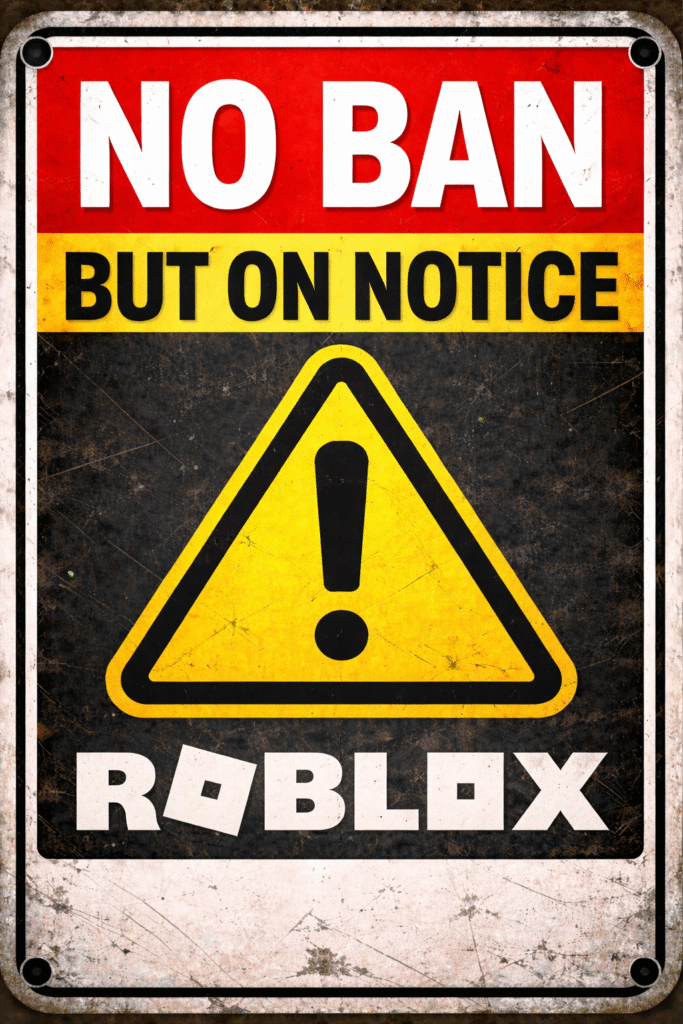
MANILA (April 8) — The Philippine government has backed away from banning Roblox, but the decision comes with a clear warning: prove you can protect Filipino children—or face consequences.
At a closed-door meeting on April 7, officials from the Department of Information and Communications Technology (DICT) and the Cybercrime Investigation and Coordinating Center (CICC) pressed Roblox executives over allegations that the platform has been exploited by predators targeting minors. Law enforcement and private sector groups joined the talks, underscoring the growing alarm over digital spaces becoming conduits for abuse.
The outcome stops short of a ban, but shifts the burden squarely onto the platform: tighten safeguards, enforce them, and show results.
From threat to test
Just weeks ago, the CICC issued a stark ultimatum—fix the problem within 30 days or face a nationwide block—after reports that pedophiles and even drug traffickers were using the platform to groom and exploit underage users. The warning exposed a deeper governance gap: how far can the state go in policing global tech platforms operating within its borders?
Tuesday’s decision suggests a pivot from punishment to conditional trust. Roblox has pledged stricter monitoring and stronger age-based content controls, while promising an April 12 rollout of an information campaign to guide parents through its safety features.
But for child protection advocates, the question is no longer about tools—it is about accountability.
Safety tools vs. systemic risk
Roblox’s safeguards—parental controls for screen time, spending limits, and content filtering—have long existed. What critics point out is the gap between availability and effectiveness, especially in contexts like the Philippines where digital literacy among parents varies widely and children often access platforms unsupervised.
“The issue is not whether controls exist, but whether harm is being prevented,” a cybersecurity advocate familiar with the discussions said. “Platforms must be accountable for outcomes, not just features.”
The government’s approach reflects that tension. By rejecting an outright ban, regulators avoid disrupting millions of young users. But by publicly extracting commitments, they also create a paper trail of responsibility—one that could justify stronger sanctions if failures persist.
A broader reckoning for platforms
The case highlights a growing dilemma for regulators: global platforms operate locally, but accountability mechanisms remain fragmented. Unlike traditional media, companies like Roblox are governed largely by their own policies, with governments often reacting only after harm surfaces.
For the DICT and CICC, this moment is a test of whether soft regulation—dialogue, pressure, and public scrutiny—can compel real change.
For Roblox, it is a reputational crossroads. Its response in the coming weeks will determine whether it is seen as a cooperative partner in child protection—or a platform reacting only under threat.
And for Filipino families, the stakes remain immediate: whether the digital playgrounds their children inhabit are being made safer—or simply better explained