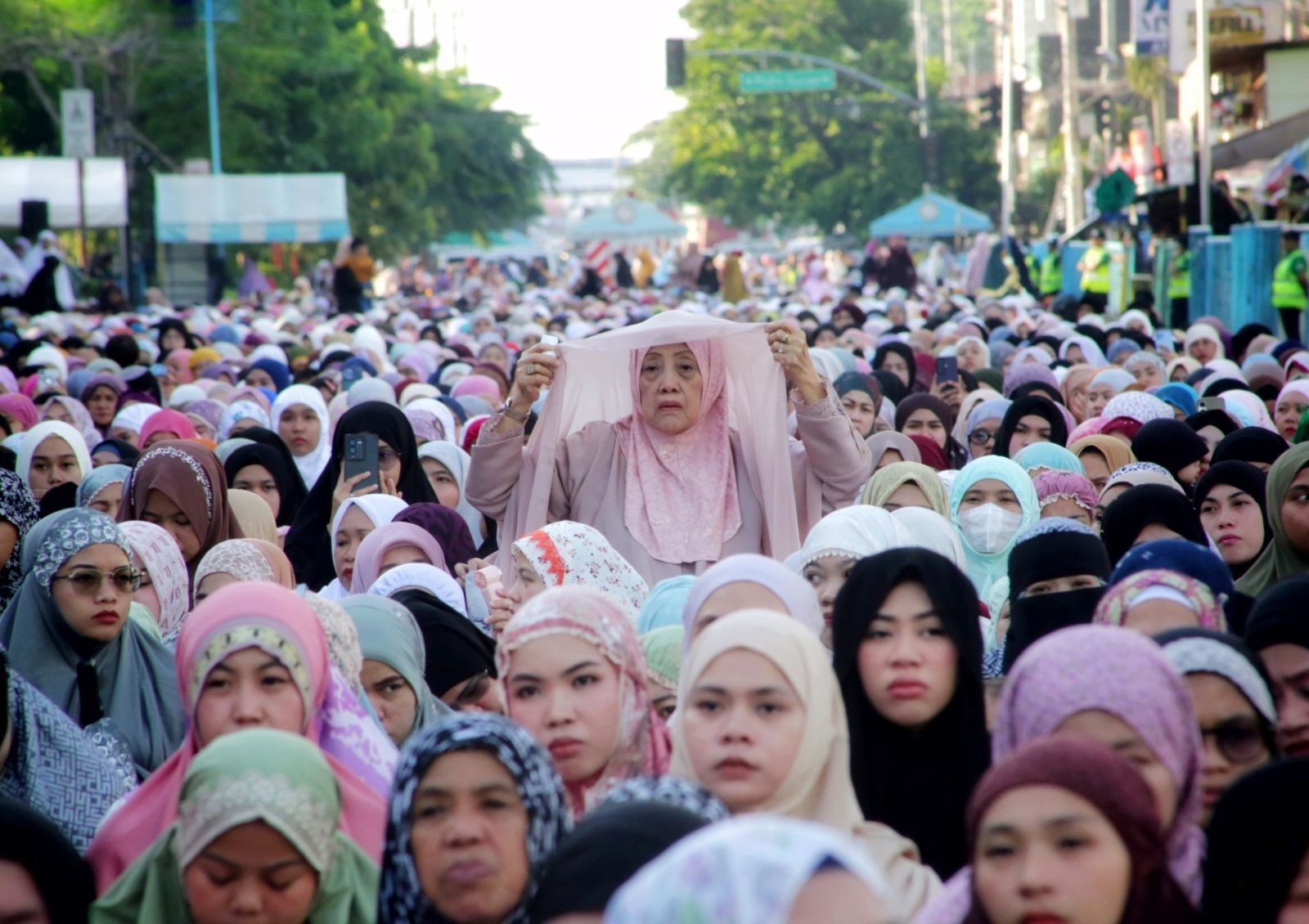
COTABATO CITY (May 27) — As millions of Muslims worldwide marked Eid al-Adha today, the observance in Mindanao unfolded not only as a sacred religious celebration but also as a reflection on sacrifice, peacebuilding, and the political future of the Bangsamoro homeland.
From packed mosques to open prayer grounds across the Bangsamoro Autonomous Region in Muslim Mindanao, Muslim families gathered for congregational prayers and qurban rituals commemorating Prophet Ibrahim’s willingness to sacrifice his son Ismael in obedience to Allah — a defining story of faith and submission in Islam.
But beyond the ritual slaughter of goats, cattle, and other sacrificial animals, this year’s Eid carried deeper resonance in a region navigating transition, fragile peace, and the approach of the first-ever BARMM parliamentary elections in September.
The annual feast coincided with the culmination of the hajj pilgrimage in Makkah, where more than two million Muslims converged for one of Islam’s holiest obligations. More than 5,000 Filipino Muslims reportedly joined this year’s pilgrimage, many of them from Mindanao.
In the Philippines, Malacañang declared May 27 a regular holiday in observance of Eid al-Adha, with Ferdinand Marcos Jr. urging Filipinos to view sacrifice through the lens of social responsibility and nation-building.
“It is not in how much is given but in what is restored,” Marcos said, calling for dignity, fairness, and compassion in public life.
For the Bangsamoro leadership, however, the symbolism of sacrifice also intersects with the region’s long struggle for self-determination.
Interim Chief Minister Abdulraof Macacua framed Eid al-Adha as a reminder of perseverance amid hardship and uncertainty, while linking the values of sacrifice to the continuing pursuit of peace and genuine autonomy.
“The story of Prophet Ibrahim teaches us that true sacrifice is measured not by what we keep for ourselves, but by what we are willing to offer for a greater purpose,” Macacua said.
The message comes at a politically charged moment for the Bangsamoro region, where alliances and campaigns are intensifying ahead of the September 14 parliamentary polls — a milestone election seen as a crucial test of the peace process born from decades of Moro armed struggle.
In a move laden with symbolism, the BARMM government this year subsidized the hajj pilgrimage of 451 former Moro Islamic Liberation Front combatants and their family members, honoring sacrifices made during the conflict that culminated in the 2014 signing of the Comprehensive Agreement on the Bangsamoro.
For many in the Bangsamoro, Eid al-Adha now represents more than a religious commemoration. It has become a mirror of the region’s collective journey — from war to autonomy, from sacrifice to self-governance, and from conflict toward the uncertain promise of lasting peace.