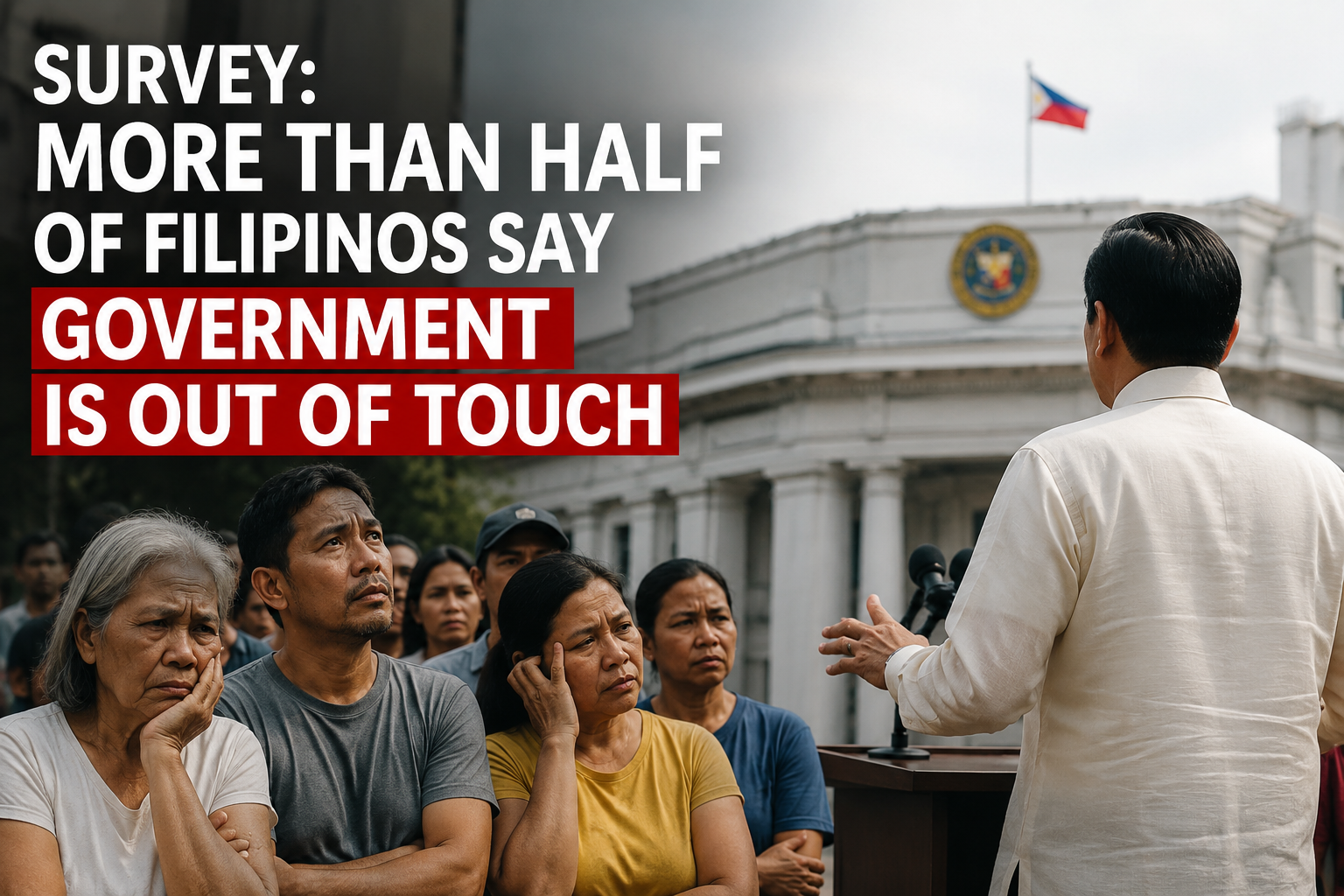
MANILA (July 27) — More than half of Filipinos believe the government does not understand their daily struggles or listen to their concerns, a new survey found, underscoring a deepening trust gap as President Ferdinand Marcos Jr. prepares to deliver his fifth State of the Nation Address (SONA).
The non-commissioned EON–Tangere Pre-SONA Survey 2026 found that 53.8% of respondents believe the government fails to understand the problems faced by ordinary citizens.
The disconnect is even more pronounced when it comes to being heard.
Fifty-five percent said the government does not listen to ordinary Filipinos, while 49.4% expressed distrust in the administration’s ability to solve the country’s most pressing problems.
Another 40.8% said they do not believe the government can fulfill the commitments expected to be presented in this year’s SONA.
The findings paint a public increasingly focused on results rather than rhetoric as Marcos prepares to address the nation on Monday, July 27.
Filipinos want solutions, not just accomplishments
When asked what they most want to hear from the President, nearly half—or 48.3%—said they want concrete solutions to the country’s current problems.
Anti-corruption measures and government reforms ranked second at 35.6%, followed by updates on previous government promises at 34.7%.
A plan to bring down prices was also a priority, cited by 32.8% of respondents.
Only 22% said they wanted to hear primarily about the administration’s accomplishments.
The results suggest that Filipinos are less interested in a scorecard of past achievements than in a clear roadmap for problems they continue to face at home, at work, and in their communities.
Economy, jobs top public concerns
Household economics and essential services dominated the list of issues Filipinos want addressed in the 2026 SONA.
The economy and inflation topped the list at 67.1%, followed by jobs and wages at 56.2%.
Education ranked third at 53.2%, while agriculture and food security registered 47.3%.
Health was cited by 44.7%, followed by the cost of living at 43.3%.
Crime and public safety accounted for 42.4% of responses, while corruption was identified by 42.2%.
The findings show that Filipinos’ expectations are centered on the basics of daily life: keeping prices manageable, securing decent jobs, improving public services, and ensuring that government institutions are responsive and trustworthy.
A test of public trust
The survey comes as Marcos prepares to deliver his fifth SONA, placing renewed attention on whether the administration can bridge the gap between its accomplishments and the public’s lived experience.
For many Filipinos, the survey suggests, the measure of success is not simply what government has completed—but whether those achievements translate into affordable food, stable jobs, accessible education and healthcare, and safer communities.
The EON–Tangere survey used a mobile-based, self-administered questionnaire completed by 1,200 Filipino adults selected through quota-based stratified random sampling.
Respondents were distributed across the National Capital Region (12%), Northern Luzon (23%), Southern Luzon (22%), the Visayas (20%), and Mindanao (23%).
The survey has a margin of error of ±2.96 percentage points at a 95% confidence level.
As the President takes the podium, the survey presents a clear challenge: Filipinos are not simply asking what the government has done.
They want to know whether it understands what they are going through—and, more importantly, what it plans to do about it.