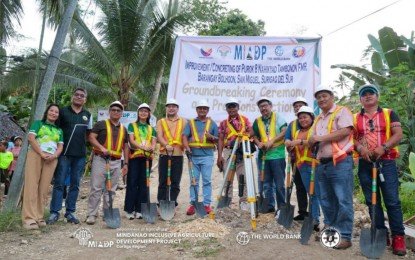
BUTUAN CITY (July 28) — For Manobo farmers in two remote barangays of San Miguel, Surigao del Sur, the long-awaited road to better livelihoods is finally taking shape.
New farm-to-market roads in Barangays Bagyang and Bolhoon are expected to give Indigenous Peoples (IP) communities easier access to markets, essential services, and new livelihood opportunities.
The two projects involve the improvement and concreting of the 1.1-kilometer Purok 8 to Nahikyad-Tambonon farm-to-market road, funded at PHP21.4 million, and the 2.4-kilometer Lower Bagyang to Upper Bagyang road, with an appropriation of PHP37.1 million.
Together, the projects cost PHP58.5 million and are expected to benefit more than 1,000 IP farmers living within Certificate of Ancestral Domain Title (CADT) 116, home to the Manobo tribe in San Miguel.
“These vital infrastructures are game changers for the Manobo tribe in Bagyang and Bolhoon, as these will provide faster, safer, and easier access to the market centers, especially for our farmers,” Datu Rico Maca, the IP Mandatory Representative in San Miguel, said in an interview Monday.
About 800 hectares of farmland in the two barangays are devoted to abaca, coconut, banana, and corn production. More than 90 percent of IP residents in the communities are farmers.
For farmers who often face difficult transportation routes, the new roads could mean less time and lower costs in bringing their harvests to market—and a better chance of earning more from their hard work.
“Over a thousand of our IP farmers welcome these road projects as they see them as lifelines that will ensure increased farm production and income,” Maca said.
The roads are being implemented under the Mindanao Inclusive Agriculture Development Project (MIADP) of the Department of Agriculture (DA), in partnership with the provincial government of Surigao del Sur.
Launched in 2023, the PHP6.6-billion World Bank-funded program seeks to sustainably increase agricultural productivity, strengthen the resilience of IP farming systems, and improve access to markets and essential services for organized farmer and fisherfolk groups in selected ancestral domains across Mindanao.
CADT 116 is among five priority ancestral domains in the Caraga Region identified for the MIADP. The five ancestral domains cover more than 129,000 hectares and are home to around 47,000 IPs.
But for the Manobo communities of Bagyang and Bolhoon, the impact of the roads goes beyond agriculture.
Maca said the farm-to-market roads would help connect ancestral lands to the wider economic and social fabric of Surigao del Sur while allowing the Manobo people to safeguard their cultural identity.
The roads are also expected to benefit children and young people who travel to school from remote communities.
“Our children and the youth will also benefit from these projects through safer and faster routes to schools and eventually reduce absenteeism and dropout rates,” said Datu Bislao Aly Montenegro, chair of the Indigenous Peoples Organization in CADT 116.
Datu Subang Arnold Acebedo, municipal tribal chieftain of San Miguel, said the roads would also provide a crucial link to health centers and facilities, particularly during emergencies.
For communities long isolated by distance and difficult terrain, the new roads could become more than concrete pathways.
They could become routes to markets, schools, health care, emergency services—and ultimately, to a more secure future for Manobo families.
The groundbreaking ceremony was led by DA Assistant Secretary U-Nichols Manalo, together with DA-13 Executive Director Ricardo Oñate Jr., Surigao del Sur Provincial Administrator John Vincent Pimentel, and San Miguel Mayor Michael Corilla.