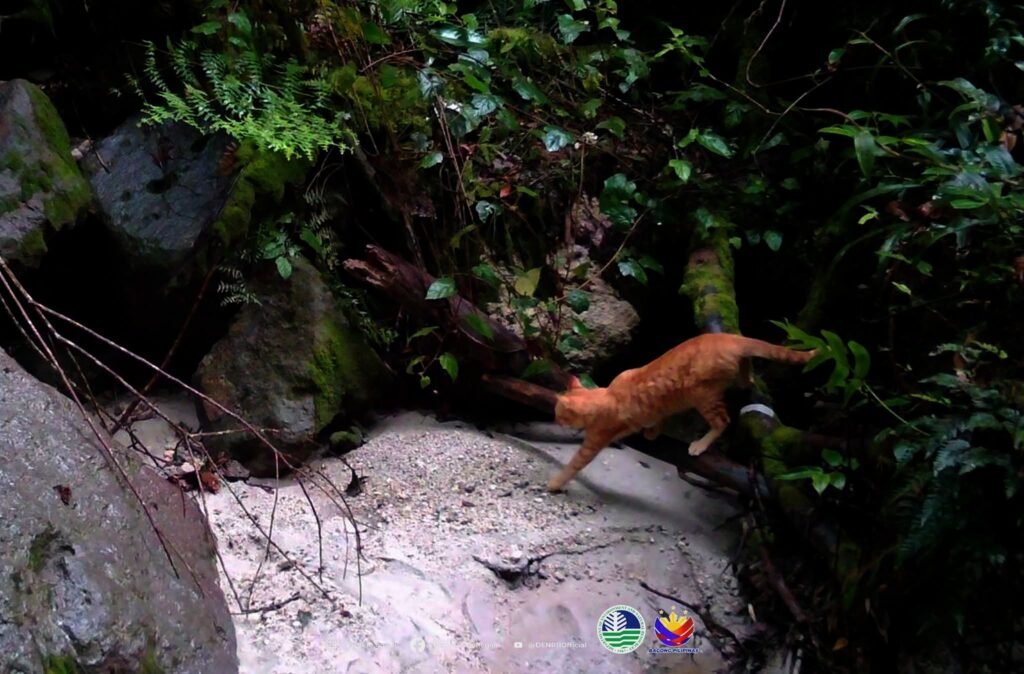
DAVAO CITY (July 29) — They may look harmless, even cuddly, but feral cats roaming the forests of Mt. Apo are emerging as a potential threat to native wildlife in one of Mindanao’s most important protected areas.
The Department of Environment and Natural Resources (DENR) Davao Region is raising concern over a growing population of free-ranging domestic cats in the Mount Apo Natural Park (MANP), warning that the animals could prey on birds, mammals and other native species.
The first documented sightings of free-ranging cats in the park date back to around 2016. Park personnel said the cats were initially drawn to campsites by food waste left behind by trekkers and mountaineers, feeding on food scraps discarded by visitors.
But some of the cats have since ventured deeper into the forest, where they have adapted to life in the wild with little or no dependence on humans.
“When you visit Mt. Apo, never feed stray or feral cats, no matter how harmless they may seem. Likewise, never leave food scraps or other waste behind. Properly pack out your trash and strictly observe the Leave No Trace Principles,” said Michael Cleofe, Protected Area Superintendent of Mount Apo Natural Park.
A predator in the forest
DENR’s concern is not simply about the presence of cats inside the protected area. It is their potential impact on wildlife that worries conservation officials.
Among the species considered vulnerable is the Mindanao Island Thrush, a bird found only in Mindanao and commonly observed at the higher elevations of Mt. Apo.
Camera traps have documented both feral cats and Mindanao Island Thrushes in the same areas.
No actual cat hunting of the island thrush has been documented so far, DENR said. But their presence in the same habitat highlights a potential threat to a species already restricted to Mindanao.
Domestic cats are naturally skilled hunters and can prey on small birds, mammals and reptiles. Worldwide, they have contributed to the extinction of 63 animal species.
For the wildlife of Mt. Apo, conservation officials are concerned that even a small feral cat population could become a bigger problem if left unmanaged.
From scraps to the forest
Food waste left by visitors may be helping drive the problem.
Cats attracted to readily available food around campsites can gradually become accustomed to human presence. Some may eventually move farther into the forest, where they can survive and reproduce without direct human care.
Their reproductive capacity also makes population growth difficult to control.
DENR said a female cat can produce two to three kittens and give birth up to twice a year. Without intervention, the number of free-ranging cats can therefore increase rapidly.
What may begin as a few cats waiting around campsites for leftovers can eventually become a population spreading into the habitat of native wildlife.
That is why DENR is stressing that feeding stray or feral cats is not an act of kindness inside a protected area—it can help sustain an invasive predator in the wild.
Humane removal planned
To address the growing concern, the Mount Apo Natural Park management will deploy humane cat traps in areas where free-ranging cats have been documented.
Captured cats will be safely transported out of the protected area and turned over to the appropriate local government units (LGUs) for proper handling and disposition.
Additional traps have already been procured to strengthen the continuing management effort.
But DENR officials say management efforts must go hand in hand with responsible behavior from visitors.
Trekkers and mountaineers are urged not to feed cats encountered along the trails and campsites and to ensure that no food scraps or other waste are left behind.
The message is simple: Leave no food, leave no trash, and leave wildlife to the wild.
In Mt. Apo’s fragile forest ecosystem, a discarded meal may seem insignificant. But for a growing population of feral cats, it can become an invitation to stay—and hunt.