DAVAO CITY (July 31) — WHERE people move, communities change—and local governments need reliable data to keep up.
The Commission on Population and Development (CPD) Region XI is pushing for stronger barangay-level migration data systems to help local governments anticipate where people will need schools, health services, housing, jobs and social protection.
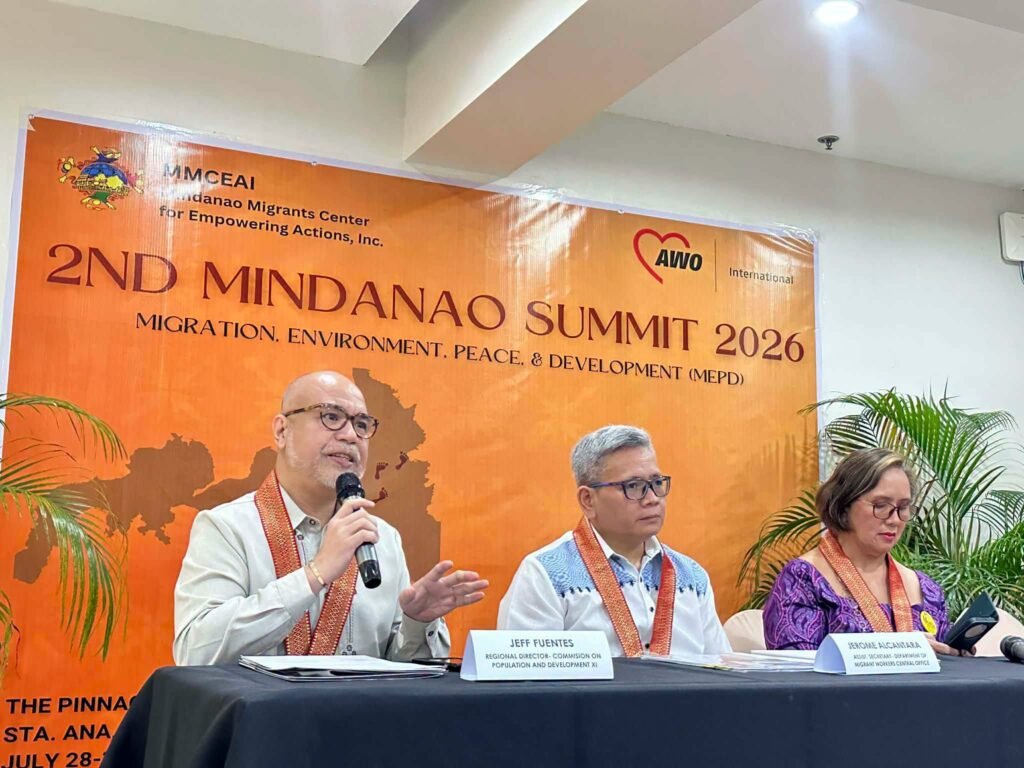
CPD XI Director Jeff Fuentes made the call during the opening of the 2nd Migration, Environment, Peace and Development (MEPD) Mindanao Summit 2026 held Tuesday, July 28, at The Pinnacle Hotel and Suites in Davao City.
The three-day summit, organized by the Mindanao Migrants Center for Empowering Actions, Inc. (MMCEAI), brings together government agencies, civil society groups, academe, development partners and other migration stakeholders to examine the changing migration landscape across Mindanao.
Fuentes said migration is often overlooked in development planning despite being one of the three major population processes—alongside fertility and mortality—that shape the size and distribution of communities.
“Migration is not merely the movement of people,” Fuentes said. “It influences where services are needed, how resources should be allocated, and how development should be planned. Responsive governance begins with reliable data.”
When people move, needs move with them
For local governments, tracking population movement is not simply a matter of counting who comes and goes.
Families moving into a barangay can mean more children needing classrooms, more patients seeking health services, greater demand for housing and jobs, and additional households needing social protection.
At the same time, communities losing residents may face a different set of development challenges.
Fuentes said the country’s 2018 National Migration Survey remains the latest comprehensive migration dataset, but changing migration patterns make it increasingly important for government to have more current and localized information.
CPD XI is therefore advocating stronger barangay-level migration databases that local governments can regularly update and use in planning.
Among the existing systems that could provide migration-related information are the Community-Based Monitoring System (CBMS), Barangay Information Management System (BIMS), and Registry of Barangay Inhabitants and Migrants (RBIM).
Fuentes particularly cited RBIM as a practical tool for tracking internal migration at the community level.
“Accurate migration data enables LGUs to anticipate emerging needs in education, health, housing, employment, social protection, and other essential services,” he said.
Beyond migration numbers
The push for better data comes as Mindanao communities deal with increasingly complex reasons why people move—from jobs and family concerns to conflict, disasters and climate-related pressures.
The summit’s discussions cover internal migration, children of overseas Filipino workers, irregular migration corridors and climate-induced migration, reflecting the many ways migration affects families and communities.
Assistant Secretary Jerome Alcantara of the Department of Migrant Workers Central Office and MMCEAI Executive Director Inorisa Elento joined Fuentes during the opening press conference to discuss key migration concerns.
Through plenary discussions, workshops and learning sessions, the summit seeks to strengthen coordination among government, civil society, academe and development partners.
For CPD XI, however, the message is straightforward: if local governments want to plan for the people they serve, they first need to know where their people are coming from, where they are going—and why.