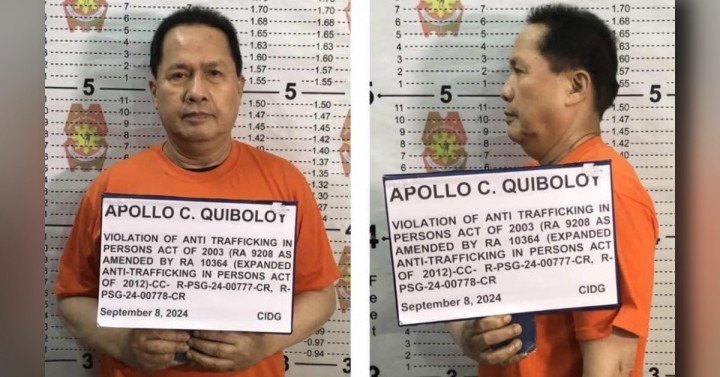
MANILA (August 14) — The United States has formally asked the Philippines to extradite Kingdom of Jesus Christ (KOJC) founder Apollo Quiboloy and two other respondents, but the request is far from an automatic ticket to US custody.
The Department of Justice (DOJ) is now combing through the US request to determine whether it meets Philippine law and the Philippines-US extradition treaty.
Chief State Counsel Dennis Arvin Chan confirmed Thursday that the documents have been received and are undergoing legal review.
The question now is simple for the public: Will Quiboloy be sent to the United States, or will he first face the cases filed against him in the Philippines?
The answer could take time.
The DOJ must clear several hurdles
Before an extradition case can move forward, Philippine authorities must establish that the person sought by the United States is indeed the same individual in Philippine custody or jurisdiction.
They must also apply the principle of dual criminality—meaning the acts for which the US is seeking extradition must also constitute crimes under Philippine law.
The offenses do not have to carry identical names in the two legal systems.
“What is important is that the act involved is the same,” Chan said.
The DOJ will also check whether the offenses are punishable by at least one year in prison, whether the cases remain prosecutable under US law and whether the charges have not prescribed.
Another safeguard concerns the death penalty.
The Philippines must ensure that Quiboloy and the other respondents would not face capital punishment if convicted of the offenses covered by the extradition request.
Local cases complicate the decision
The extradition request comes while Quiboloy is also facing criminal cases in the Philippines.
That creates a major question for the government: Should the US request move ahead now, or should local proceedings take priority?
Under Article 11 of the Philippines-US extradition treaty, the Philippine government has the option to file an extradition petition and let the courts decide, or defer the filing until the local cases have been resolved.
In either scenario, extradition would still be subject to legal proceedings and due process.
This means the DOJ cannot simply turn Quiboloy over to US authorities based solely on the request.
Why the review is taking time
The DOJ is dealing with a substantial volume of documents.
Chief State Counsel Dennis Arvin Chan said the Department of Foreign Affairs transmitted about six batches of supporting documents for each respondent.
Lawyers must examine the submissions and determine whether they satisfy every requirement under Philippine law and the treaty.
Chan declined to give a fixed timetable but said the DOJ understands that the public is closely watching the case.
“We will just try to hasten our action,” he said.
What happens next?
The immediate step is the DOJ’s legal evaluation.
If the request meets the treaty and legal requirements, the government could pursue an extradition petition before the courts.
If authorities decide that the local criminal proceedings should take precedence, action on the extradition request could be deferred.
For the public, the key point is this: a US extradition request is only the beginning of the process.
Before Quiboloy can be sent abroad, the request must pass Philippine legal safeguards, survive possible court proceedings and comply with the country’s treaty obligations.
The next decision, therefore, is not yet about boarding a plane.
It is about whether the US request can first clear the Philippine justice system.