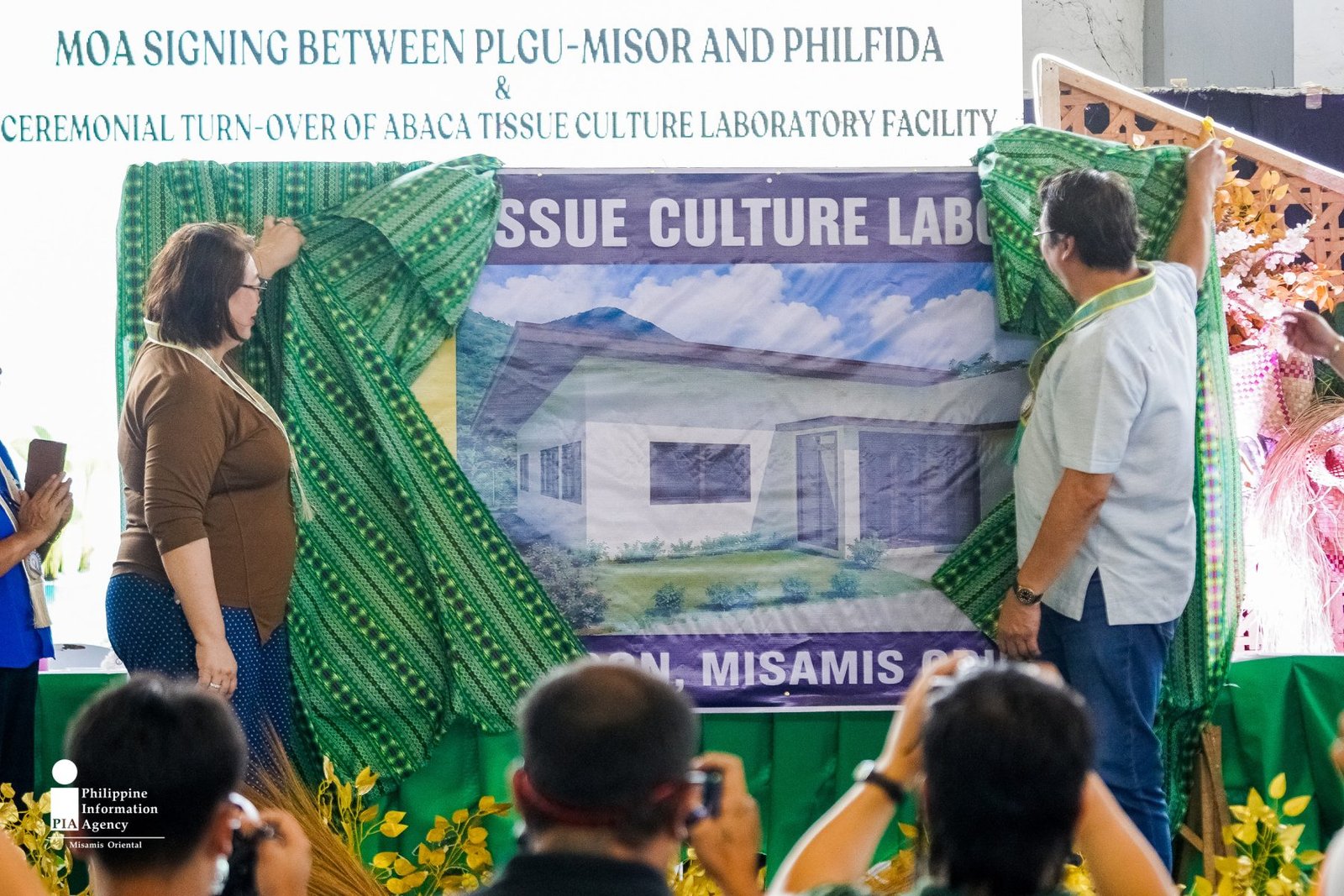
MISAMIS ORIENTAL (August 26) — An idle tissue culture laboratory in Sugbongcogon is being revived to give abaca farmers in Misamis Oriental a cleaner source of planting materials—but the bigger challenge is making sure farmers earn more from the crop they produce.
The Philippine Fiber Industry Development Authority (PhilFIDA) is moving to repair and operate the Abaca Tissue Culture Laboratory under a new agreement with the provincial government, signed Aug. 18.
The facility is expected to produce disease-free planting materials and help farmers establish healthier plantations.
For abaca growers, that could address a basic problem: planting materials obtained from unreliable sources can carry diseases that eventually damage plantations and cut into farm incomes.
PhilFIDA Executive Director Undersecretary Arnold “Ali” I. Atienza said the laboratory will give farmers access to planting materials that meet health standards.
But clean planting materials are only the first step.
The harder question is whether farmers can capture more of the money generated by the global abaca trade.
The Philippines supplies about 87 percent of the world’s abaca, according to Atienza, yet Filipino producers capture only a small portion of an estimated $1-billion global industry.
That imbalance exposes a familiar problem in agriculture: producing the raw material does not necessarily mean earning the biggest share of its value.
“What saddens me is that farmers receive only 10% of the 10% earned by the industry,” Atienza said, stressing the need to develop value-added products.
The proposed program therefore goes beyond planting.
PhilFIDA plans to train farmers and their families, including farmers’ spouses, to turn abaca into finished products such as bags that can reportedly sell for around P1,200 each.
The objective is straightforward: move farmers higher up the value chain instead of leaving them dependent on raw fiber prices.
From fiber to finished products
The provincial government is also considering investments in machinery and processing facilities that could turn abaca into products such as plywood.
Gov. Juliette T. Uy said increasing production without creating additional markets could put downward pressure on prices.
Her concern points to the danger of expanding farm output without building the processing and marketing capacity needed to absorb it.
“If our production increases, we will work to keep prices from falling. So we need to turn abaca into value-added products that we can sell,” Uy said.
That means the success of the revived laboratory should not be measured simply by the number of planting materials it produces.
Farmers need a complete chain—from disease-free planting materials and production support to processing equipment, skills, financing and buyers.
Without those links, the facility risks becoming another government agricultural project that solves one part of the problem while leaving farmers exposed to the same low-value market.
Farmers must be at the center
The provincial government is encouraging abaca farmers to organize into cooperatives, undergo training and prepare for opportunities in processing and product development.
This is crucial because individual smallholders may struggle to meet the volume, quality and consistency required by larger institutional and export buyers.
But organizing farmers should not become an excuse to shift the burden of development onto them.
Government agencies must ensure that training is matched with actual access to equipment, financing, technology and markets.
Sugbongcogon Mayor Cheezee Salvador Lagbas described the project as a major opportunity for the small municipality, particularly if it improves productivity and creates additional livelihood opportunities for farming families.
The laboratory was originally established in March 2019 with support from national agriculture and science agencies. Its revival now offers a chance to turn an underused public facility into a functioning part of the local agricultural economy.
PhilFIDA’s Atienza said the agency’s support will extend beyond the laboratory and urged farmers to seek assistance as the industry develops.
“The farmers are there; we have to support them because without the farmers, there’s no industry and there’s no PhilFIDA,” he said.
That should be the guiding principle of the project.
The goal cannot simply be to produce more abaca. It must be to make abaca production more profitable for the people who grow it.
If Misamis Oriental succeeds in connecting clean planting materials to processing, value-adding and reliable markets, the revived laboratory could become more than a facility—it could become the starting point of a stronger local abaca economy.
But if farmers remain sellers of raw fiber while others capture the higher-value stages of the business, the industry’s impressive global numbers will continue to tell an uncomfortable story: the Philippines grows the world’s abaca, but its farmers still struggle to get a fair share of its value.