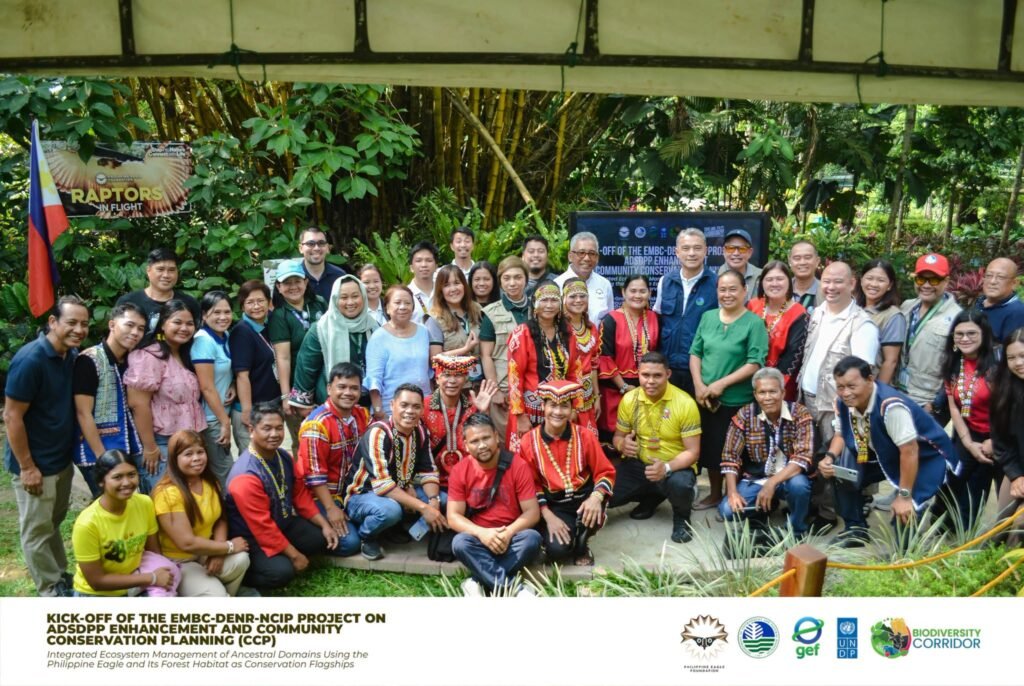
DAVAO CITY (September 8) — Indigenous Peoples (IPs) are being enlisted as key partners in protecting the Philippine Eagle under a new initiative of the Department of Environment and Natural Resources in Davao Region (DENR-XI) and the Philippine Eagle Foundation (PEF) covering ancestral domains in the Eastern Mindanao Biodiversity Corridor.
The Integrated Approach in the Management of Major Biodiversity Corridors in the Philippines, or BD Corridor Project, was launched at the Philippine Eagle Center in Malagos under the banner “One Eagle. Many Landscapes. Shared Stewardship.”
The project, supported by the Global Environment Facility through the United Nations Development Programme, seeks to incorporate indigenous knowledge and community participation into biodiversity management across the corridor.
Environment Secretary Atty. Juan Miguel T. Cuna said IP participation is particularly important because many suitable Philippine Eagle nesting sites are located within ancestral domains.
“Malaking bahagi ng mga suitable nesting sites ng ating Philippine Eagle ay nasa Ancestral Domain kaya nandito ang ibang mga indigenous peoples natin and leaders dahil gusto natin magtulungan tayo, ma-integrate yung kanilang traditional indigenous knowledge na alam nila kung paano rin aalagaan ang mga ito,” Cuna said in a media interview.
(A large portion of the suitable nesting sites for the Philippine Eagle is located within ancestral domains. That is why Indigenous Peoples and leaders are here—to work together and integrate their traditional knowledge on protecting the eagles.)
Cuna said IP leaders could also help prevent hunting practices that may unintentionally trap or harm the birds.
The initiative will also support the development of the Philippine Eagle Center as an eco-cultural tourism destination, educational park and Conservation Academy, linking wildlife protection with education and local culture.
The project aims to extend protection of Philippine Eagles beyond the conservation center by working with communities that live within or near critical forest habitats.