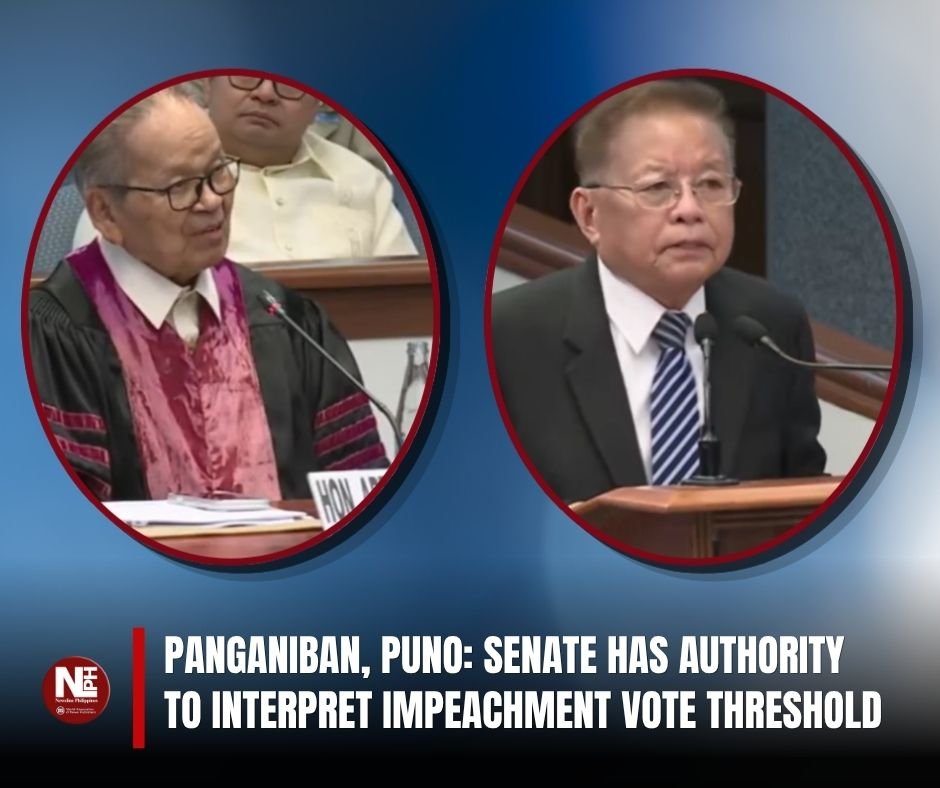
MANILA (September 17) — Retired Supreme Court justices told the Senate impeachment court Wednesday that reviewing the 16-vote threshold for convicting Vice President Sara Duterte does not by itself violate her right to due process, but they differed on how the constitutional requirement should be calculated.
The issue arose after Sen. Francis “Kiko” Pangilinan asked the amici curiae, or friends of the court, whether revisiting Presiding Officer Francis “Chiz” Escudero’s earlier ruling would prejudice Duterte because the trial was already underway.
Retired Chief Justice Artemio Panganiban said there was no due-process violation at this stage because the senator-judges had yet to decide the threshold. He also said there was no basis yet for finding grave abuse of discretion by the Senate.
Retired Chief Justice Reynato Puno similarly said the Senate was not necessarily changing an established rule because there is no controlling precedent determining how the constitutional provision should be applied to the circumstances of the current trial.
The dispute centers on Article XI, Section 3(6) of the 1987 Constitution, which requires the concurrence of two-thirds of all members of the Senate to convict an impeachable official.
Escudero earlier interpreted the provision to require 16 votes in the 24-member Senate.
Panganiban and former Chief Justice Hilario Davide Jr. said the computation should instead consider senators who are qualified to vote and have actively participated in the proceedings. Davide submitted his position in a memorandum because he could not appear in person.
Panganiban said active participation and independent evaluation of evidence are important to a senator’s constitutional responsibility as an impeachment judge.
Puno said the constitutional language itself does not simply state that 16 votes are required. It uses the phrase “two-thirds of all the Members of the Senate,” leaving room for interpretation.
Azcuna takes a different view
Retired Associate Justice Adolfo Azcuna disagreed with the position that absent or nonparticipating senators should be excluded from the denominator.
Azcuna said every senator who remains a member of the chamber must be included in calculating the two-thirds requirement, with exceptions only for senators who have died, resigned or been removed from office.
He nevertheless said the Senate may establish procedural rules on how the impeachment proceedings are conducted.
The former justices also cautioned against treating Avelino v. Cuenco as a direct precedent for the dispute. Puno, Davide and Azcuna noted that the 1949 case dealt with determining a legislative quorum under the 1935 Constitution, not the number of votes required to convict an impeachable official.
Panganiban said the case could still have persuasive value as part of a broader constitutional interpretation.
Why the threshold matters
The dispute was raised by Sen. Erwin Tulfo, who questioned whether senators unable to participate in the trial should still be counted when determining the two-thirds threshold.
Four senator-judges have not participated in the proceedings because of detention, being in hiding or medical leave abroad. The question is whether their absence should affect the number of votes required for conviction.
The issue is not yet before the Supreme Court. Puno said it is not ripe for judicial review because the Senate has yet to make a final determination on the threshold.
Escudero has said his original 16-vote ruling was intended to settle the issue early, allowing the parties to seek judicial review if necessary rather than raising the dispute only after the Senate reaches a verdict.
The prosecution and defense are scheduled to present their arguments on Sept. 23. The senator-judges will then decide whether to retain or overturn Escudero’s 16-vote interpretation.
The threshold debate is separate from the merits of the impeachment allegations against Duterte. The Senate impeachment court will determine how the constitutional voting requirement applies to the case.