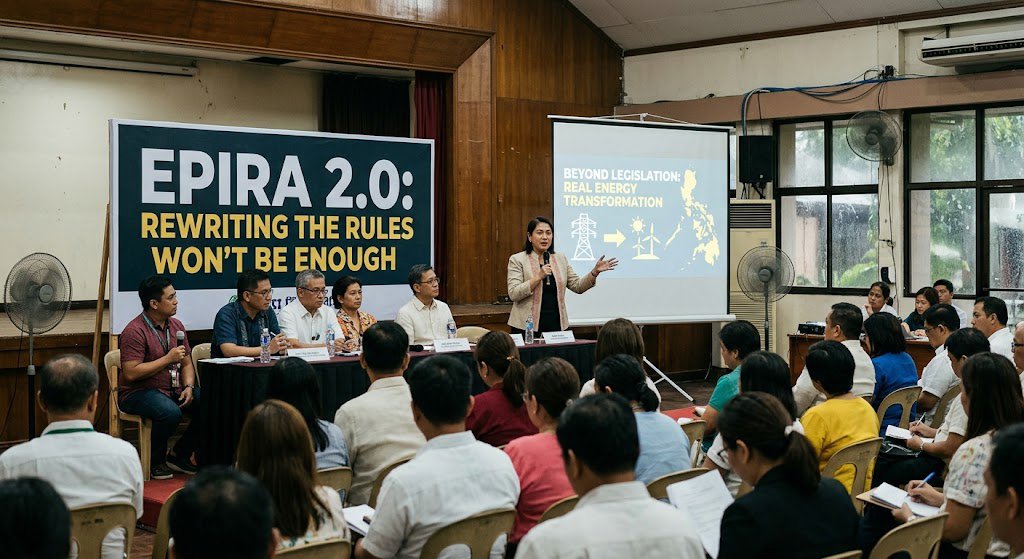
After 25 years, the power sector’s biggest problem may not be the rules—but whether government can make them work.
AI Generated Photo
MANILA (September 18) — Twenty-five years after the Philippines restructured its power industry, consumers are still dealing with two stubborn problems: expensive electricity and vulnerable supply.
That is why Congress is revisiting the Electric Power Industry Reform Act (EPIRA), the 2001 law that broke up the state-dominated power sector and introduced competition in generation and electricity supply.
But the experience of the past 25 years points to a problem that a new law alone may not solve.
EPIRA did not fail only because of what was written. Some of its biggest weaknesses were in implementation.
High bills, tight supply
Philippine electricity prices remain among the highest in Asia.
GlobalPetrolPrices.com estimates average Philippine rates from 2023 to 2026 at $0.209 per kilowatt-hour for residential consumers and $0.156 for businesses—among the three highest in its comparison of Asian economies.
High power costs affect household budgets, business operating expenses and investment decisions.
The supply picture is also a concern.
On Sept. 9, the Visayas grid faced a 308-megawatt shortfall during a red alert, while Mindanao had only about 6 MW of reserve capacity under a yellow alert.
The country is far from the 12-hour daily brownouts experienced in parts of Luzon during the power crisis of the early 1990s. But thin reserves leave less room for plant outages, transmission problems or sudden demand increases.
The gap between policy and delivery
EPIRA created the Wholesale Electricity Spot Market and Retail Competition and Open Access (RCOA) to encourage competition and give qualified consumers more choice.
But RCOA, originally targeted for 2006, was implemented only in 2013.
Power generation has faced similar delays. Developers have had to secure permits from multiple national agencies and local governments. The Energy Virtual One-Stop Shop was created to streamline approvals, but project proponents can still encounter multiple requirements and coordination hurdles.
The result is a familiar infrastructure problem: projects can be approved on paper but arrive late—or not at all.
DOE projections, for example, include both committed and indicative generation projects. Indicative projects remain subject to development, financing and approvals and are not guaranteed additions to the grid.
Data cited in the analysis show that only 23 percent of projects in the DOE’s Private Sector Initiated Power Projects list for 2020–2025 reached commercial operation within the target period.
Announced megawatts do not keep the lights on. Operating megawatts do.
That gap should be central to the EPIRA review: Why are projects delayed, and who is accountable when promised capacity fails to materialize?
Competition needs teeth
EPIRA’s promise of competition also depends on whether new players can enter the market.
DOE data cited in the analysis show that the seven largest generation companies account for nearly half of Luzon’s installed capacity.
The figure alone does not establish that concentration causes high electricity prices. But it raises a question for regulators: Are market rules creating meaningful competition, and can new players compete effectively?
This puts the Energy Regulatory Commission at the center of reform.
Senate President Win Gatchalian has called for a stronger ERC with greater authority and resources to scrutinize charges, impose penalties and ensure rate adjustments are justified. The ERC has said it is ready to work with Congress on possible reforms.
Who pays for inefficiency?
Consumer charges are another flashpoint.
President Ferdinand Marcos Jr. has called for consumers to stop shouldering system losses arising from inefficiencies and electricity theft. Several lawmakers have filed measures seeking changes to the rules governing these charges.
The Department of Energy supports efforts to reduce consumer costs but says reforms must also protect the financial sustainability of utilities.
The challenge is to prevent consumers from paying for avoidable losses while ensuring utilities have enough resources to maintain networks and invest in new capacity.
The questions EPIRA 2.0 must answer
The debate should therefore go beyond whether EPIRA needs new provisions.
It should ask:
· Why were some reforms implemented years later than planned?
· Why do power projects miss commercial-operation targets?
· How can permitting delays be reduced and agency accountability strengthened?
· Are market rules creating meaningful competition?
· Who should bear the cost of inefficiencies, theft and system losses?
· How will government ensure projected capacity actually reaches the grid?
These are questions of execution and enforcement.
After 25 years, the Philippines has learned that a sound policy can still produce disappointing results when implementation falls short.
EPIRA 2.0 should not be measured by how much the law changes. It should be measured by what changes for consumers.