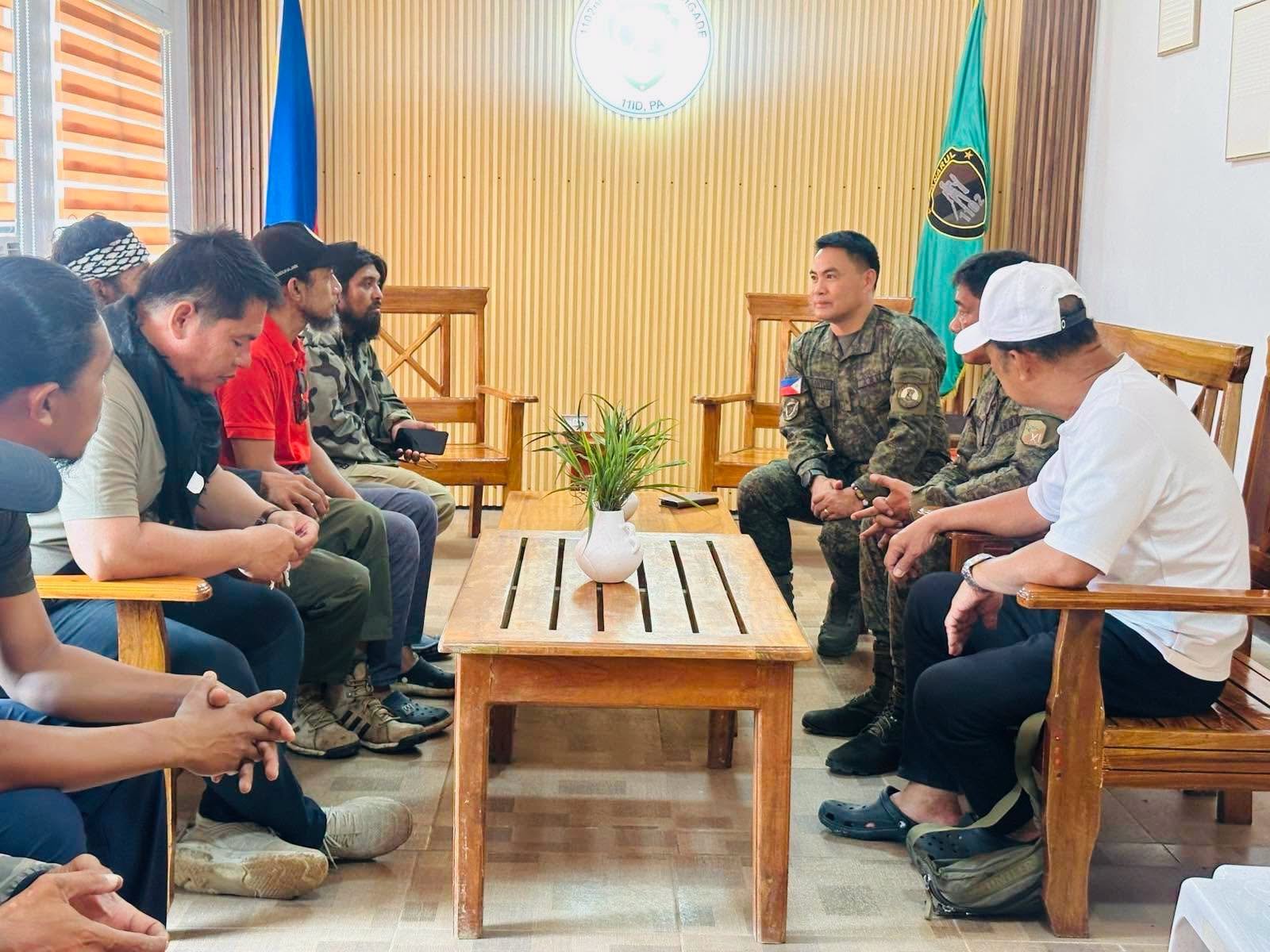
LUUK, Sulu (September 21) — Army and Moro National Liberation Front (MNLF) leaders have agreed to strengthen direct communication and joint monitoring in Sulu, aiming to address local disputes before they escalate into violence or wider security incidents.
The commitment came during a high-level dialogue Thursday in Barangay Bual between officials of the 1102nd Infantry “Ganarul” Brigade and MNLF leaders operating in the province.
Brig. Gen. Alaric Avelino Delos Santos, brigade commander, led the Army delegation, joined by deputy brigade commander Col. Alex Gagula and brigade executive officer Lt. Col. Rolando Granados.
The MNLF delegation included Saikal Madjuri, Mhadz Akmad, Makis Suluman Abduhajan, Abduraddul Abduhajan, Hji. Pahmi Amiril, Junhar Abdulla and Hji. Amilhamja Hadjiri.
Rather than limiting the discussion to broad peace commitments, the two sides focused on early communication and response mechanisms for localized disputes, community concerns and emerging security problems.
The objective is to create channels through which potential conflicts can be reported, verified and addressed before they develop into armed confrontations.
Delos Santos said maintaining active communication between the Army, MNLF and community stakeholders is necessary to prevent misunderstandings from escalating and to protect gains made in Sulu’s peace process.
He stressed that active listening, mutual respect and shared responsibility are essential to building trust and resolving field-level problems through dialogue.
The commitments also place responsibility on both sides to keep communication lines open and act on emerging concerns rather than wait for disputes to become security incidents.
For the MNLF, grassroots engagement remains central to conflict prevention. Its representatives reaffirmed the importance of open communication in containing tensions and resolving problems before they escalate.
From dialogue to response
The agreement to maintain joint monitoring and strengthen trust-building measures provides a practical mechanism for sustaining the dialogue beyond the meeting itself.
The effectiveness of the arrangement, however, will depend on whether concerns raised at the community level are acted upon promptly, whether communication channels remain accessible, and whether both sides follow through on commitments when tensions emerge.
This makes community-level coordination an important part of accountability—not only between the Army and MNLF, but also in their engagement with local leaders and residents who are often the first to see tensions developing.
The Ganarul Brigade said it will continue stakeholder outreach within its area of responsibility, while the MNLF reiterated its commitment to grassroots peacebuilding.
For communities in Sulu, the measure of such engagements ultimately lies not in the number of dialogue meetings held but in whether early warnings lead to early action, local disputes are resolved without violence, and agreed mechanisms remain functional when tensions arise.