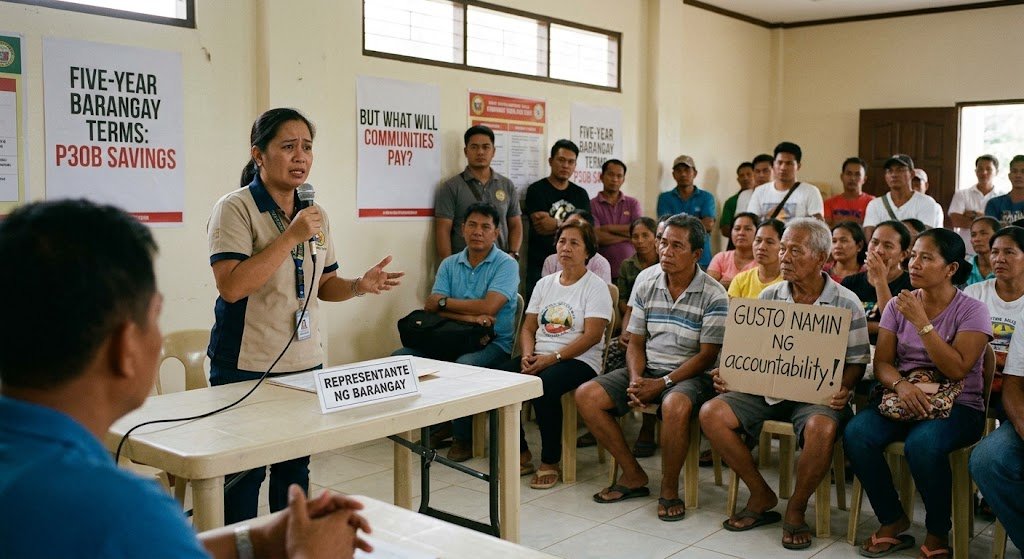
MANILA (September 21) — Extending barangay officials’ terms from four to five years could save the government about P30 billion in election costs, but it would also mean that residents would have to wait longer for the next opportunity to change their local leadership through the ballot.
That trade-off is at the heart of the debate over Senate Bill No. 2387, which the House adopted on Sept. 16 after the Senate approved it on third and final reading.
Deputy Speaker Janette Garin said the five-year term could free up about P30 billion in direct election costs that could instead be used for disaster response and other government priorities.
But for communities, the cost-benefit question goes beyond the price of an election.
A barangay government is the level of government closest to residents. It deals directly with concerns ranging from peace and order, social welfare and health services to disaster response, youth programs and community disputes.
Extending its officials’ tenure therefore also extends the period during which residents must live with the consequences—positive or negative—of local leadership decisions.
One more year without an electoral reset
Under the proposed arrangement, barangay and SK officials would serve five-year terms, with the next elections set for November 2028.
That gives communities one additional year before they can use the ballot to reward or replace their local officials.
For residents satisfied with their barangay leadership, the longer term may provide greater continuity for programs and projects.
For residents dissatisfied with their officials, however, it could mean one more year before electoral accountability takes place.
This makes other accountability mechanisms—public disclosure of funds, barangay assemblies, citizen complaints, audits, transparency requirements and community participation—more important during the longer interval between elections.
The measure also introduces a two-term limit for barangay officials moving forward, with each term lasting five years.
The social cost is harder to measure
The financial savings from postponing an election can be calculated.
The social cost of weaker or delayed accountability is harder to put a peso value on.
If a barangay government performs well, a longer term can provide continuity and more time to complete programs.
But where leadership is ineffective, public funds are poorly managed, services are inadequate or community concerns are ignored, residents may have fewer immediate electoral options.
That is why the debate should not be reduced to whether P30 billion is saved.
The more important question for communities is whether the government can ensure that longer terms come with stronger transparency and accountability safeguards between elections.
SK reform adds another layer
The proposed extension also gives Congress more time to examine the Sangguniang Kabataan system.
Garin cited complaints involving the financial management of some SK councils, including allegations of forged signatures and questionable handling of checks. She emphasized that these concerns do not involve all SK officials and did not identify specific cases.
Such allegations must still be established through investigation and due process.
But the concerns highlight a broader issue: extending the term of youth officials without addressing weaknesses in financial controls, training, oversight and meaningful youth participation could simply extend the period in which those weaknesses remain unresolved.
Garin said lawmakers are considering possible reforms to the SK, including changes to its structure and, among some lawmakers, even its abolition.
One alternative being discussed is retaining youth representation in the barangay council without maintaining the SK in its current form.
The accountability gap
Barangay officials occupy a unique position because they are often the first government officials residents encounter.
For vulnerable families, young people, senior citizens, persons with disabilities and residents seeking assistance during emergencies, the barangay can be the first—and sometimes only—door to government.
A five-year term therefore has consequences beyond electoral calendars.
It can affect how long communities experience a particular leadership style, how quickly local concerns receive attention and how much influence residents can exercise over barangay priorities.
The challenge is to ensure that a longer term does not become a longer accountability gap.
If government is saving money by holding elections less frequently, communities need meaningful ways to scrutinize spending, question decisions, report abuses and participate in local planning between elections.
The P30-billion figure may be the most visible argument for the proposal.
But for barangay residents, the more immediate measure will be whether the extra year produces better continuity of services—or simply more time before they can hold their local leaders to account at the ballot box.