DAVAO CITY (September 20) — The numbers tell a story of progress. The people behind the numbers tell a more complicated one.
Poverty in Mindanao has declined substantially, according to findings discussed by the World Bank and the Mindanao Development Authority (MinDA), but officials caution that the gains have not been shared equally across communities and sectors. For MinDA Executive Director Undersecretary Janet M. Lopoz, the message from the latest assessment is encouraging—but it is also a warning that falling poverty rates do not mean the region has already escaped poverty.
“Maganda ang finding,” Lopoz said, referring to the World Bank assessment discussed during a recent Mindanao Poverty Assessment roundtable in Davao City. Poverty has been declining, she said, but “the reduction is concentrated,” pointing to the need to identify which sectors and communities are still being left behind and what interventions are needed to close those gaps.
The discussion was part of an ongoing MinDA-World Bank engagement on Mindanao’s economic and poverty conditions, bringing together regional development council chairpersons, local government representatives and World Bank economists to examine poverty, vulnerability, social protection, service delivery and the quality of jobs. The September 2026 roundtable in Davao City was attended by World Bank Lead Economist Javier Baez, Practice Manager Benu Bidani, Senior Economist Liliana Sousa and regional leaders.
The timing of the discussion is significant. The Philippine Statistics Authority reported in August that all 18 Philippine regions recorded statistically significant declines in poverty incidence among families between 2023 and 2025. Nationally, family poverty fell from 10.9 percent to 6.4 percent, while poverty among the population declined to 9.7 percent, or about 11.08 million people. BARMM registered the largest decline among the regions, falling from 26 percent in 2023 to 12.8 percent in 2025.
Other Mindanao regions also posted lower family poverty rates by 2025. Based on the latest PSA data, Northern Mindanao was at 14.4 percent, Zamboanga Peninsula at 9.8 percent, SOCCSKSARGEN at 9.6 percent, and Caraga at 7.8 percent. The Davao Region also recorded a lower rate than in 2023.
The improvement is real, but the geography of poverty remains important. The World Bank’s latest assessment notes that poverty reduction in the Philippines has been driven largely by growth in rural areas and by workers shifting from low-productivity own-account activities, particularly in agriculture, to wage employment in sectors such as construction and services. It also found that people in poorer regions benefited from faster income growth and improvements in access to basic services.
That helps explain Lopoz’s warning that the reduction is “concentrated.” A lower regional poverty rate can conceal major differences between provinces, municipalities, occupations, and households.
Mindanao remains particularly important to the national poverty story. In 2023, the World Bank noted that Mindanao was home to about a quarter of the country’s population but accounted for a disproportionate share of poor Filipinos. Its earlier work linked the region’s poverty closely to rural underdevelopment, weak connectivity, limited market access, conflict, and low productivity.
For Lopoz, one of the first places to look is agriculture.
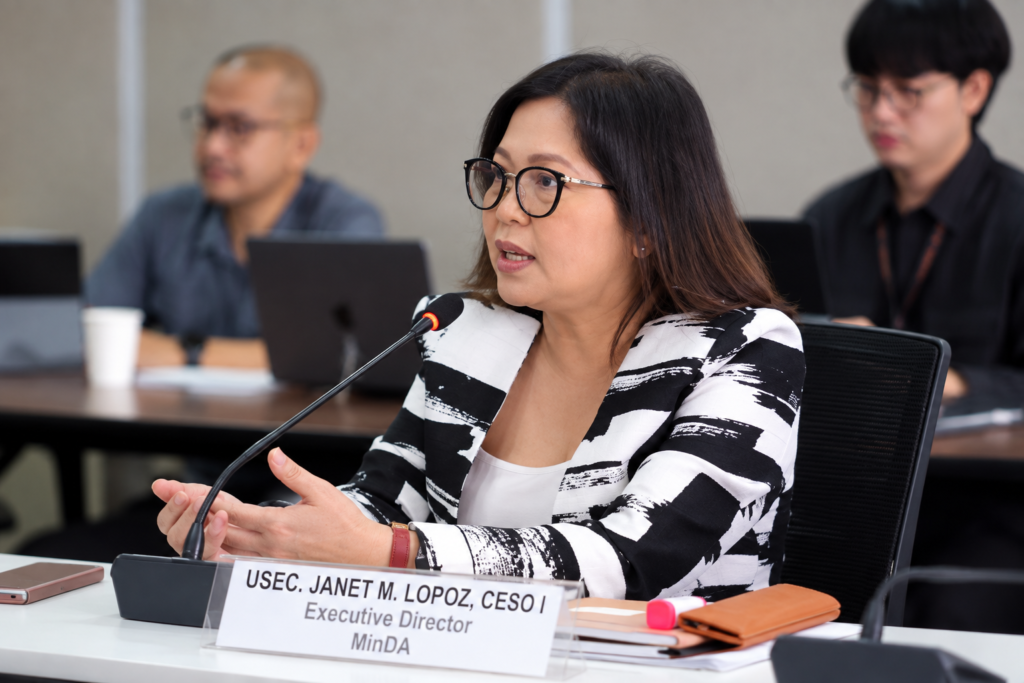
“Mindanao is still an agricultural economy,” she said, emphasizing that agriculture remains a major source of economic activity and livelihoods in many communities. The challenge, she said, is to raise farmers’ productivity and address the structural factors that keep food prices high.
The World Bank’s latest national assessment points in the same direction. It identifies low agricultural productivity as a structural driver of high food prices and rural poverty, noting that food takes up about 60 percent of the spending of the poorest 30 percent of Filipino households, while rice alone accounts for about 18 percent of their budgets. The report argues that durable reductions in food prices require reforms that raise agricultural productivity rather than relying primarily on subsidies and trade interventions.
For Mindanao, that means more than putting seeds and fertilizer into farmers’ hands. Lopoz said the discussion focused on farm-to-market roads, connectivity, agricultural infrastructure, research and development, technology, and better productivity. The region has enormous agricultural resources, she said, but much of that potential remains underused.
Evidence shows these investments can matter. A World Bank review of the Philippine Rural Development Project found that improved rural roads, market access and enterprise development raised incomes among participating farmer and fisherfolk households. By 2025, the project had reached about 1.55 million beneficiaries, while direct farmer and fisherfolk beneficiaries recorded a roughly 67 percent increase in real household incomes. More than 2,400 kilometers of rural roads had been built or rehabilitated, cutting travel time and transport costs.
For Mindanao, where farming and fishing remain central to many rural economies, the implication is straightforward: poverty reduction requires people to earn more from the work they already do, while creating alternatives for those who cannot rely on agriculture alone.
But Lopoz’s second concern is much closer to home and much harder to measure. It is the child growing up in a poor household.
During the poverty assessment discussion, she highlighted children’s vulnerability and the implications of poor nutrition, particularly stunting. She said the assessment raised concern about the large share of children living in poorer households and what that means for the quality of the workforce Mindanao will have years from now.
The World Bank’s latest assessment provides a stark national context. Nearly 60 percent of Filipino children live in poor or vulnerable households; 24 percent live in poverty, and another 34 percent live in vulnerable households. The World Bank warns that stunting and other forms of early-childhood disadvantage can undermine learning, health, and future productivity.
That is why Lopoz stressed the importance of the first 1,000 days of life, when nutrition and development are particularly critical. The World Bank has likewise identified the period from conception through a child’s second birthday as a crucial window for brain development, with inadequate nutrition and other early-life adversities potentially affecting physical and cognitive development well into adulthood.
The poverty discussion therefore moved beyond money. It became a discussion about whether a child has enough food, whether a mother can access health services, whether a child enters school on time, whether that child remains in school and whether the public system can intervene before deprivation becomes permanent.
For Lopoz, this means social protection must become more responsive and more accurately targeted. Assistance in education, health and other basic services should reach the households that need it most, she said. And that requires something government agencies often struggle with: good local data.
“Data matters a lot,” was the recurring message in the discussion.
Local governments are already doing much of the groundwork, Lopoz said, but she argued that targeting needs to become sharper and community-level information needs to become more reliable. In Cotabato province, for example, local authorities are hiring enumerators to gather information directly from communities, according to Lopoz, to establish a clearer picture of who is poor, where poverty is concentrated, and what those households actually need.
That emphasis on ground-level data mirrors concerns raised by regional leaders at the Davao roundtable. Cotabato Governor Emmylou “Lala” Taliño-Mendoza, who chairs the Regional Development Council for SOCCSKSARGEN and sits on the MinDA Board, said accurate and comprehensive data are essential for understanding the extent of poverty and improving local capacity to respond.
A family may be classified as poor in one dataset but missed by another. A municipality may appear to have made progress while a particular Indigenous community remains deeply vulnerable. A province may have growing gross domestic product while households at the bottom of the income distribution continue to struggle.
Poverty policy, in other words, cannot be built only from averages. It has to find the people who disappear inside the averages.
The third area discussed by MinDA and the World Bank was service delivery in lagging areas, especially local governments’ capacity to finance and implement projects that create quality jobs and reach vulnerable communities.
Lopoz pointed to a long-running fiscal concern involving the distribution and situs of local business taxation, particularly for companies whose principal offices are located away from the communities where production and economic activity take place. Under Section 150 of the Local Government Code, local business tax is generally tied to where sales or business activity are recorded, with specific allocation rules for businesses with factories, plants, project offices, or plantations in different localities. The Supreme Court has addressed these allocation rules in cases involving competing local governments.
For Lopoz, the broader issue is not simply taxation. It is fiscal capacity.
A local government with limited revenue has less room to invest in roads, water systems, health services, agricultural support, education, and economic projects the very interventions needed to help communities move permanently out of poverty.
This is why she described the issue as fundamentally a fiscal and development problem, not simply a poverty problem.
The proposed response is not to wait for national government alone. Lopoz wants to strengthen local governments so they can identify and invest in projects that generate quality, sustainable jobs, particularly in communities where poverty remains concentrated.
The World Bank assessment similarly argues that creating better jobs is central to sustaining poverty reduction and strengthening the emerging middle class. The report notes that the shift toward wage employment has been important to recent gains, but that vulnerable households remain exposed to shocks and need better opportunities, stronger social protection and improved access to quality services.
The concern is especially important for Indigenous Peoples and women, groups that Lopoz said should remain a focus of development interventions.
The World Bank reports that Indigenous Peoples continue to experience disproportionately high poverty and weaker access to key services. In its latest analysis, IPs had a poverty rate of 32.4 percent in 2023 and also experienced lower access to internet connectivity, secondary education, and improved sanitation.
For Mindanao, this is not an abstract statistic. Many Indigenous communities are located in remote areas where distance from markets, schools and health facilities compounds the effects of poverty. The World Bank’s Mindanao agriculture programs have consequently placed particular emphasis on Indigenous Peoples and marginalized rural communities, including through support for agricultural enterprises, water systems, post-harvest facilities and market access.
Another important lesson from the assessment is that economic growth and poverty reduction are related, but not automatically the same.
Mindanao’s economies continue to grow. The PSA reported that all regional economies recorded positive growth in 2024, with Davao Region expanding by 6.3 percent, Northern Mindanao by 6.0 percent, and Caraga by 6.9 percent.
The challenge is ensuring that growth creates enough income, productive employment, and access to services for the households that remain vulnerable.
That is the central tension behind the latest poverty discussion. The headline is encouraging: poverty is falling. The harder story is that some people are falling out of poverty faster than others.
Some households are moving toward stable employment and the emerging middle class. Others remain one bad harvest, medical emergency, food-price increase, disaster, or job loss away from falling back.
The World Bank calls this vulnerability and “churning” between poverty and non-poverty. Its latest assessment notes that many households remain only marginally above the poverty line and therefore remain exposed to shocks.
For Lopoz, policy must now become more sophisticated. The task is no longer simply to ask how many Mindanaoans are poor.
Government must ask where they are, why they remain poor, what keeps them vulnerable, what kind of work they do, what services they can access, what happens to their children, and what intervention can permanently change their economic trajectory.
The World Bank partnership is therefore evolving from measuring poverty to understanding the structures behind it.
And MinDA’s role, through the Mindanao Board and the Regional Development Councils, is to translate that evidence into regional policy positions and concrete interventions. Lopoz said the recommendations will be brought to the next Mindanao Board discussions, particularly those requiring legislative, executive, or institutional action.
The numbers may be moving in the right direction. But for Mindanao, the real measure of poverty reduction will not be found only in a declining percentage.
It will be found in the farmer who earns enough to keep farming, the mother who can feed her children properly, the Indigenous family that finally gains reliable access to services, the worker who finds a productive job close to home, and the child who enters school healthy enough to learn.
Because poverty is not eradicated when a statistic changes. It is eradicated when a family no longer has to live one crisis away from falling back. And that, more than the improving numbers, is the unfinished work now before Mindanao.-Editha Z. Caduaya