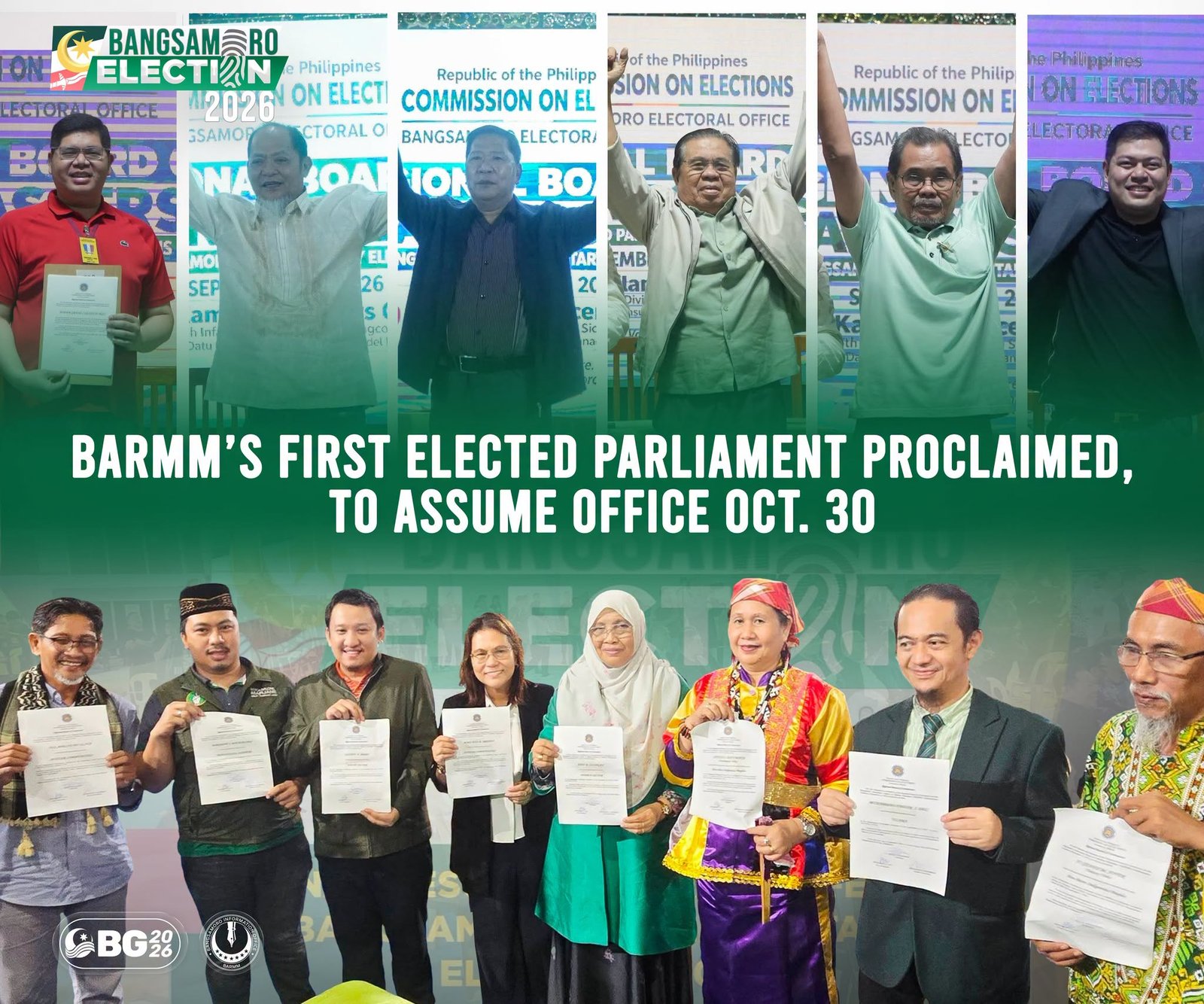
ZAMBOANGA CITY (September 25) — THE 80 newly elected Bangsamoro Members of Parliament (MPs) will take their oaths and assume office on October 30, but before they can begin governing, they face their first major political test: building a coalition strong enough to elect the region’s first regular chief minister.
The deadline is set by Republic Act 12317 and the Bangsamoro Organic Law, marking the formal shift from the interim Bangsamoro Transition Authority (BTA) to the region’s first regular parliamentary government.
The Regional Board of Canvassers (RBOC)-BARMM certified the winning MPs on September 16, clearing the way for the October 30 transition.
But with no party winning the 41 seats needed for a majority, the incoming parliament will open with coalition-building already underway.
31-30-15: the numbers driving the talks
The Bangsamoro Federalist Party (BFP) emerged with 31 seats, giving it the largest bloc but not enough to govern on its own.
The United Bangsamoro Justice Party (UBJP) follows with 30 seats, while the Bangsamoro Grand Coalition (BGC)holds 15 seats, with four additional seats going to minor party and sectoral representatives.
The numbers mean neither of the two largest blocs can reach the 41-seat threshold without partners.
That puts the BGC and the smaller blocs in a potentially decisive position as parties negotiate the composition of the first regular Bangsamoro government.
The immediate prize is the chief ministership.
Under the parliamentary system, the incoming MPs will elect the region’s first regular chief minister during their inaugural session.
From campaign rivals to coalition partners
The coalition talks come barely weeks after the September 14 parliamentary elections, where parties competed against one another across Bangsamoro’s parliamentary districts and party-list contests.
BFP leader and interim Chief Minister Abdulraof Macacua, who won as district representative for Maguindanao del Norte, has called for political factions to move beyond the campaign.
“The election has ended, but our work does not end here. Now is the time to unite and continue what we have started,” Macacua said.
The BFP’s 31 seats give Macacua’s bloc the largest starting position, but the numbers also make clear that it cannot form a government without reaching across party lines.
UBJP seeks its own majority
The UBJP is likewise negotiating with potential partners as it seeks to assemble an alternative majority.
Senior UBJP leader and MP Mohagher Iqbal said coalition discussions must also protect the gains of the Bangsamoro peace process.
“We see to it that the remaining aspects of the Comprehensive Agreement on the Bangsamoro shall be implemented by the regular government,” Iqbal said.
That puts the implementation of outstanding peace-agreement commitments among the issues likely to shape negotiations over the incoming administration.
The transition clock is ticking
While politicians negotiate, transition steering committees are working on parliamentary rules and administrative arrangements for the new government.
The objective is to avoid a vacuum when the BTA formally dissolves on October 30.
For communities across Bangsamoro, the transition is more than a change in political titles.
The new parliament will inherit responsibility for turning the region’s autonomous institutions into a functioning regular government while continuing the peace and normalization process that underpins the Bangsamoro political settlement.
The first major decision will come almost immediately.
By the time the 80 MPs take their oaths on October 30, they will need more than seats. They will need 41 votes—or a coalition capable of producing them—to choose the Bangsamoro’s first regular chief minister.