DAVAO CITY (August 4) — Deep in the forests of Mount Hamiguitan, where the thick vegetation can hide more wildlife than the human eye can ever catch, two elusive birds have offered conservationists a rare reason for hope.
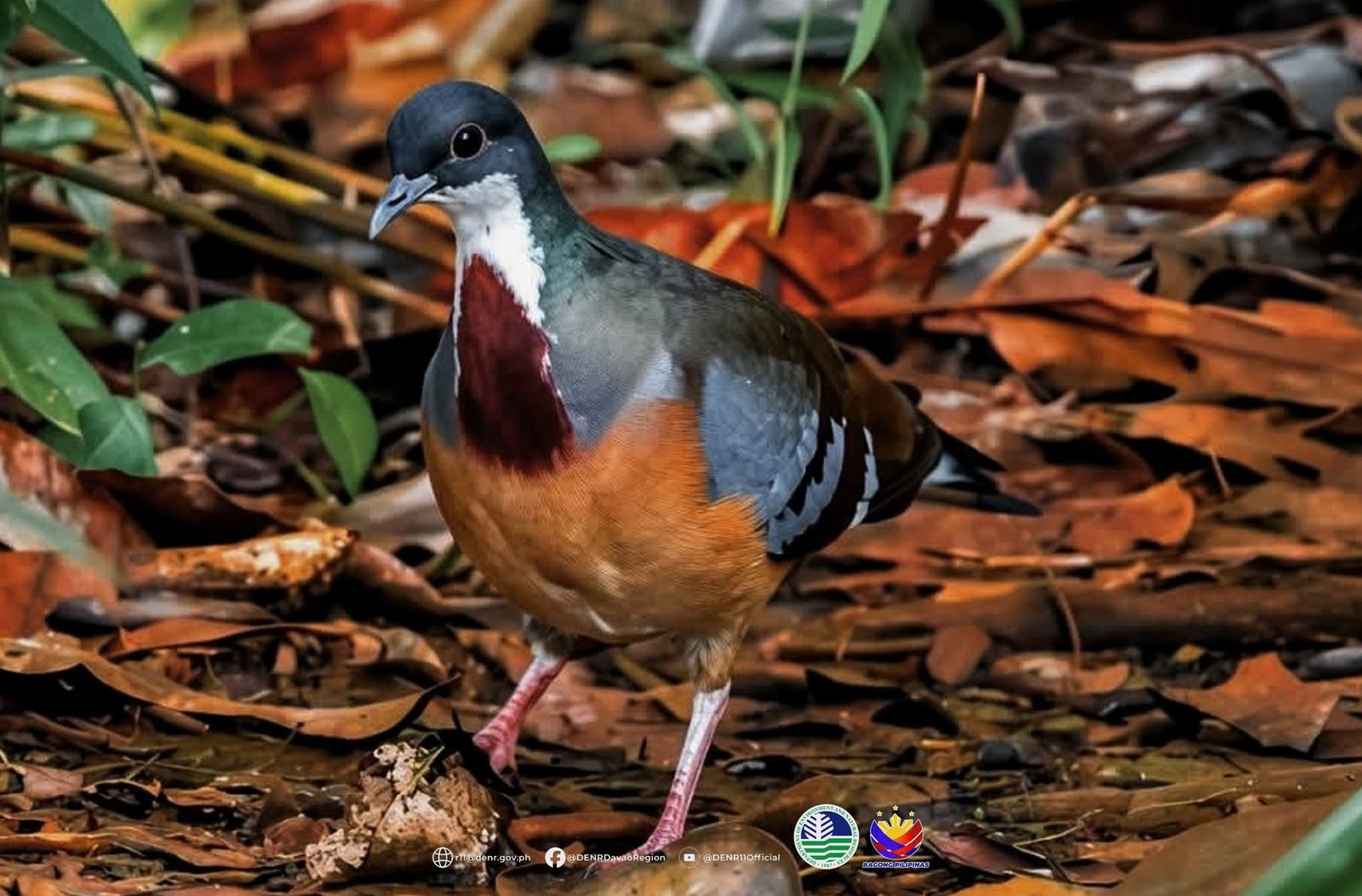
Two Mindanao bleeding-heart pigeons (Gallicolumba crinigera) were documented on July 29 during a biodiversity assessment at the foothills of the Mount Hamiguitan Range Wildlife Sanctuary—a discovery that may seem small on the surface but carries a bigger message about the health and importance of one of Mindanao’s most valuable forests.
The species is not a bird commonly seen by visitors.
It is a ground-dwelling, forest-dependent dove, and its presence can easily go unnoticed. Unlike birds that announce themselves with loud calls or frequent open-air flight, the Mindanao bleeding-heart spends much of its time close to the forest floor.
That makes the recent documentation particularly significant.
Before the July 29 sighting, a biodiversity monitoring intern had accidentally encountered the species in the same area between June and July. More encouragingly, a male was observed displaying courtship behavior toward a female—an indication that the birds may be breeding within the sanctuary.
The intern reported the observation to sanctuary personnel, allowing conservation workers to monitor the species more closely.
The latest sighting was recorded during a Biodiversity Assessment and Monitoring System (BAMS) activity jointly conducted by the Protected Area Management Office of the Mount Hamiguitan Range Wildlife Sanctuary and the Department of Environment and Natural Resources (DENR) XI.
For conservation workers, such encounters are more than entries in a monitoring sheet.
They are evidence.
Evidence that the forest continues to provide habitat for wildlife. Evidence that long-term monitoring can uncover species that might otherwise remain invisible. And evidence that protecting a forest is ultimately about protecting an entire living system.
A bird that carries a warning
The Mindanao bleeding-heart is endemic to the Philippines, meaning it is found nowhere else in the world.
Its natural range includes Mindanao, Basilan, Samar, Leyte, Bohol and the Dinagat Islands, where it inhabits primary and secondary tropical forests at elevations of up to about 750 meters above sea level.
The Philippines has five endemic bleeding-heart dove species, each associated with particular island groups.
But being endemic also makes a species especially vulnerable.
According to the Updated National List of Threatened Philippine Fauna and their Categories under DENR Administrative Order No. 2019-09, the Mindanao bleeding-heart is classified as Vulnerable.
That classification means the bird faces a high risk of population decline in the wild if existing threats continue.
And that is where the rare sighting becomes a community issue.
The survival of a bird that many people may never see depends on decisions made far beyond the forest floor—from how protected areas are managed to how illegal wildlife trade is controlled and how forests are protected from degradation.
The forest is the real story
The temptation with a rare wildlife sighting is to focus on the animal.
But the bigger story may be the forest that allows the animal to survive.
A bleeding-heart pigeon appearing in a protected area suggests that there is still habitat capable of supporting a species that depends on forest ecosystems. Its possible courtship activity offers an even more hopeful sign.
But conservation cannot stop at documenting a bird.
The July 29 sighting also underscores why sustained biodiversity monitoring matters. Wildlife populations can decline quietly long before the disappearance of a species becomes obvious.
Regular monitoring allows conservationists to establish where species occur, observe population trends and identify emerging threats.
In the case of the Mindanao bleeding-heart, it also provides a basis for stronger protection against illegal wildlife collection and trade, habitat destruction and other pressures that can push vulnerable species closer to decline.
The last confirmed observation of the species in the sanctuary before the recent records was documented on August 8, 2019, according to conservation authorities.
That gap itself is a reminder of how difficult it can be to track elusive wildlife.
A species can be present without being seen.
And the absence of sightings does not necessarily mean the absence of life.
What communities can protect
Mount Hamiguitan is not simply a destination or a patch of green on a map.
It is a living refuge.
Every tree, stream, understory plant and patch of forest floor can form part of the habitat that allows rare species to survive.
For communities surrounding protected areas, this makes conservation a shared responsibility.
Residents can help by reporting suspected wildlife collection and illegal wildlife trading, refusing to buy wild-caught animals and supporting efforts that keep forests intact.
Visitors, meanwhile, can help by following sanctuary rules, staying on designated trails, avoiding disturbance of wildlife and never feeding, touching or attempting to capture wild animals.
Even something as simple as not taking a wild animal home can become an act of conservation.
For authorities, the challenge is larger: ensure that laws protecting threatened wildlife are enforced, monitoring continues and protected-area management receives enough resources to keep conservation efforts from becoming dependent on occasional projects.
A small bird, a big responsibility
The two bleeding-heart pigeons documented in Mount Hamiguitan may never become famous.
They do not need to.
Their value lies precisely in the fact that they are part of a natural world that existed long before most of us and could disappear if people fail to protect it.
The sighting is a welcome sign. But it should not be mistaken for proof that the species is safe.
A Vulnerable species remains vulnerable even when it is seen.
The real measure of conservation success is not how often people photograph rare wildlife, but whether those animals continue to find enough safe habitat to feed, reproduce and survive without human interference.
For Mount Hamiguitan, the recent sighting offers both a celebration and a warning.
Somewhere beneath the forest canopy, a rare bird is still living its quiet life. The community’s responsibility is to make sure the forest remains wild enough for it to continue doing so.