MANILA (October 7) — For the Philippines, the ASEAN Power Grid is not simply about connecting electricity networks across Southeast Asia. It is about finding more ways to secure power for a country whose islands, growing demand and exposure to extreme weather make reliable electricity a continuing challenge.
That is why the Philippines is putting regional electricity connectivity high on the agenda as it hosts the 44th ASEAN Ministers on Energy Meeting (AMEM44) in Manila this week.
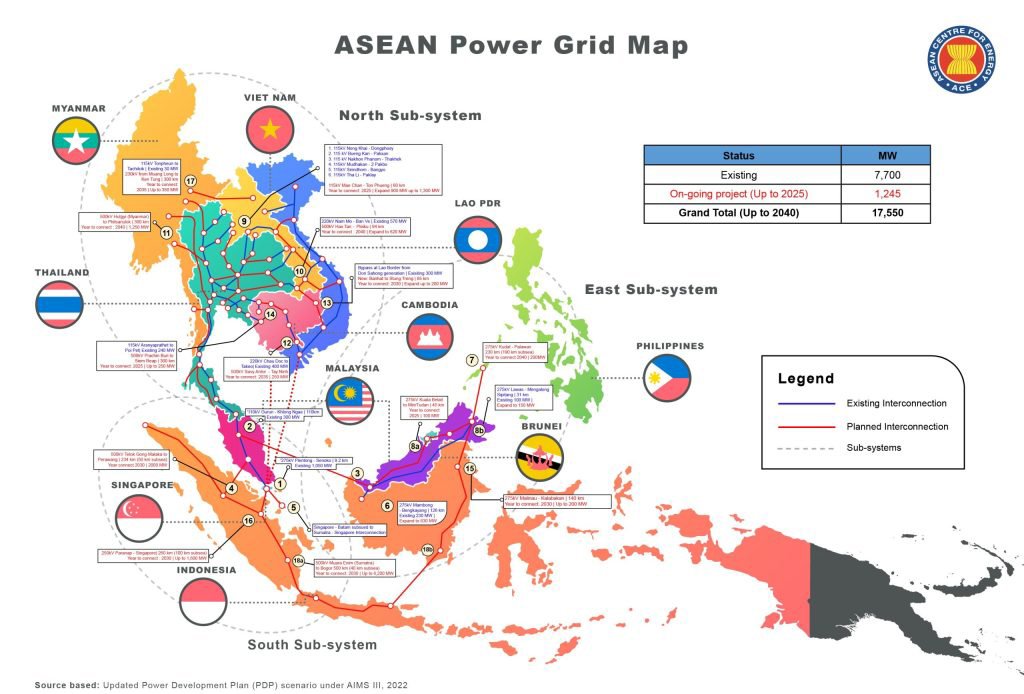
The long-term goal is to link the power systems of ASEAN’s 10 member states, allowing countries to trade electricity across borders and tap energy resources that may be unavailable or too far away from their own major demand centers.
For the Philippines, that could eventually mean access to additional sources of electricity while opening a market for the country’s own renewable-energy potential.
But getting there will require something the Philippines and its neighbors have yet to fully achieve: building compatible grids, agreeing on common rules and laying expensive connections under the sea.
Why the Philippines has a stake
The Philippines has significant renewable-energy resources, including geothermal and offshore wind, but its geography presents a major challenge.
Unlike mainland Southeast Asian countries that can connect their grids through land-based transmission lines, the Philippines is an archipelago. Any direct regional electricity connection would require subsea infrastructure.
One proposed project is a Philippines-Sabah interconnection, which would connect Palawan to Kudat in Sabah, Malaysia, through a planned high-voltage direct-current subsea cable. The project is envisioned as part of a wider connection linking the Philippines, Malaysia and Indonesia.
The potential payoff is regional power trading: electricity generated where resources are abundant could be delivered to areas where demand is higher.
Think of it as a regional power-sharing system
The ASEAN Power Grid was first conceptualized in 1997. It is not a plan to build one giant power plant or one centralized grid.
Instead, existing national grids would be connected through cross-border transmission lines and subsea cables.
The idea is straightforward: when one country has surplus electricity, another country could potentially use it.
That could become increasingly valuable as Southeast Asia’s electricity demand grows and countries add more solar, wind and hydropower to their energy mix.
The International Energy Agency says expanding cross-border connections can help ASEAN countries balance electricity supply and demand, integrate renewable energy and improve flexibility. Planned cross-border interconnections through the ASEAN Power Grid are estimated to require about US$27 billion through 2040.
The Philippines is pushing the next step
The Philippines is not starting from scratch.
ASEAN energy officials are now working to implement the Enhanced ASEAN Power Grid Memorandum of Understanding, which aims to advance multilateral power trading, renewable-energy integration and investment.
As ASEAN chair, the Philippines has also been tasked with developing operational guidelines for the Submarine Power Cable Framework, covering legal, regulatory, technical, financial and commercial issues.
The challenge is turning agreements into infrastructure that can actually be built and operated.
For the Philippines, that means answering difficult questions: Who pays for the subsea cables? How will electricity be traded? Which country’s rules apply when power crosses borders? And how can the connections be protected from typhoons, earthquakes, underwater hazards and other disruptions?
More connections, more protection needed
Interconnecting grids can provide backup when electricity supplies are tight. But it also means that problems in one part of the network can potentially affect others.
That makes climate resilience critical.
Energy experts meeting in Manila have warned that typhoons, floods and extreme heat can damage power infrastructure and disrupt electricity flows across borders. Philippine experience with extreme heat has already shown how weather can push electricity demand sharply higher and put pressure on the grid.
That is why experts are calling for common climate and engineering standards, stronger transmission infrastructure, battery storage and other technologies that can help stabilize grids during emergencies.
So what could Filipino consumers gain?
The ASEAN Power Grid will not immediately translate into cheaper electricity bills or guarantee an end to power interruptions.
But over the longer term, regional interconnection could give the Philippines more options.
It could provide access to electricity from neighboring countries during periods of tight supply, create new markets for Philippine renewable energy and encourage investment in transmission, storage and clean-energy projects.
It could also make the country’s electricity system part of a larger regional safety net rather than leaving each national grid to deal with shortages and disruptions on its own.
The scale of the ambition is enormous. ASEAN’s long-term goal is a fully integrated regional power system by 2045, backed by major investments in cross-border connections and domestic grids.
For the Philippines, however, the immediate task is more practical.
Before electricity can flow across borders, the region has to agree on how the wires—and the rules governing them—will work.
That is the real significance of the ASEAN Power Grid discussions now taking place in Manila.