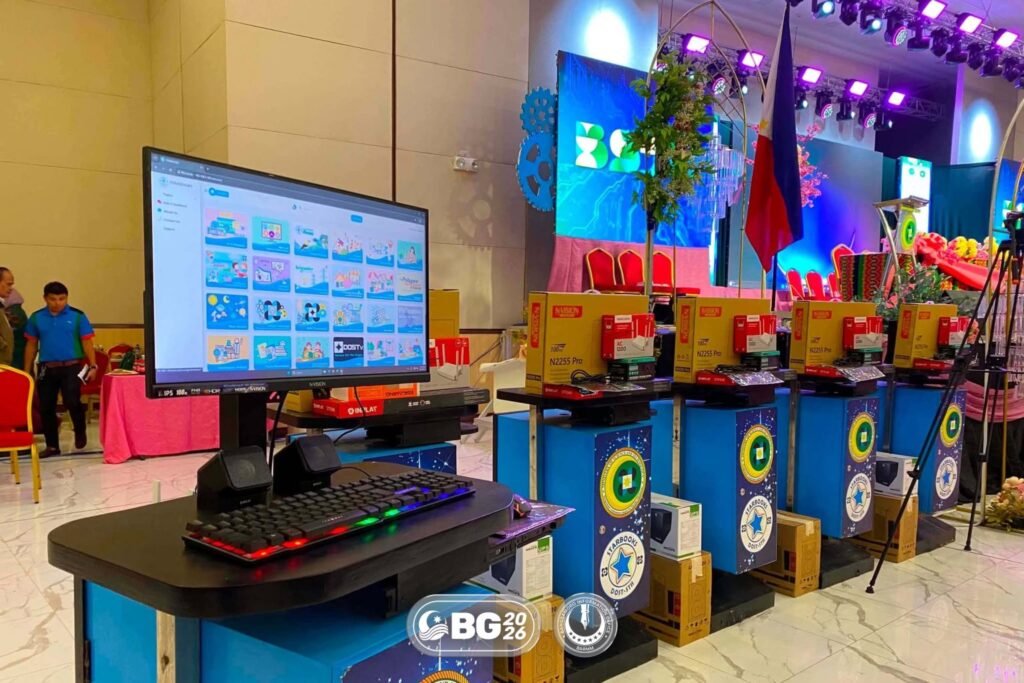
Photo: BANGSAMORO AUTONOMOUS REGION IN MUSLIM MINDANAO
COTABATO CITY (September 1) — For students in the Bangsamoro, a lack of reliable internet can mean limited access to research materials, science references and other resources that their peers in better-connected schools can readily access.
The Bangsamoro Government is trying to bridge that gap by bringing offline digital libraries to schools, but the initiative also highlights the region’s continuing struggle with basic connectivity.
The Ministry of Science and Technology (MOST) on August 27 turned over Science and Technology Academic and Research-Based Openly Operated KioskS (STARBOOKS) units to six schools in Cotabato City during the Bangsamoro Science and Technology Week.
The recipient schools are Kilangan National High School, Bai Monera Abas-Asim High School, Dar Al-Uloom Wal-Hikmah Institute Inc., Simuay Junction Central Elementary School, St. Benedict College of Cotabato and Cotabato City Institute Inc.
The latest turnover brings to 12 the number of BARMM schools that have received STARBOOKS units from MOST this year.
Six other schools received units in May: Bangsamoro Science High School, Mindanao Capitol College Inc., Datu Siang National High School, Kutawato Institute of Technology Foundation Inc., Datu Sema Kalantungan High School and Cotabato City National High School Annex–Diocolano.
The program provides students and teachers with access to science and technology references, research materials, journals, educational videos and interactive resources without requiring an internet connection.
That offline capability is particularly significant in a region where connectivity remains a major barrier to digital learning.
A 2025 study by Mamalampac et al. found that only 15.75 percent of households had internet access, underscoring the scale of the digital divide confronting learners.
For students, the consequences go beyond inconvenience.
When internet access is unreliable or unaffordable, learners can be forced to depend on whatever resources are available to them—from teachers and classmates to random websites and social media posts. This can make it harder to distinguish credible academic information from misinformation.
Hainie Balabagan, principal of St. Benedict College of Cotabato, said some students turn to random websites and social media when they cannot access reliable online resources.
“Sometimes, they rely on random websites or social media, making it difficult for them to determine which information is trustworthy,” she said.
STARBOOKS, she said, could provide students with credible science and technology materials and help them become more independent researchers.
For Grade 11 STEM student Rayanna-Snow Mocsin of Cotabato City Institute Inc., the offline library offers an opportunity for students who have fewer resources at home.
“STARBOOKS will be a huge help for us students, especially now that we have it in our school. Some of us only have limited resources so this is a great opportunity for us to learn more,” she said.
MOST Director General Engineer Abdulrakman Asim said the program is intended to address the lack of accessible learning resources while encouraging curiosity, innovation and research among students and teachers.
“Through these projects, we are bringing science and technology closer to our people, especially our learners, who continue to face limited access to information,” Asim said.
Nasrodin Buisan, director II of the Technical Management and Operation Services, said the initiative is also part of MOST’s efforts to encourage learners to pursue science, technology, engineering and mathematics, or STEM, education and careers.
MOST Minister and Member of Parliament Baileng Mantawil said the deployment aims to strengthen science education and promote research and innovation by making technology-driven learning resources more accessible.
But while STARBOOKS provides a practical response to the connectivity problem, it does not remove the underlying digital divide.
Twelve schools gaining access to offline digital libraries is a step forward, but it remains a limited intervention against a region-wide connectivity problem affecting far more households and learners.
Students still need functioning schools, electricity, devices, trained teachers, updated learning materials and affordable internet access if they are to participate fully in an increasingly digital education system.
The offline libraries may help students work around poor connectivity. But the longer-term challenge for the Bangsamoro Government is to ensure that students do not have to work around the digital divide in the first place.
For now, STARBOOKS gives learners a valuable alternative: access to credible educational resources even when the internet is unavailable.
But the measure of success should eventually go beyond the number of kiosks installed.
It should be seen in whether more Bangsamoro students can conduct quality research, develop STEM skills and access the same learning opportunities as students in better-connected parts of the country.