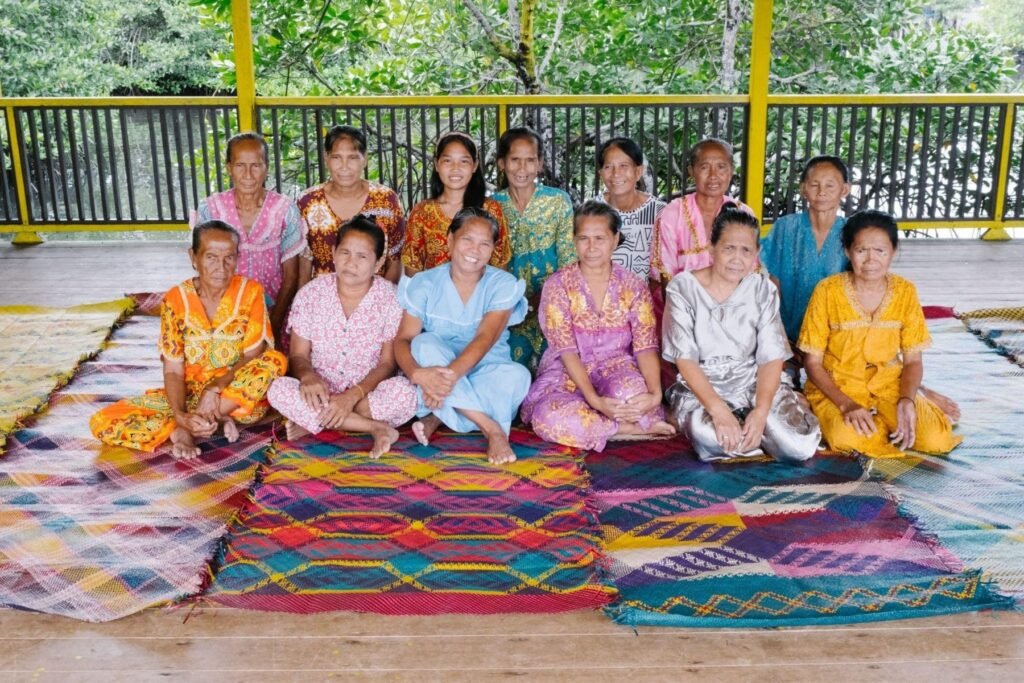
Sama-Bajau weavers sitting on their traditional tepo creations (Photo by Jay Bautista)
MALUSO, Basilan (March 2) — Along the coastal stretch of Sitio Teheman, where the Sama-Bajau have lived for generations, a new structure now rises on stilts — not just as a building, but as a promise.
The Sama-Bajau Weaving and Cultural Center has officially opened, bringing together heritage preservation, women’s livelihood, and community education under one roof. The project is spearheaded by the Claret Samal Foundation Inc. (CSFI) in partnership with the Yellow Boat of Hope Foundation (YBH).
For the Sama-Bajau community of Maluso, the center represents more than infrastructure. It is a space designed to protect identity while creating sustainable income.
A working hub for women weavers
The center provides local artisans — mostly women — with a dedicated venue to weave, display, and sell their pandan-crafted “tepo” products, including mats, hats, pouches, and bags. These items, long woven in homes and informal spaces, now have a formal platform that can connect them to broader markets.
Beyond retail, the facility functions as a training and cultural space. Workshops, product development sessions, and storytelling activities aim to ensure that younger generations learn traditional weaving patterns and the stories embedded in them.
By professionalizing the craft while preserving its authenticity, organizers hope to transform weaving from a subsistence activity into a stable source of livelihood.
A partnership decades in the making
CSFI has worked in Sitio Teheman for over 30 years, supporting programs in health, education, environmental protection, and community development. Its long-term engagement laid the groundwork for the weaving center.
YBH began its work with the Sama-Bajau community in 2013 through its Yellow School of Hope floating school, which delivers education to children in remote coastal areas of Basilan. Over time, the collaboration expanded from access to schooling to broader community empowerment.
Dr. Anton Lim, co-founder and president of YBH, described the center as both cultural anchor and economic lifeline.
“The Sama-Bajau Weaving and Cultural Center is a symbol of hope and empowerment for the Sama-Bajau community of Maluso, Basilan. It serves as a place to preserve their rich weaving heritage, strengthen livelihoods, celebrate their culture and traditions, and remind current generations of their proud identity while inspiring future generations to learn,” Lim said.
Architecture rooted in identity
The building itself mirrors Sama-Bajau heritage. Designed by Architect Peach Buencamino, it echoes the stilted structure of traditional coastal homes, while its façade reflects the interlaced patterns of woven pandan strips.
A mural by artist AG Saño adorns the exterior, portraying themes of resilience and collective dreams. Inside, an inaugural exhibition curated by Janine Cabato highlights eleven indigenous weaving patterns — visual narratives tied to environment, kinship, and shared memory.
Weaving culture into the local economy
The center was conceived in response to persistent challenges faced by families in Sitio Teheman — limited livelihood options, unstable income, and the absence of proper facilities for traditional crafts.
By integrating cultural pride with structured economic opportunity, the project demonstrates a model of development that does not erase identity but builds upon it.
As community members gathered to mark the opening, the new weaving center stood as a tangible symbol of what sustained partnerships can achieve: a future where tradition is not left behind, but woven directly into progress.