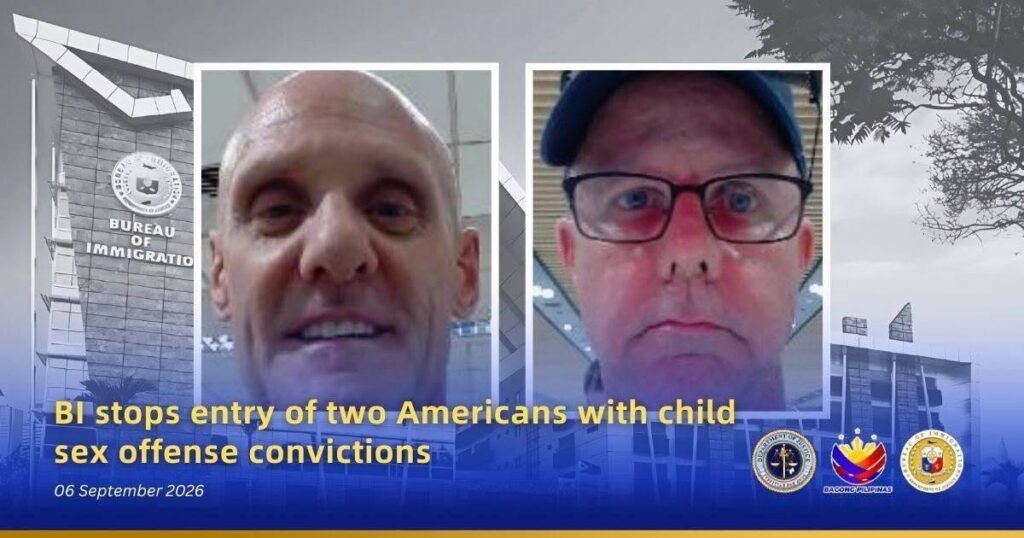
Photo: Bureau of Immigration, Republic of the Philippines
MANILA (September 7) — The Bureau of Immigration (BI) has barred two American nationals convicted in the United States of offenses involving children from entering the Philippines, in a move aimed at preventing individuals with documented histories of child sexual abuse from gaining access to the country.
The latest case occurred on Aug. 20 at Ninoy Aquino International Airport Terminal 3, where immigration officers excluded Daniel Anthony Welch, 53, who arrived aboard a United Airlines flight from San Francisco.
BI records showed Welch was convicted in the United States in 2006 of sexual assault and a pattern of abuse involving a child. The victim was identified as 14 years old.
Welch was excluded under provisions of Philippine immigration law covering foreign nationals whose presence is considered prejudicial to the public interest.
The case followed the exclusion of another American national, Christopher Jon Plowman, 57, at Mactan-Cebu International Airport on Aug. 16.
Plowman arrived aboard an EVA Air flight from Taipei and was excluded after BI officers verified a criminal record involving a child, for which he was convicted in the United States in 2005.
Child protection at the border
The two cases highlight the role of immigration screening as an early safeguard against individuals with known criminal histories involving children.
“This demonstrates our commitment to keeping children and vulnerable persons safe. The Philippines will not be a refuge for foreign nationals with criminal records involving the sexual abuse of children,” BI Commissioner Joel Anthony Viado said.
Viado said BI frontline and enforcement units remain vigilant in screening foreign nationals and prioritizing the exclusion of individuals who may pose a threat to the public.
From a child-rights perspective, preventing known offenders from entering the country is part of the State’s responsibility to protect children from sexual abuse, exploitation and other forms of violence.
Such preventive action is particularly important because child protection cannot depend solely on responding after abuse has occurred. Screening and information-sharing mechanisms can help identify risks before they reach communities where children may be exposed.
Protection requires more than screening
The exclusions also underscore the importance of sustained coordination among immigration authorities, law enforcement agencies, social welfare institutions and child-protection organizations.
Immigration screening can prevent a person with a documented criminal history from entering the country, but broader child safeguarding requires mechanisms for reporting abuse, protecting victims and survivors, investigating complaints and ensuring that children have access to appropriate support and justice.
The BI’s actions also send a broader message that a conviction for sexual offenses against children can carry consequences beyond the country where the offense occurred.
For children and families, the objective is ultimately straightforward: to ensure that communities, institutions and borders do not become pathways through which known risks to children can enter.
The two exclusions demonstrate how immigration controls can serve not only as a border-management function but also as one component of a wider system for protecting children from abuse and exploitation.