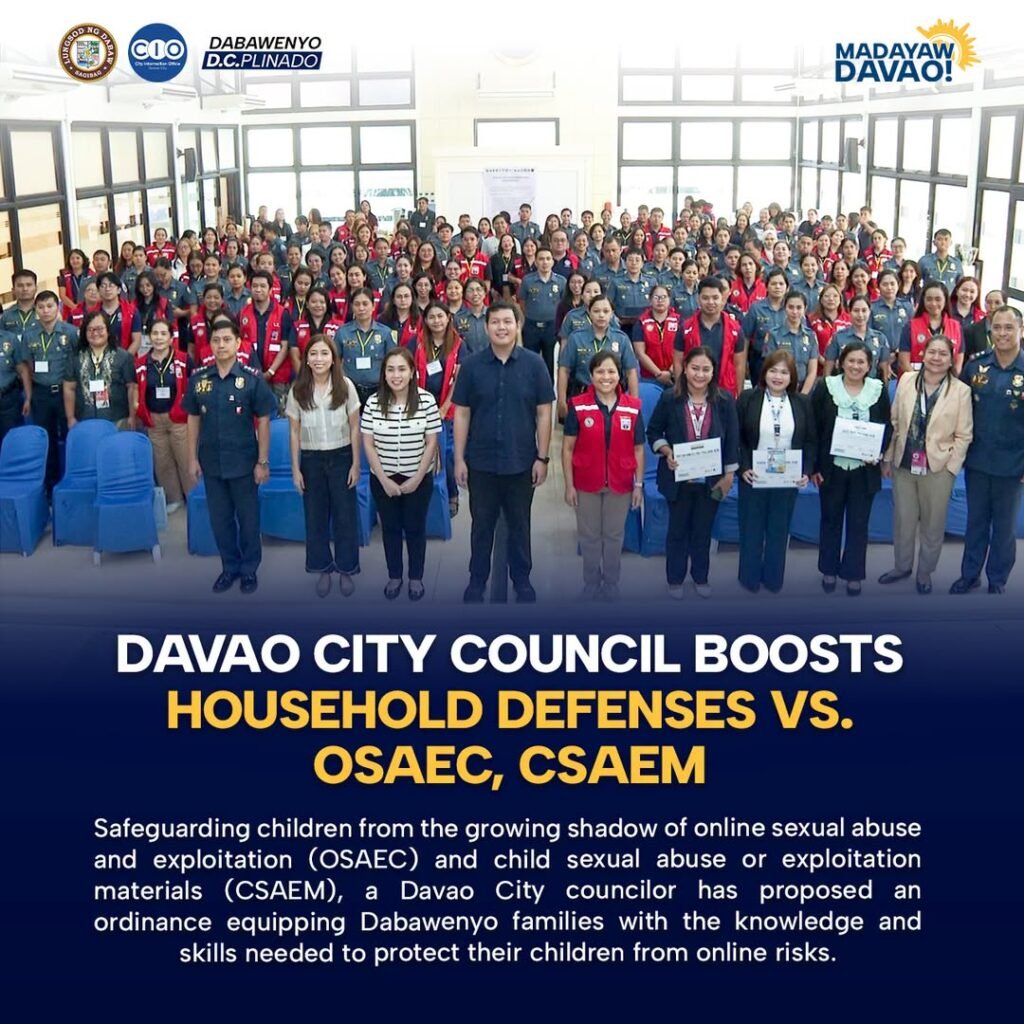
DAVAO CITY (September 4) — A proposed Davao City ordinance is putting parents at the center of the fight against online sexual abuse and exploitation of children (Osaec), but the growing number of reported cases and the low rate of disclosure point to a deeper problem: many children may be suffering in silence while families and authorities struggle to detect abuse happening behind screens.
Councilor Richlyn N. Justol-Baguilod, chairperson of the City Council’s Committee on Women, Children, and Family Relations, has proposed an ordinance institutionalizing the Parent Effectiveness Service (PES) Program in Davao City under Republic Act No. 11908.
The measure seeks to equip parents and caregivers with knowledge and skills to identify online risks, protect children from exploitation, and respond appropriately when abuse occurs.
The proposal comes as data show that Osaec remains significantly underreported.
A 2022 study cited by UNICEF found that two in 10, or around two million, internet-using Filipino children aged 12 to 17 experienced Osaec in the previous year. More troublingly, fewer than 3 percent of affected children reported the abuse to authorities.
That reporting gap means official case counts can represent only a fraction of the actual problem.
In Davao Region, the Department of Social Welfare and Development recorded around seven Osaec cases involving 11 victims in 2025, compared with four cases in 2024 and two in 2023. The cases were reported in several municipalities, including Maco, Cateel, Mawab, Lupon and Carmen. The Department of Justice, meanwhile, confirmed six documented Osaec cases, most of them filed in Davao City.
The figures raise an uncomfortable question for local authorities: are reported cases increasing because exploitation itself is increasing, because detection is improving, or simply because more victims are finding ways to come forward?
Whatever the explanation, the numbers do not capture children who remain unidentified or cases that never reach authorities.
“The internet has transformed the way our children experience the world but the same technology that gives our children opportunities can also expose them to individuals who seek to put them at risk,” Baguilod said in her privilege speech on September 1.
The challenge is particularly difficult because online exploitation can occur inside the home, often through devices parents may not fully understand or monitor.
And while parental supervision is important, child-protection advocates have repeatedly warned that families cannot be expected to carry the burden alone. Osaec can involve grooming, coercion, manipulation, trafficking, financial exploitation and the production or distribution of child sexual abuse materials, requiring specialized investigation and coordinated social, legal and psychological interventions.
The Davao City Social Welfare and Development Office, in partnership with the International Justice Mission, recently sought to strengthen that institutional response through a Multi-Disciplinary Team-Basic Internet Crimes Against Children (MDT-BICAC) training held from August 24 to 28.
The training was intended to improve the capacity of local protection officers to respond to Osaec and child sexual abuse or exploitation materials (CSAEM) cases.
But training personnel after cases are detected addresses only part of the problem.
The harder task is identifying abuse before it escalates — and creating an environment where children feel safe enough to disclose what is happening.
“It takes a village to raise a child. And that village begins at home. The family remains the basic unit of society. It forms the foundational social structure where children first learn values, behavior, and social norms,” Baguilod said.
The proposed PES ordinance would build on City Ordinance No. 0194-26, Series of 2026, which prohibits Osaec and CSAEM and institutionalizes programs for prevention and victim support.
But for the new measure to have an impact beyond another policy on paper, its implementation will be critical.
The city will need to determine how many parents can actually be reached, how often training will be conducted, whether barangays have adequately trained personnel, how disclosures will be handled, and whether families can quickly access social workers, law enforcement, health services and legal assistance.
It must also confront the socioeconomic conditions that can make children more vulnerable to exploitation. DSWD-Davao has previously identified poverty and limited awareness as among the factors complicating the fight against Osaec in the region.
For the city, therefore, the issue is no longer simply whether parents know what their children are doing online.
It is whether Davao’s entire child-protection system can keep pace with an abuse that can occur in seconds, cross borders instantly and leave victims carrying the consequences long after the screen goes dark.
The proposed ordinance is a step toward strengthening the first line of protection — the family. But its success will ultimately depend on whether that first line is backed by a system capable of detecting abuse, protecting children, holding perpetrators accountable and supporting survivors.