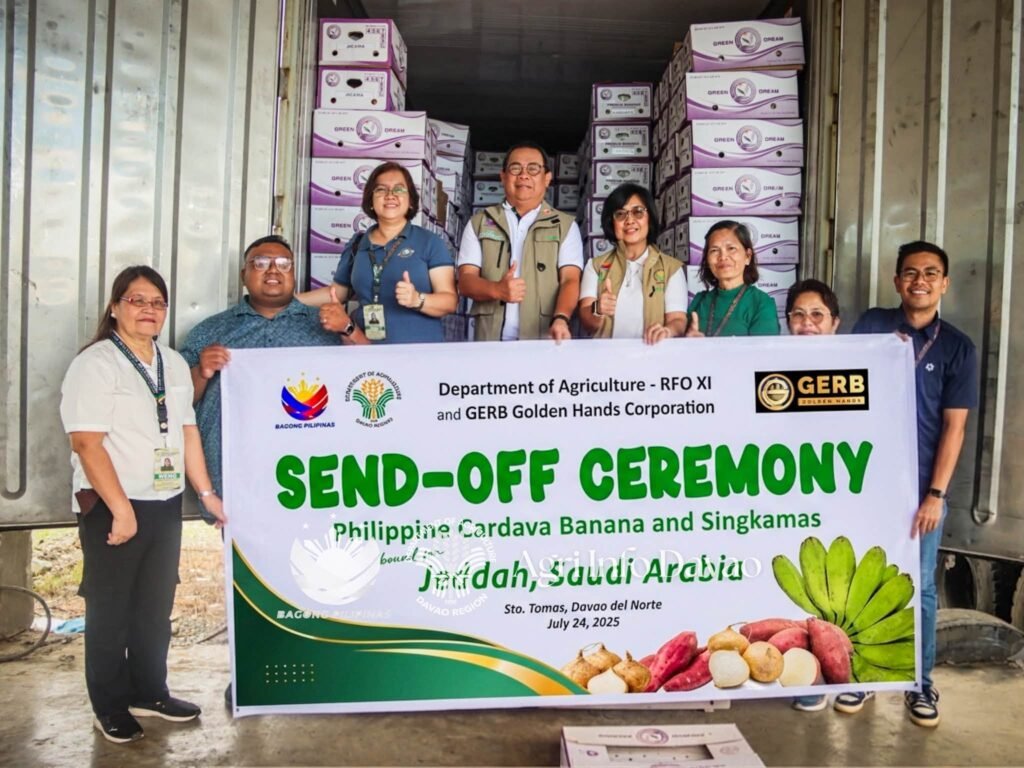
DAVAO CITY (August 10) — A SHIPMENT of 17.2 metric tons of Davao-grown agricultural products to Saudi Arabia is being touted as a breakthrough for Philippine farm exports. But for farmers, the bigger question is whether entering new overseas markets will translate into better and more stable incomes at the farm gate.
The Department of Agriculture said 17.2 MT of Cardava bananas, sweet potatoes and singkamas from Davao were shipped to Jeddah, Saudi Arabia, in a shipment valued at ₱800,000.
The shipment consisted of 1,350 boxes of bananas weighing 12 kilograms each, along with 50 boxes each of sweet potatoes and singkamas weighing 10 kilograms per box.
The products were exported by Gerb Golden Hands Corp. of Sto. Tomas, Davao del Norte, to Rana Mohammed Saleem Commercial LLC in Jeddah.
For the government, the shipment represents another step toward expanding Philippine agricultural exports and reducing the country’s more than $11-billion annual farm trade deficit.
Agriculture Secretary Francisco Tiu Laurel Jr. said wider access to foreign markets could attract investments in modern farming and logistics, create rural jobs and strengthen the competitiveness of Philippine agriculture.
But export growth alone does not automatically mean higher earnings for farmers.
From farm gate to foreign market
The ₱800,000 value of the shipment highlights the potential value of Davao agriculture in international markets. The challenge is ensuring that the value generated along the export chain reaches the farmers who produce the crops.
Farmers often face rising costs for fertilizer, fuel, labor, transport and post-harvest handling. They also remain vulnerable to weather disruptions, crop losses and fluctuating farm-gate prices.
Without stronger links between farmers and exporters, the gains from overseas markets could remain concentrated among traders, consolidators and other parts of the supply chain.
Tiu Laurel said opening new markets would give farmers opportunities to earn more rather than allowing the value of agricultural products to benefit producers in other countries.
That promise, however, will ultimately have to be measured at the farm level: How much more are farmers actually earning because their products are being exported?
A market built one shipment at a time
The Davao shipment is nevertheless an important test of whether smaller Philippine agricultural producers can penetrate markets traditionally dominated by large exporters.
The products were promoted during the 2024 AGRA Middle East Exhibition at the Dubai World Trade Centre, where the DA’s Agricultural Regional Field Office XI and Gerb Golden Hands showcased Davao products.
Business discussions during the exhibition eventually helped open a market in Saudi Arabia.
Davao Region DA executive director Macario Gonzaga said the shipment demonstrates how sustained export promotion can create opportunities for farmers and agribusinesses.
He also emphasized the value of participating in international trade exhibitions to connect local producers with potential buyers.
For Davao, the opportunity is significant. The region already has an established reputation for agricultural production, but gaining a foothold in foreign markets requires consistent supply, quality control, competitive pricing, efficient logistics and reliable delivery.
The bigger challenge: making exports inclusive
The Saudi shipment may be only 17.2 MT, but its significance goes beyond the volume.
It demonstrates that Davao-grown products can find buyers thousands of kilometers away.
The bigger challenge is scaling that success without leaving small farmers behind.
If export programs are to become a long-term strategy for agriculture, farmers need more than access to foreign buyers. They need financing, technology, post-harvest facilities, cold-chain and transport systems, quality certification and stronger bargaining power.
Otherwise, the country could succeed in exporting more while the farmers who grow the products continue to struggle with low and unstable incomes.
For Davao farmers, therefore, the real measure of export success should not simply be how many boxes reach Saudi Arabia.
It should be how much of the value comes back to the farm.