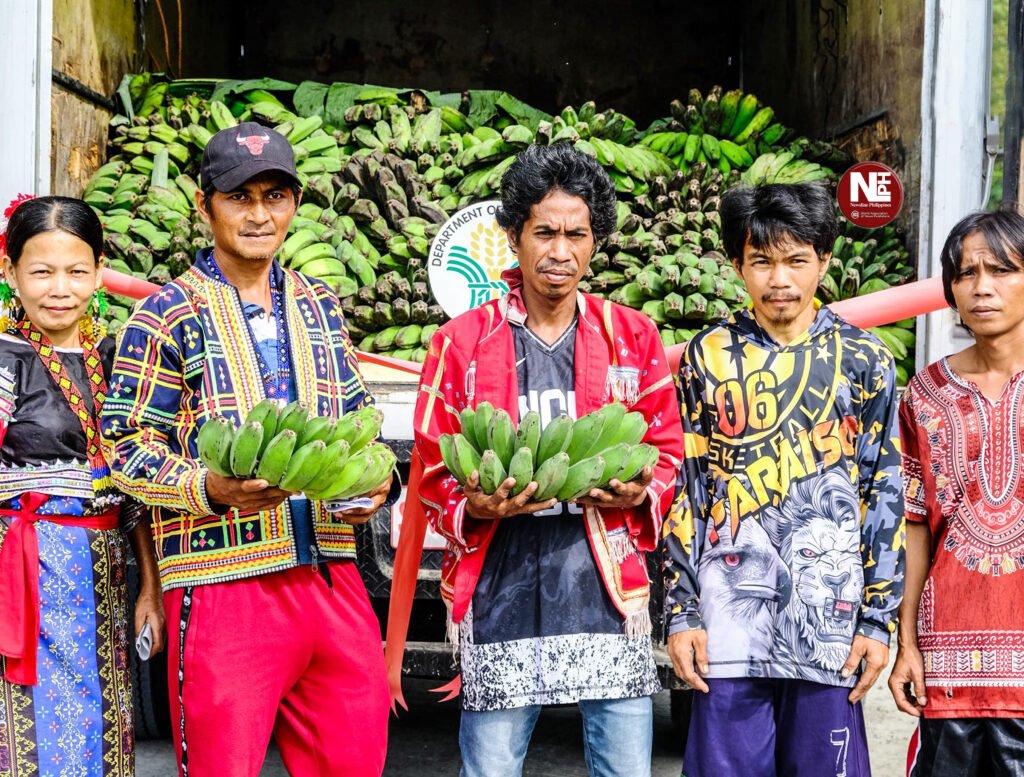
DAVAO CITY (September 22) – Communities of Indigenous Peoples (IP) who grow Cardava bananas have created a link to the world market according to the Department of Agriculture (DA).
In August, See’s International Food Manufacturing Corporation purchased 1,593 kg of Cardava bananas from the Ata Paquibato Tribal Association (APATA), according to the DA-Davao Region (DA-11).
Through the use of its Kadiwa trucks, the DA supplied transportation services, allowing APATA to convey its first shipment straight to See’s factory in Bunawan, Davao City. See’s has been in business for 30 years, exporting high-quality Philippine banana chips all over the world. It pledged to buying APATA’s Cardava bananas every 15 days.
For both parties’ protection, the DA will help establish a formal contract.
Oliver Manlangan, chairperson of APATA, appreciated the organization’s public and corporate partners for their support and trust. “We thank the DA for providing us with this market linkage. “This will greatly benefit our livelihood,” Manlangan said in a statement.
The endeavor was facilitated by DA-11’s Kabuhayan at Kaunlaran ng Kababayang Katutubo program, in collaboration with the Agribusiness and Marketing Assistance Divisions.
Ruben See, the company’s president, reaffirmed the company’s commitment to supporting APATA production. “This is a dream come true,” See stated in an earlier press release.
See held a briefing for APATA members on the correct classification of Cardava bananas in order to guarantee quality requirements. According to the Department of Trade and Industry, the Cardava banana grows best in consistently warm and humid weather and can survive in a variety of soil types, with the exception of extremely sandy or rocky terrain.
With an emphasis on boosting rural incomes by creating value chains for important agribusinesses, the DTI RAPID (Rural Agro-Enterprise Partnership for Inclusive Development and Growth) project, which is funded by the International Fund for Agricultural Development, also lists the variety as one of its priority commodities.
According to the DTI, the Cardava type is frequently processed into banana chips because of its larger size. “Our efforts will not be wasted. We are committed to finding ways to connect our farmers to markets,” DA-11 Director Macario Gonzaga stated in a press release.