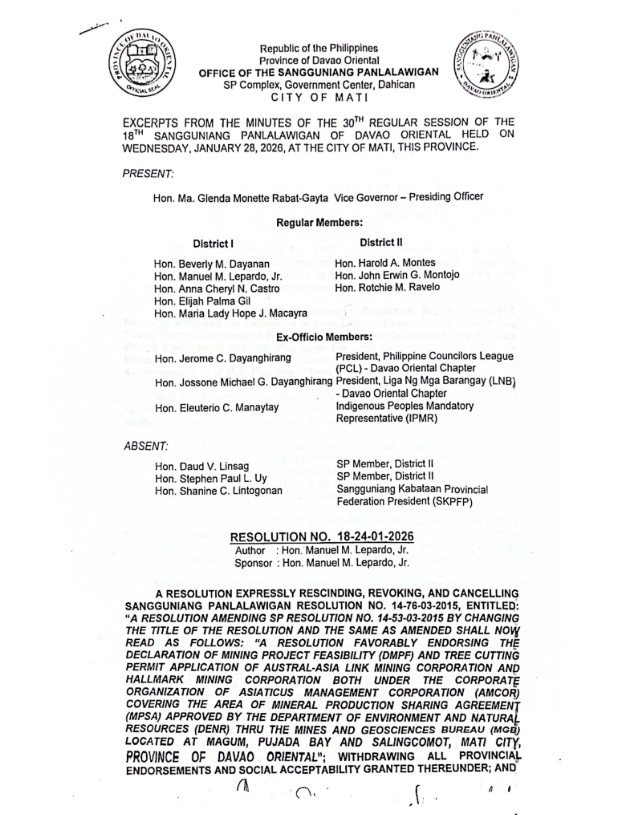
MATI, DAVAO ORIENTAL (February 7) — In a rare show of unity, the Sangguniang Panlalawigan of Davao Oriental has unanimously withdrawn its endorsement of mining projects linked to Austral-Asia Link Mining Corporation and Hallmark Mining Corporation, both operating under Asiaticus Management Corporation (AMCOR).
The decision, formalized through Resolution No. 18-24-01-2026, sends a clear message: environmental protection and community welfare will take precedence over profit-driven extractive ventures in the province.
Why the Province Drew the Line
Provincial lawmakers cited several unresolved issues that pushed them to reverse earlier support for the mining operations.
Among these were a severe backlog in mandatory tree replacement, concerns that mining activities were blocking a key provincial road project, and actions by the companies that local officials described as inconsistent with regulatory cooperation.
For residents living near the mining sites, these issues are not abstract policy debates—they affect daily life.
“When roads are blocked and forests are not restored, communities pay the price,” one provincial official noted during deliberations. “Development cannot come at the cost of safety and sustainability.”
Protected Areas at Risk
Environmental concerns intensified due to the mining sites’ proximity to two of the province’s most ecologically sensitive areas: the Mt. Hamiguitan Range Wildlife Sanctuary and Pujada Bay.
Mt. Hamiguitan is a UNESCO World Heritage Site, recognized globally for its rich biodiversity and endemic species. Pujada Bay, meanwhile, is a vital marine ecosystem that supports fisheries, tourism, and coastal livelihoods.
Both areas are protected under the Expanded National Integrated Protected Areas System (NIPAS) Act, which places strict limits on activities that could threaten ecological integrity.
“The risks are simply too high,” a board member said. “Once these ecosystems are damaged, there is no bringing them back.”
A Shift in Development Priorities
By withdrawing its endorsement, the provincial government signaled a broader shift in how development is being defined in Davao Oriental.
Local leaders emphasized that economic growth must align with environmental stewardship and long-term community welfare—not undermine them.
For farmers, fisherfolk, and indigenous communities who depend on healthy forests and seas, the resolution was seen as a protective step.
“This decision tells us the province is listening,” said a community leader from a coastal barangay near Pujada Bay. “Our livelihoods depend on these ecosystems.”
What Happens Next
While the resolution does not automatically halt mining operations, it removes crucial local government support—often a key requirement for project continuity, expansion, or renewal of permits.
Provincial officials said they expect stricter scrutiny of mining activities moving forward, especially those near protected areas.
For now, residents and environmental advocates view the move as a strong stand—one that reflects growing public demand for accountability, transparency, and sustainable development.
As one lawmaker put it, “Progress should leave communities stronger, not stripped of the very resources they rely on.”