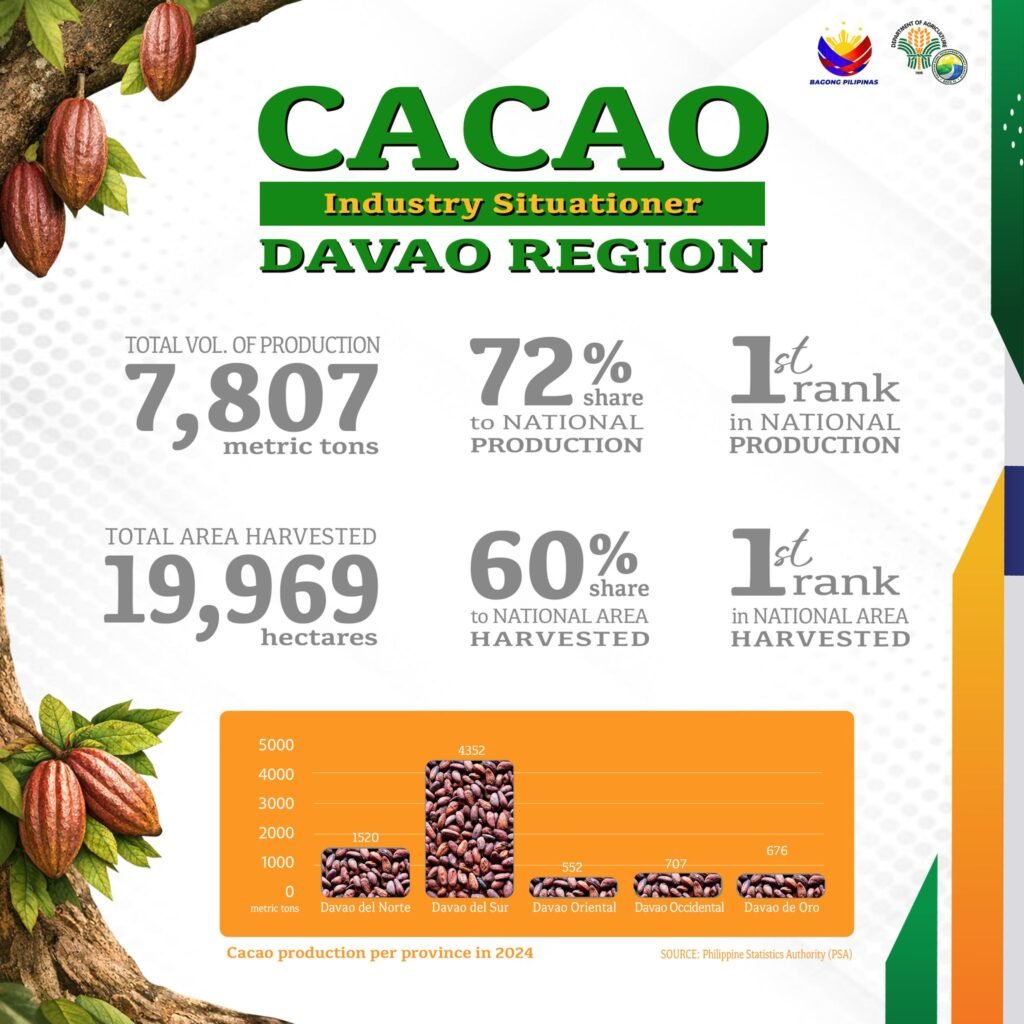
DAVAO CITY (April 23) — Region 11 continues to dominate the country’s cacao industry, producing 7,807 metric tons (MT) and accounting for 72 percent of national output, according to the Department of Agriculture-11 (DA-11).
Beyond production volume, the region also leads in scale, with 19,969 hectares of cacao farms—about 60 percent of the national total—anchoring Davao’s long-standing identity as the country’s cacao capital.
The figures, drawn from the Philippine Statistics Authority, show sustained dominance: Davao Region contributed 80 percent of national cacao output in both 2022 and 2023.
Among provinces, Davao del Sur remained the top producer with 4,352 MT, followed by Davao del Norte (1,520 MT), Davao Occidental (707 MT), Davao de Oro (676 MT), and Davao Oriental (552 MT).
“This is a testament to the hard work of our farmers and the strength of our cacao sector,” DA-11 said.
But behind the strong numbers, agriculture planners warn of persistent structural gaps that threaten long-term growth.
Farmers continue to struggle with limited access to quality planting materials, low bean supply, labor shortages, weak farm management systems, and inadequate postharvest facilities—challenges that directly affect productivity and income at the community level.
These constraints are especially felt in rural farming communities, where cacao production is often a primary livelihood but remains vulnerable to price fluctuations and infrastructure gaps.
To sustain its leadership, the region is pushing a long-term development roadmap under the Philippine Rural Development Project. The plan aims to maintain Davao’s cacao capital status through 2030 while shifting 80 percent of production toward traceable, high-quality fermentation systems for premium local and export markets.
Priority interventions include establishing a regional cacao development hub, a farmers’ knowledge center, and a trading center. Support programs also cover community cacao nurseries, farmer field schools, farm rehabilitation and cluster expansion, and community-managed fermentation and drying facilities.
Industry stakeholders say the challenge now is ensuring that growth translates into stronger livelihoods—turning cacao’s global demand into real, sustained gains for smallholder farmers who remain at the center of the sector’s success.