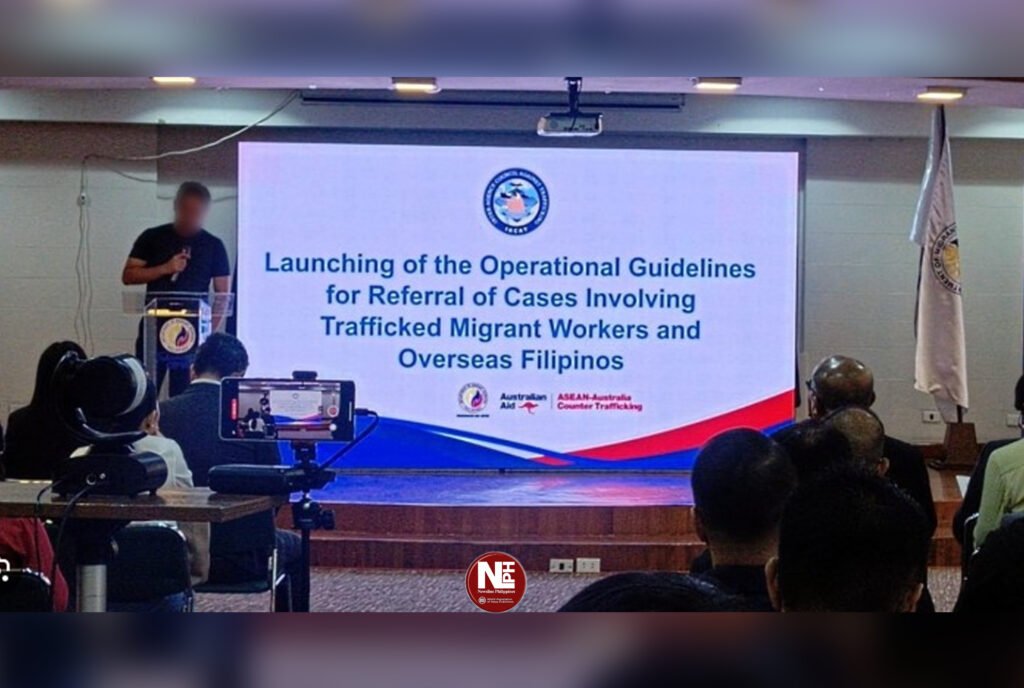
MANILA (December 20) — For overseas Filipino workers (OFWs) rescued from human trafficking, help often comes late — delayed by paperwork, agency handoffs, and repeated interviews that reopen trauma.
A new referral system rolled out this week aims to change that.
The Department of Migrant Workers (DMW) and the Inter-Agency Council Against Trafficking (IACAT) have launched unified operational guidelines designed to fast-track reporting, protection, and assistance for trafficked OFWs and their families — from the moment a case is flagged abroad to reintegration back home.
Announced Thursday in Mandaluyong City during the observance of International Migrants Day, the new system creates a single, coordinated pathway for survivors, cutting through layers of bureaucracy that have long slowed government response.
“This is about making sure no victim is left navigating the system alone,” Migrant Workers Secretary Hans Leo Cacdac said.
“When referral leads to action, that is when it truly impacts our citizens and our victims.”
One pathway, faster response
Under the new framework, government agencies, service providers, and partner organizations will operate using harmonized procedures — clearly defining who does what, and when, at every stage of a trafficking case.
Cacdac said the guidelines strengthen the country’s national referral mechanism by embedding a rights-based and gender-responsive approach, ensuring survivors receive timely, appropriate, and compassionate assistance — whether they are potential victims, presumed victims, or formally identified survivors.
The initiative also fulfills the directive of Ferdinand R. Marcos Jr. to ensure government agencies are visible and responsive wherever OFWs need help.
As chair of the Inter-Agency Committee on Migrant Workers and Overseas Filipinos, Cacdac said the DMW — with the Department of Foreign Affairs as co-chair — led the development of the framework to improve coordination from overseas rescue to local reintegration.
Less paperwork, less trauma
For DOJ–IACAT Executive Director Hannah Lizette Manalili, one of the most important changes is the adoption of a unified intake information sheet.
“This reduces repeated interviews and paperwork that often retraumatize survivors,” Manalili said.
Information gathered at the first point of contact will now be shared across agencies handling assistance and case-building — sparing victims from retelling painful experiences each time they move from one office to another.
Reports coursed through IACAT will also be immediately coordinated with Philippine foreign service posts and Migrant Workers Offices abroad, ensuring continuity of support when survivors are repatriated.
‘Door-to-door’ protection
Labor Attaché and Migrant Workers Protection Bureau officer-in-charge Geraldine Mendez described the system as “door to door” service delivery.
“From the foreign post, to the airport, to the central office, and all the way to the survivor’s province and local government — the services are now coordinated,” she said.
This end-to-end approach is meant to prevent survivors from falling into gaps once they return home, a problem advocates say has left many victims vulnerable to re-trafficking.
A survivor’s reminder
“Kurt,” not his real name, a trafficking survivor who spoke during the launch, underscored why clear referral mechanisms matter.
“When victims know where to go and know someone will catch them, it becomes possible to survive and recover,” he said.
He reminded officials and the public that survivors are more than statistics. “Hindi kami simpleng kaso lamang. Tao po kami — mga taong nasaktan, natakot, pero patuloy na lumalaban.”
Nationwide rollout next
The guidelines have initially been rolled out to frontline airport and law enforcement personnel in Metro Manila. Nationwide implementation will follow next year, covering major gateways such as Clark, Cebu, and Davao.
A separate set of operational guidelines for trafficking cases in seaports is also being developed, starting in Zamboanga.
For communities with migrant workers abroad, officials say the message is clear: reporting channels are now simpler, response is faster, and help is meant to reach victims — not halfway, but all the way home.