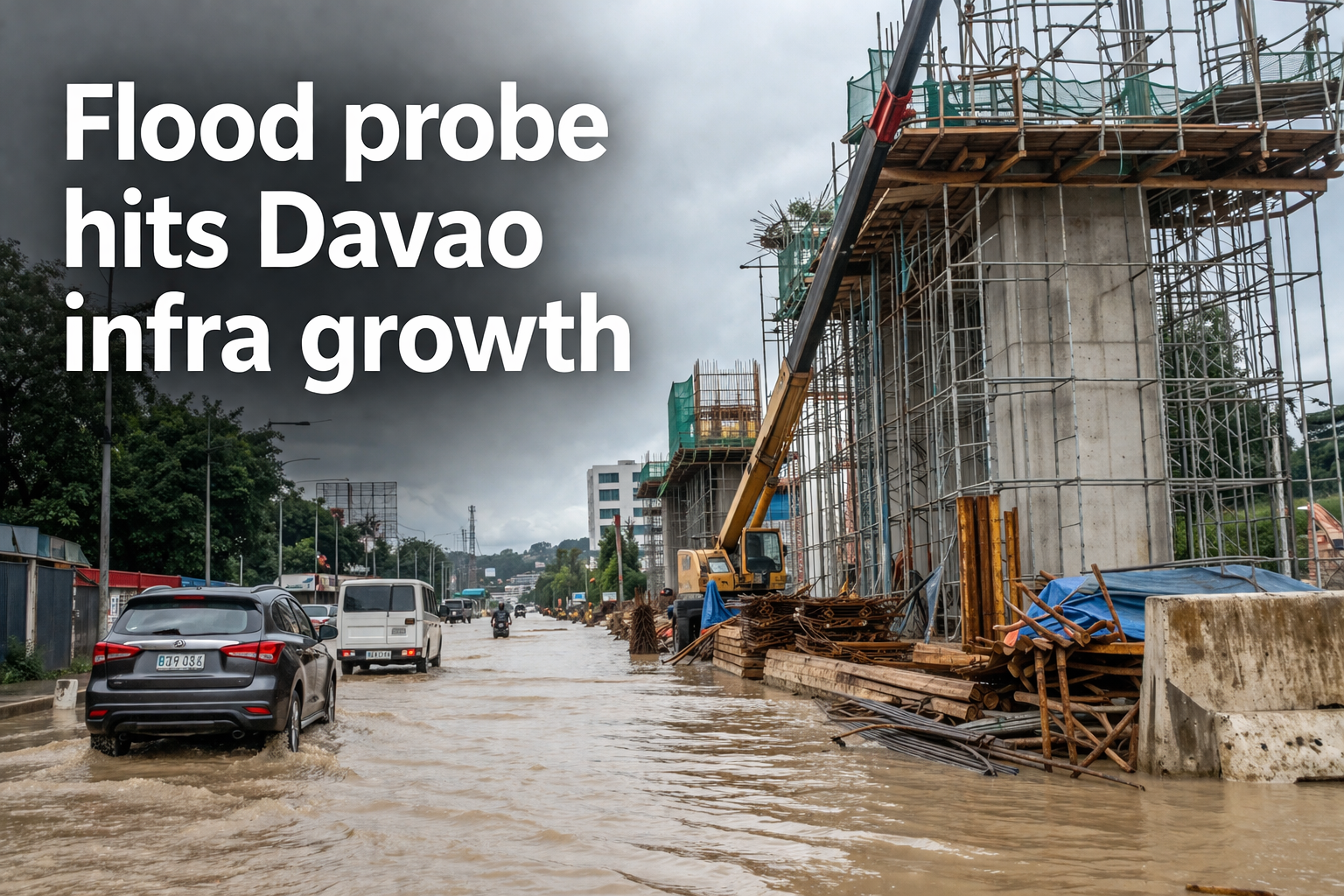
DAVAO CITY (April 27) — In Barangay Mintal, the slowdown in government projects is felt not in statistics—but in empty workdays.
For 38-year-old mason “Romy,” work has become unpredictable since a 2025 probe into flood control projects stalled several government-funded constructions across the Davao Region.
“Dati halos tuloy-tuloy ang trabaho, lalo na kapag may government projects,” he said. “Ngayon, pa-isa-isa na lang. Minsan matagal ang pagitan.”
The probe, which led to reviews and temporary suspensions of infrastructure projects, has slowed what used to be one of the region’s strongest-performing sectors.
Data from the Philippine Statistics Authority (PSA) XI show that while total construction value still rose—from P124 billion in 2024 to P127 billion in 2025—the growth rate sharply dropped from 15.5 percent to just 2.7 percent.
For workers like Romy, that drop translates to fewer days on site—and less income to bring home.
“Kapag walang project, tambay talaga. Mahirap kasi arawan kami,” he added.
Small suppliers are also feeling the pinch. In Barangay Matina, a local hardware store owner said orders for cement and steel have slowed compared to previous years.
“Dati may bulk orders para sa government projects,” said “Liza,” who has been running the shop for over a decade. “Ngayon, mas maliliit na lang, kadalasan pang-house construction.”
Officials say the slowdown is tied to halted government spending, which makes up about 30 percent of the construction sector.
“May suspension ng construction from the government side. That’s why our construction industry slowed down severely,” said Department of Economy, Planning and Development (DEPDev) XI Regional Director Priscilla Sonido.
Private construction has helped keep the sector afloat—but not enough to fully offset the gap.
“In total, tumaas tayo, pero sa government construction bumaba,” said PSA XI Officer-in-Charge Regional Director Baby Jean Alid. “Lumalaban ang private at household, pero ramdam ang epekto ng government slowdown.”
For communities, the impact goes beyond unfinished structures. It means delayed livelihoods, tighter household budgets, and uncertainty about when steady work will return.
As 2026 approaches, officials are pushing for stronger safeguards and more transparent project implementation to restore trust—and restart the flow of projects that many depend on.
But on the ground, workers like Romy are simply waiting.
“Sana bumalik na ulit sa dati,” he said. “Para tuloy-tuloy na ulit ang trabaho.”