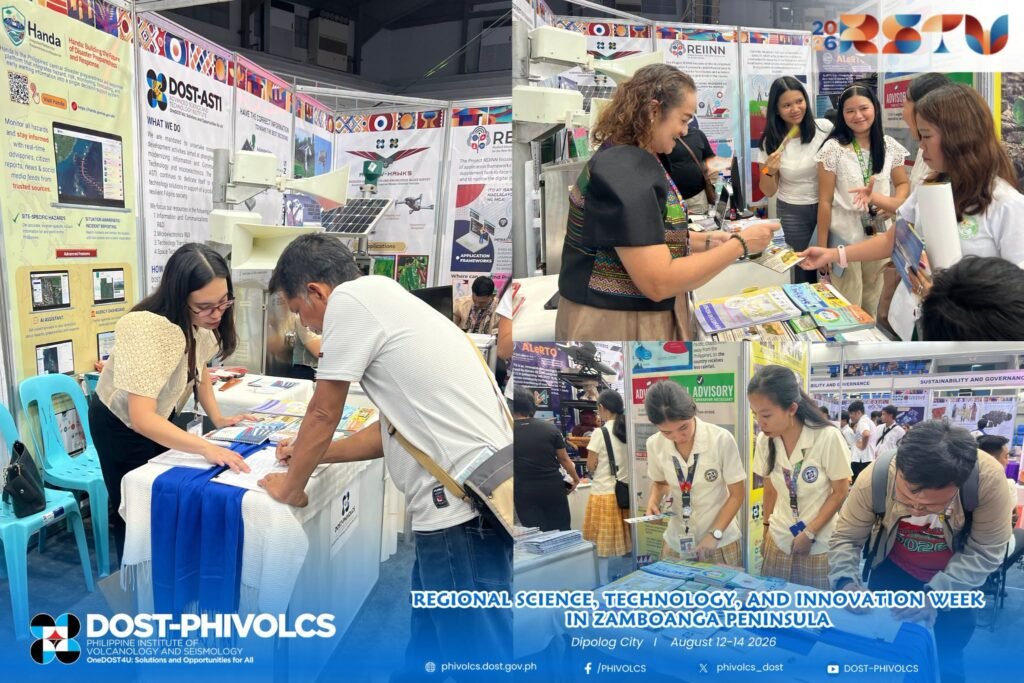
Photo: Philippine Institute of Volcanology and Seismology (PHIVOLCS-DOST)
DIPOLOG CITY(August 14) — For more than 400 students in Zamboanga del Norte, the universe suddenly felt a little closer.
Inside a darkened dome at the Zamboanga del Norte Convention Center, students looked beyond textbooks and classroom diagrams as the Philippine Atmospheric, Geophysical and Astronomical Services Administration (PAGASA) brought the wonders of the cosmos to life through its mobile planetarium on Thursday.
The immersive exhibit was among the attractions of the second day of the Regional Science and Technology Week (RSTW) 2026 for Region 9, drawing students from Zamboanga del Norte National High School–Main Campus, Philippine Science High School–Zamboanga Peninsula Regional Campus, Metro Dipolog Baptist Academy, Dipolog Central School and other schools in the province.
For some students, it was their first encounter with a planetarium—and an experience they described as unforgettable.
“It was actually very wonderful and an eye-opener to learn about stars, galaxies and horoscopes,” a Metro Dipolog Baptist Academy student shared.
Another student described the experience as “mind-blowing,” particularly because it offered a chance to better understand the planets, the solar system and the Milky Way.
“It was my first time to get to know our planets, solar system and the Milky Way better,” the student said, expressing gratitude for the opportunity to experience the planetarium with schoolmates.
Bringing the universe closer
The mobile planetarium is one of PAGASA’s featured exhibits for the ZAMPEN RSTW 2026, which runs from Aug. 12 to 14.
More than simply displaying astronomical images, the planetarium provides students with an immersive learning experience—turning lessons about celestial bodies and the vastness of space into something they can see and experience.
For young learners who may never have visited a permanent planetarium, the mobile facility brings astronomy directly to the communities.
And Mindanao does have a permanent facility.
PAGASA said a 100-capacity, fixed dome-shaped and fully air-conditioned planetarium is located in Barangay Molugan, El Salvador City, Misamis Oriental.
The facility also conducts stargazing and telescope observation activities, giving students and astronomy enthusiasts opportunities to observe the night sky beyond simulated projections.
More than a science exhibit
The excitement inside the mobile planetarium points to a larger challenge—and opportunity—for science education in the region: making science tangible for young people.
For students accustomed to learning about the solar system through books, illustrations and screens, sitting beneath a simulated night sky can transform abstract concepts into an experience they can remember.
The RSTW exhibit also puts astronomy within reach of students who may otherwise have limited opportunities to visit specialized science facilities.
For a few minutes inside the dome, the classroom disappeared.
There were no chalkboards, worksheets or examinations—only stars, galaxies, planets and a universe waiting to be explored.
And for more than 400 Zamboanga students, that may be the kind of science lesson they will remember long after the regional science week ends.