MARAWI CITY (January 29) — “I want to go back to school.” For many children here, those simple words carry the weight of years spent amid conflict and displacement — the lingering legacy of the 2017 Marawi siege and persistent unrest across the Bangsamoro Autonomous Region in Muslim Mindanao (BARMM).
While intense fighting in Marawi displaced more than 300,000 residents in 2017, thousands of families have yet to fully rebuild their lives. As of mid-2025, humanitarian agencies estimate that over 80,000 people remain protractedly displaced by the siege, living in temporary shelters or with host families as they struggle to find stable housing and livelihoods.
Across BARMM, conflict and clan violence have also contributed to protracted displacement. A regional assessment in 2022 found that tens of thousands of individuals remain displaced long-term, with a significant share linked to armed conflict and communal violence in Lanao del Sur and neighboring provinces.
Against this backdrop, the provincial government of Lanao del Sur is pushing to turn child-welfare policies into practical, life-changing services.
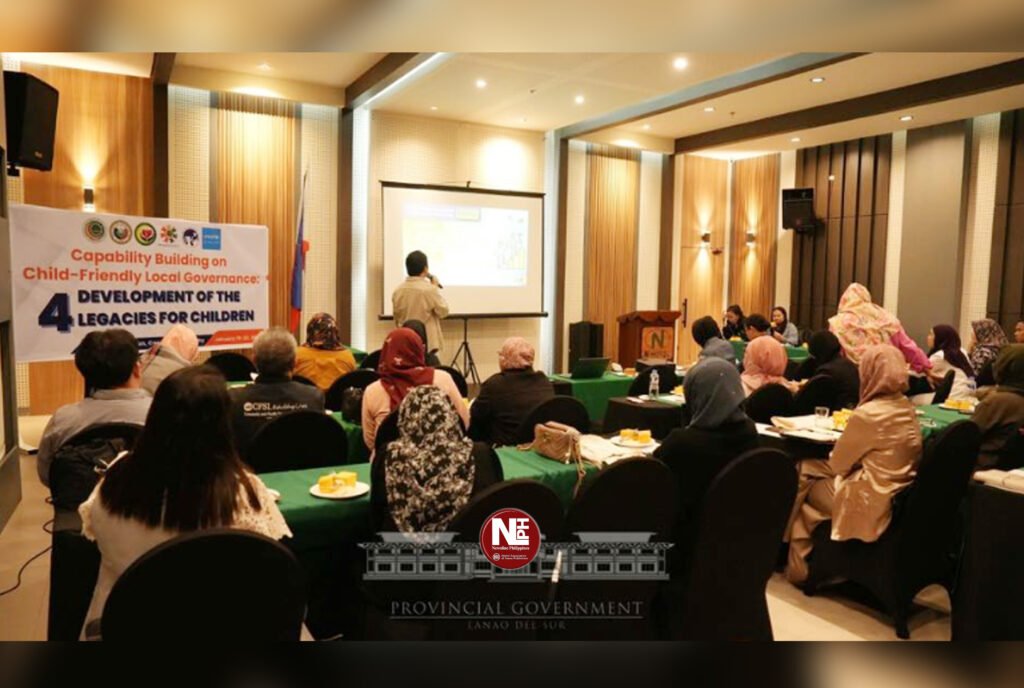
From January 19 to 23, the Provincial Social Welfare and Development Office (PSWDO) led a five-day workshop in Cagayan de Oro City to strengthen the Provincial Council for the Protection of Children (PCPC). The training focused on child-friendly local governance, equipping council members with tools to ensure that policy commitments become accessible programs for children — especially those affected by conflict, displacement, and poverty.
Participants worked on the “four legacies for children” framework — the Local Development Plan, Local Investment Plan, Local Code, and Local State of Children Report — which together guide planning, budgeting, legislation, and monitoring of services for children’s education, health, protection, and empowerment.
The workshop was held in partnership with the Ministry of Interior and Local Government, the Regional Sub-Committee for the Welfare of Children, the Ministry of Social Services and Development, and UNICEF.
In a message delivered by Provincial ICT Officer Mahid Macadato, Governor Mamintal A. Adiong Jr. said governance must do more than acknowledge hardship — it must change everyday realities for children displaced or impacted by conflict.
“Children — particularly those affected by conflict and displacement — deserve governance that goes beyond sympathy,” the governor said. “Our responsibility is to ensure that policies translate into protection, opportunities, and hope in their everyday lives.”
Provincial Board Member Sheila Gul Ganda emphasized that focusing on education, health, protection, and empowerment helps children recover not only from the structural effects of poverty but also from the psychological and social impacts of prolonged instability.
“The four legacies serve as the foundation of our efforts,” Ganda said. “By investing in these areas, we are investing in the next generation’s ability to heal, innovate, and lead.”
Under the Bangsamoro Autonomous Region’s evolving governance framework, local officials and advocates are working to move past historical marginalization — striving to align policy, funding, and services with the lived experiences of conflict-affected families.
Lawyer Nasifah Abolais-Langlang, provincial director of the Bangsamoro Human Rights Commission (BHRC), said the four-legacies framework is essential for responding not only to current vulnerabilities but also to future risks tied to climate shocks, cyclical displacement, and gaps in essential services.
As part of the PCPC, the BHRC continues to offer trainings that support child-sensitive planning and rights-based programming at the municipal level — aiming to make child protection systems durable even in times of crisis.
For leaders and families in Lanao del Sur, the goal is clear: to ensure that children who have lived through conflict — whose schooling has been interrupted, whose homes were once tents — can see a future shaped not by displacement, but by stability, opportunity, and care.