
Greenpeace Blasts Fossil Fuel Push as PH Nears Climate Commitments Deadline

Date:

Share post:

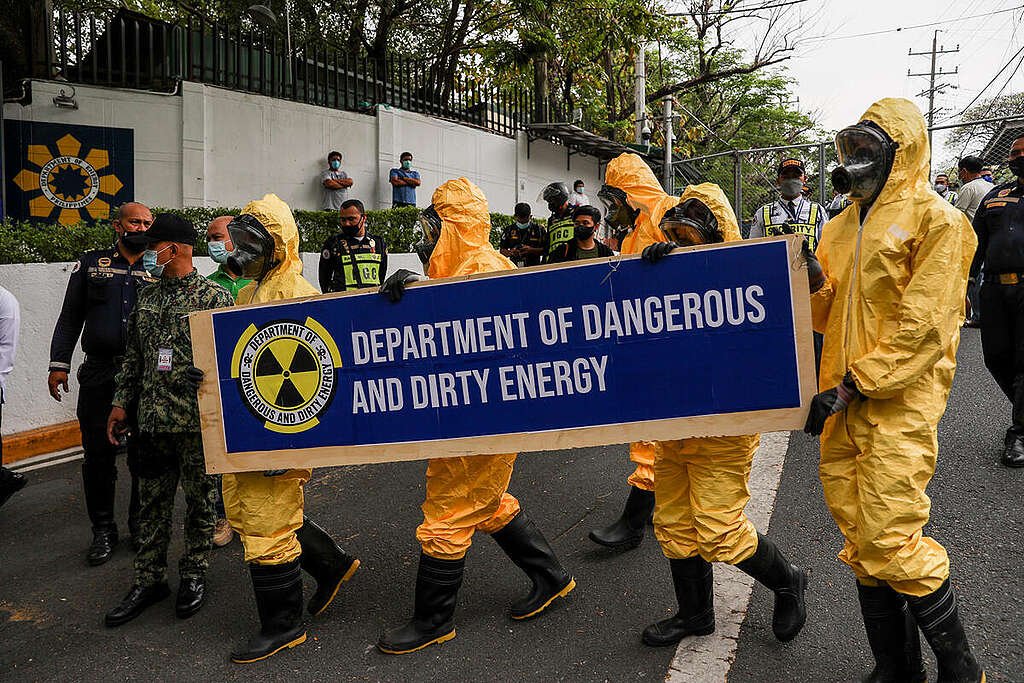
FILE PHOTO. Protest at the Department of Energy – Renewable Energy Management Bureau. GREENPEACE

MANILA  (April 13)  — Environmental group Greenpeace Philippines warned that the Philippines is risking a major policy contradiction, as the government pushes for new oil and gas exploration even while preparing to strengthen its global climate commitments.

The group criticized plans to expand fossil fuel development in ecologically sensitive and protected areas—including the Liguasan Marsh, parts of Tawi-Tawi, Cebu, and the Malampaya—calling the move “misguided” amid a global energy crisis rooted in oil dependency.

“Pivoting towards more local fossil fuel sources is not the answer to a crisis caused by a war driven by oil,” said Jefferson Chua of Greenpeace Philippines.

Energy Security vs. Climate Risk

The government has framed the exploration push as part of its response to volatile global fuel prices and supply disruptions, particularly following tensions in the Middle East and the declaration of a national energy emergency.

Officials have pointed to the untapped reserves in Mindanao, with the Department of Energy describing Liguasan Marsh’s potential as “very good.” Estimates suggest the area could hold billions of cubic feet of natural gas and up to 202 million barrels of oil.

Bangsamoro officials have also backed the move, with regional leaders arguing that developing local reserves could provide a long-term energy solution for Mindanao.

‘Carbon Bomb’ Warning

But Greenpeace argues that tapping these reserves—particularly in Liguasan Marsh—could trigger severe environmental consequences.

The marsh is home to carbon-rich peatlands, which act as natural carbon sinks. Once disturbed, these ecosystems can release large amounts of greenhouse gases.

“Opening Liguasan Marsh to extraction risks turning it into a massive carbon bomb,” Chua warned.

Beyond emissions, environmentalists say extraction could:

  • Disrupt fragile wetland ecosystems
  • Threaten biodiversity
  • Increase disaster risks for nearby communities

Timing Raises Stakes

The controversy comes at a critical moment.

The Philippines is set to submit its updated climate targets, or Nationally Determined Contribution (NDC), under the United Nations Framework Convention on Climate Change this April.

The NDC outlines how the country plans to cut emissions and adapt to climate impacts—making any expansion of fossil fuel development politically and diplomatically sensitive.

“We challenge the government to walk the talk,” Chua said, warning that deeper fossil fuel dependence could undermine the country’s credibility on climate action.

Crisis Response or Policy Backslide?

At the heart of the debate is a fundamental question: Should the Philippines double down on fossil fuels for energy security, or accelerate its transition to renewables?

Greenpeace argues that the current crisis should be used to fast-track renewable energy, not expand oil and gas dependence.

“Renewables don’t just help the environment—they shield Filipinos from economic shocks driven by wars overseas,” Chua said.

A Crossroads Moment

The clash highlights a growing tension in government policy—between short-term energy security and long-term climate commitments.

As fuel volatility continues and pressure mounts from both industry and environmental groups, the decisions made in the coming months could shape not just the country’s energy mix—but also its climate credibility and ecological future.

RIZAL MEMORIAL COLLEGEspot_img

Related articles

Aleson Resumes Domestic Sailings, but Sabah Repatriation Run Still Hangs on Maritime Clearance

Kota Kinabako, Malaysia (August 16) — Maritine authorities has authorized the resumption of passenger operations by Aleson...

Bonoan: Tanang Senador nakakuha og bahin sa ‘Leadership Fund’

DAKBAYAN SA DAVAO (Agosto 15)—Tanang Senador nakakuha og bahin sa miaging Kongreso og dili mo menus sa...

Mindanao Has the Minerals. Will Pax Silica Bring the Value?

DAVAO CITY (August 15) — Mindanao could become one of the Philippines’ most important sources of the minerals...

Quiboloy extradition: Treaty obligations, due process and the death penalty question

MANILA (August 15) — The Philippine government is preparing to surrender Pastor Apollo Quiboloy to the United States...
