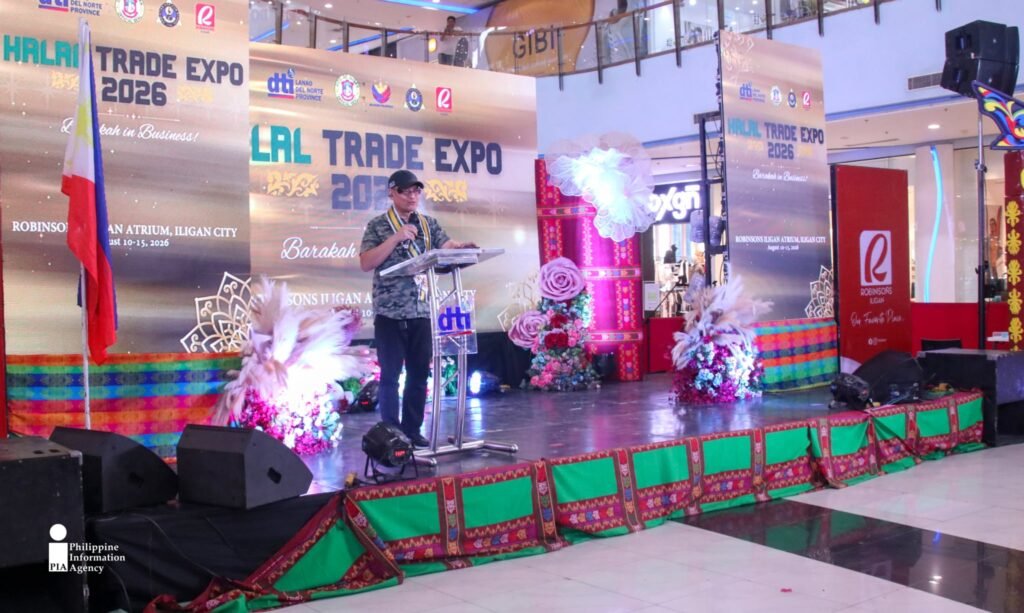
Department of Agriculture Undersecretary Zamzamin L. Ampatuan discusses the agency’s Halal Food Industry Development Program during the Halal Trade Expo 2026 in Iligan City, linking Halal industry development with food security, agricultural production, and opportunities for local farmers and enterprises. (Photo: ADD/PIA-10/Lanao del Norte)
ILIGAN CITY(August 26) — The Philippines’ ambition to become a stronger player in the global Halal market will mean little if Filipino Muslims still struggle to find enough affordable Halal food at home.
That is the central challenge facing the government’s push to develop the country’s Halal industry: building a market cannot begin and end with certification, trade fairs and export promotion. It must start with enough food being produced by Filipino farmers and fisherfolk.
The Department of Agriculture (DA) is now positioning agriculture as the foundation of its Halal Food Industry Development Program, linking farm production to food security, livelihood and access to wider markets.
DA Undersecretary for Mindanao Concerns and BARMM and Halal Food Industry Development Program Director Zamzamin L. Ampatuan said the entire Halal value chain depends on what happens at the farm level—from crops and livestock to feeds, inputs and the handling of agricultural and fishery products.
“The Halal value chain must begin with DA,” Ampatuan said during the launch of the Halal Trade Expo 2026 on Aug. 10.
His point exposes a weakness often overlooked in discussions about the growing Halal economy: there can be no thriving processing and export industry without a reliable supply of raw materials.
And for consumers, particularly Filipino Muslims, the more immediate concern is not whether Philippine Halal products can reach foreign shelves. It is whether basic Halal food—chicken, beef and goat meat among them—is consistently available and affordable in local markets.
“This is a dual challenge,” Ampatuan said, stressing that while the country looks at the much larger international Halal market, it must first ensure adequate supplies for Filipino Muslims.
That domestic gap gives the government’s Halal program a significance beyond trade.
It is also a food-security issue.
The DA is working with the Department of Trade and Industry and other agencies to strengthen the chain from production and slaughtering to processing, Halal certification, logistics, marketing and export promotion.
But expanding the industry will require more than connecting agencies on paper.
Farmers must have incentives to increase production. Livestock raisers need access to affordable feeds, breeding support, veterinary services and markets. Slaughterhouses and processors must meet Halal requirements without making compliance so costly that small producers are pushed out.
Logistics must also work, particularly in Mindanao where many potential producers are located far from major consumer and export markets.
Ampatuan said the government is linking the Halal initiative with its livestock program, including the planned Animal Industry Competitiveness Enhancement Fund for 2027, with a portion intended for Halal development.
The intended benefit is two-way: a stronger Halal industry creates markets for agricultural products, while higher farm production provides the raw materials needed by processors.
More importantly, it could put more income into the hands of farmers.
“Agriculture is a very basic foundation on which we lift our economy,” Ampatuan said, arguing that increased production can strengthen farmers’ purchasing power.
But this is where implementation will matter.
A Halal industry that grows mainly through importation of raw materials, concentration among large processors or dependence on a few suppliers would do little to transform rural livelihoods.
The real test is whether small farmers, fisherfolk, cooperatives, Muslim entrepreneurs and micro, small and medium enterprises (MSMEs) can become active participants in the value chain.
Beyond the Halal label
Ampatuan acknowledged that producing Halal food is only the beginning.
“Producing Halal food is not enough. We must produce it with quality and consistency, at the proper price,” he said.
That is an important distinction.
Certification can establish whether a product meets Halal requirements, but it does not automatically make that product affordable, competitive or accessible.
For Philippine producers hoping to enter markets dominated by countries such as Malaysia and Indonesia, consistency, volume, quality and price will ultimately determine whether the country can compete.
The government therefore plans to expand livestock and poultry production, develop more Halal-compliant slaughterhouses and processing facilities, improve logistics and connect producers with institutional buyers, retailers and exporters.
The challenge is ensuring that this expansion does not leave local consumers behind.
The Philippines may have a large domestic Muslim population and an even larger potential international market. But market size alone does not guarantee a successful industry.
What matters is whether the country can build a dependable supply chain that begins with productive farms and ends with consumers receiving safe, quality and reasonably priced food.
A test for government support
The government’s Halal strategy also provides an opportunity to test whether public investment can move beyond fragmented programs.
DA, DTI, local governments and other agencies all have roles, Ampatuan said. But farmers and MSMEs will judge the program by whether support actually reaches them—in the form of production assistance, financing, infrastructure, certification support, technology, market linkages and reliable buyers.
For communities in Mindanao, particularly Muslim-majority areas, the stakes are even more direct.
A stronger Halal value chain could create jobs and markets while strengthening local food systems. But it could also reproduce existing inequalities if small producers cannot afford to comply with standards or compete with larger businesses.
That is why the government should measure the success of the Halal program not only by the number of certified products, trade deals or exports generated.
It should also ask: Are Filipino farmers earning more? Are MSMEs entering the market? Are Halal products becoming more available and affordable to Filipino Muslims? And is domestic food supply becoming more secure?
Those are harder questions than counting exhibitors at a trade expo.
But they are the questions that will determine whether the Philippines’ Halal ambitions become a genuine rural development and food-security strategy—or simply another promising export story that leaves the producers and consumers who should benefit most waiting on the sidelines.