CAGAYAN DE ORO CITY (September 9) — For residents of Northern Mindanao, the haze drifting across the region is more than a visibility problem—it is an air-quality threat that has prompted local governments to tell people to mask up, stay indoors and limit exposure.
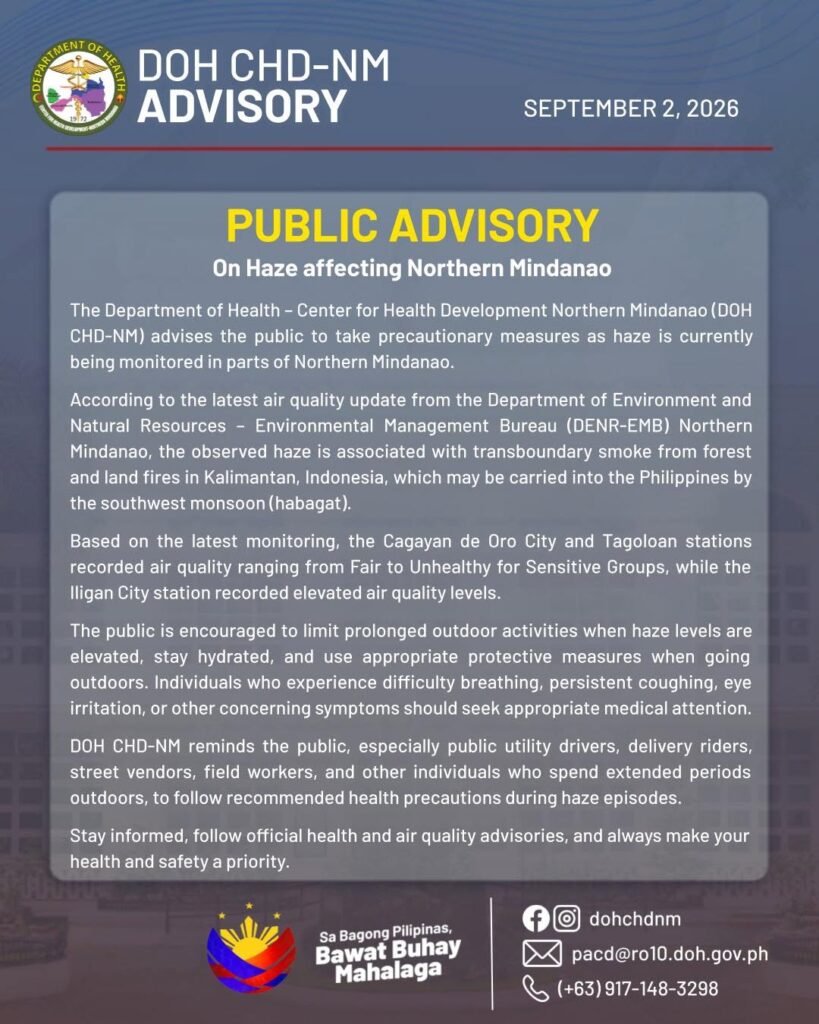
The warning came as monitoring stations recorded elevated levels of fine particulate matter (PM2.5), tiny particles that can penetrate deep into the lungs.
The Environmental Management Bureau in Northern Mindanao (EMB-10) on Tuesday recorded a PM2.5 air quality index (AQI) of 158 in Iligan City, a level classified as “very unhealthy.”
Tagoloan in Misamis Oriental posted 109, classified as “unhealthy for sensitive groups,” while Cagayan de Oro recorded 81, or “fair.”
The readings came amid haze attributed to forest fires in Indonesia, prompting health authorities and institutions in Northern Mindanao to step up precautions.
In Iligan City, the City Health Office urged residents to wear face masks and stay indoors as much as possible to reduce exposure to the haze.
The health office singled out children, older persons, pregnant women, and people with asthma or existing heart and lung conditions as particularly vulnerable to the effects of poor air quality.
“Avoid haze to protect the lungs. Clean air is important to a healthy life,” the health office said.
The advisory has also begun shaping routines in schools and other public spaces.
The City College of El Salvador in Misamis Oriental issued Administrative Memo No. 30 on Tuesday, requiring students, faculty members and staff to wear face masks while on campus.
In Cagayan de Oro, the city health office likewise encouraged residents to wear masks, particularly when going outdoors.
The health precautions come as communities contend with an environmental problem that does not stop at city or provincial boundaries.
For residents, health authorities said the immediate protection is straightforward: reduce exposure, avoid prolonged outdoor activities when air quality is poor, wear a mask when going outside and pay close attention to air-quality advisories.
For vulnerable groups, however, the haze carries a greater concern—making access to clean air not simply an environmental issue, but a matter of protecting health and preventing avoidable risks.