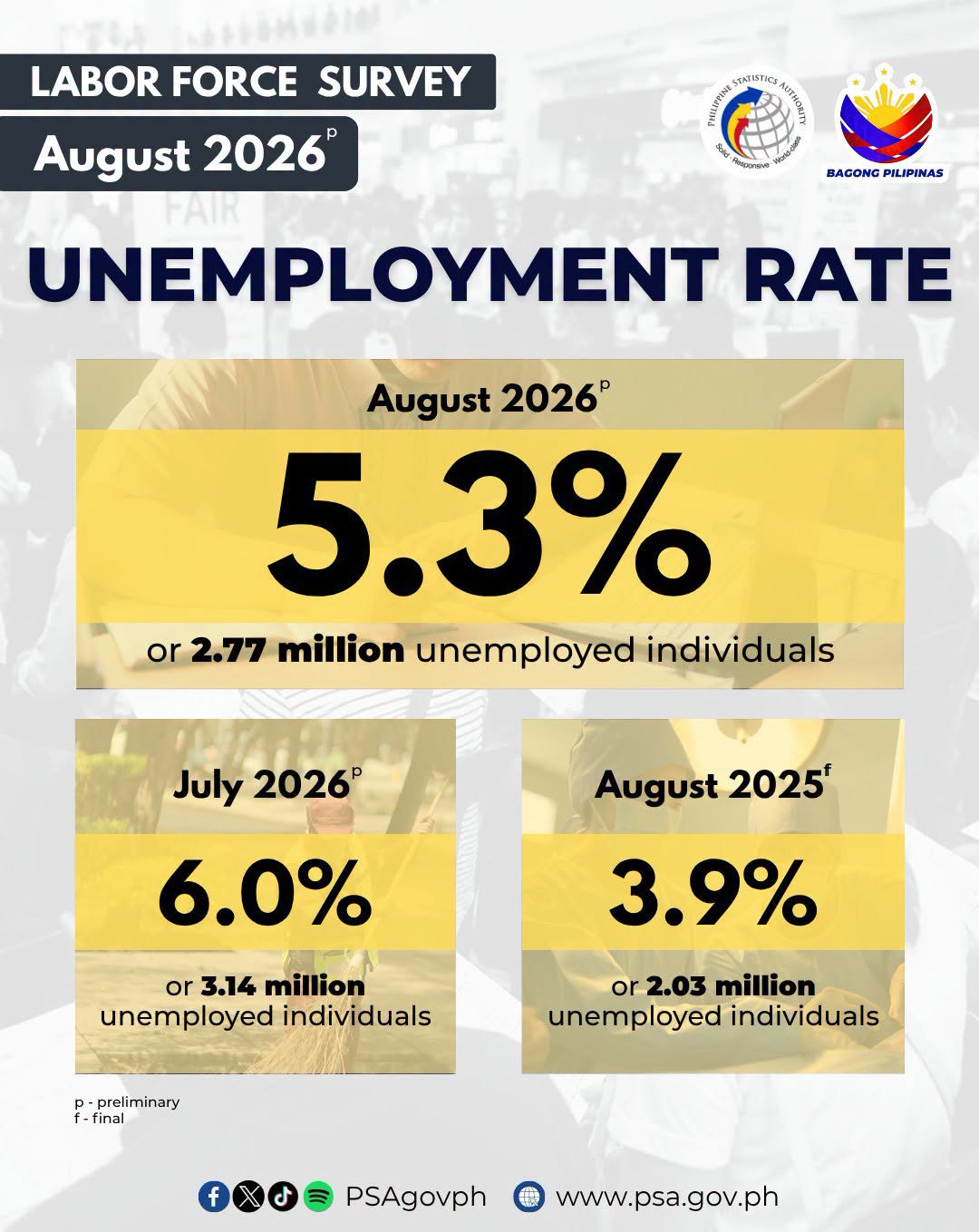
MANILA (October 8) — THE number of unemployed Filipinos fell to 2.77 million in August, bringing the unemployment rate down to 5.3 percent from 6 percent in July, according to the Philippine Statistics Authority (PSA).
National Statistician and Civil Registrar General Usec. Claire Dennis Mapa said the improvement partly reflected a sharp drop in new entrants to the labor market following the seasonal surge in graduates.
“The new entrants in July reached 1.5 million due to graduation, so there were really many. Now, it declined somewhat to 897,000. Of this 897,000, the labor market absorbed 470,000 as employed,” Mapa said.
The monthly improvement, however, masked a weaker labor market compared with a year earlier. Unemployment was 3.9 percent in August 2025, when about 2.03 million Filipinos were jobless. The employment rate also stood at 96.1 percent a year ago, compared with 94.7 percent this August.
The number of employed Filipinos reached 49.79 million, up from July but below the 50.10 million recorded a year earlier.
More Filipinos enter the labor market
The labor force participation rate edged up to 64 percent in August from 63.6 percent in July. This means about 64 out of every 100 Filipinos aged 15 and above were either working or actively looking for work.
The PSA estimated the working-age population at about 82.1 million, putting the labor force—the portion working or seeking work—at roughly 52.56 million.
However, the 64-percent participation rate remained below the 65.1 percent recorded a year earlier, indicating that a smaller share of the working-age population was participating in the labor market compared with August 2025.
Services continued to account for the largest share of employment at 61.7 percent, followed by agriculture at 20.9 percent and industry at 17.3 percent.
Agriculture and forestry posted the largest annual employment increase, adding 532,000 workers, followed by education with 298,000 and accommodation and food services with 195,000.
Employment fell in manufacturing, which lost 350,000 workers year-on-year, while fishing and aquaculture shed another 335,000.
Fewer hours, persistent need for more work
The labor market’s weakness was also reflected in working hours. Average weekly hours fell to 39.2 hours in August, from 40.6 hours in July and 41 hours a year earlier.
Mapa attributed the decline partly to unfavorable weather, noting that heavy rain affected working hours.
“The average hours worked per week were low, and the main reason was really bad weather,” she said.
Underemployment eased to 11.9 percent from 12.9 percent in July but remained above the 10.7 percent recorded a year earlier. The PSA estimated that about 5.90 million employed Filipinos wanted additional work, longer hours or another job.
The figures show that while the labor market improved from July, it remained weaker than a year earlier, with lower employment and labor force participation and a larger share of workers seeking more work.