Photo: Philippine Psychiatric Association Inc. (PPA)
MANILA (August 24) — Mental health experts are urging the Department of Education (DepEd) to defer its planned nationwide active-shooter drills, warning that realistic attack simulations could traumatize children while offering no clear evidence that they save lives or prevent school violence.
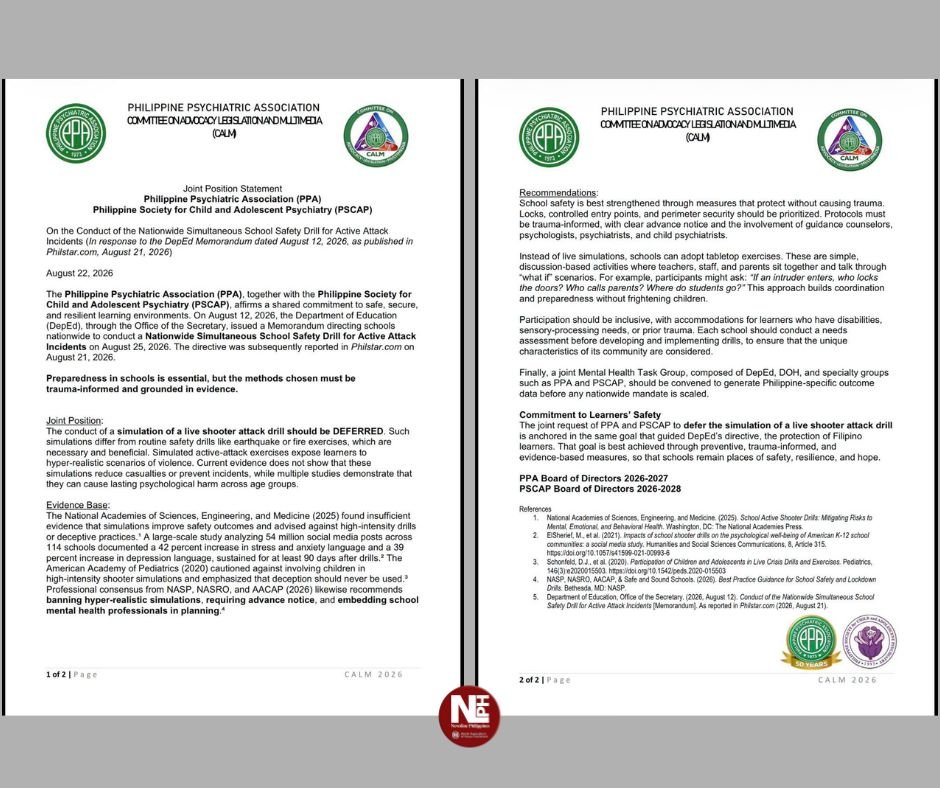
In a joint statement issued Aug. 22, the Philippine Psychiatric Association (PPA) and the Philippine Society for Child and Adolescent Psychiatry (PSCAP) opposed DepEd’s directive for a “Nationwide Simultaneous School Safety Drill for Active Attack Incidents,” saying school preparedness should not come at the expense of children’s psychological safety.
“Current evidence does not show that these simulations reduce casualties or prevent incidents, while multiple studies demonstrate that they can cause lasting psychological harm across age groups,” the groups said.
They cited research by the National Academies of Sciences, Engineering and Medicine, which found insufficient evidence that high-intensity simulations improve safety outcomes.
The groups also pointed to a study tracking 54 million social media posts across 114 schools that recorded a 42 percent surge in stress- and anxiety-related language and a 39 percent increase in depression-related language that lasted at least 90 days after active-shooter drills.
The findings have heightened concerns over the use of realistic violence scenarios in schools, particularly among children who may have difficulty distinguishing simulated threats from actual danger.
The PPA and PSCAP said the American Academy of Pediatrics in 2020 cautioned against involving children in high-intensity shooter simulations and emphasized that schools should never use deception in conducting such exercises.
They also cited professional guidance from the National Association of School Psychologists, National Association of School Resource Officers and American Academy of Child and Adolescent Psychiatry, which they said recommends banning hyper-realistic simulations, providing advance notice and involving school mental health professionals in planning.
DepEd has ordered all public and private elementary and secondary schools nationwide to conduct the simultaneous safety drill at 9 a.m. Tuesday, Aug. 25, with schools instructed to follow their localized contingency plans for active-attack incidents.
The directive was contained in a memorandum dated Aug. 12.
Safety without retraumatization
The psychiatric groups stressed that they are not opposed to school preparedness but are calling for approaches that protect students from unnecessary psychological distress.
They recommended strengthening school security through trauma-informed measures, including secured perimeters, controlled access points and advance emergency notices developed in consultation with mental health professionals.
They also proposed discussion-based tabletop exercises involving school personnel and parents, allowing adults to walk through emergency scenarios without exposing students to realistic or frightening simulations.
Schools should likewise provide inclusive accommodations for students with identified needs, based on prior assessments, they said.
To guide future policy, the groups called for a joint task force composed of education and health agencies and psychiatric organizations to gather local evidence before nationwide safety mandates are implemented.
The issue places DepEd’s push for stronger preparedness against a growing concern over the psychological cost of exposing children to simulated violence.
For the mental health groups, school safety should mean more than preparing students to respond to an attack. It should also ensure that efforts to protect them do not become another source of fear and trauma.