DAVAO CITY (July 28) — Mindanao supplies nearly half of the country’s fisheries, most of its seaweed, and vast mineral resources—but much of the value generated from these resources is processed elsewhere, leaving local communities with a smaller share of the gains.
The Mindanao Development Authority (MinDA) wants to change that by building a Blue Economy that turns the island’s ocean and coastal resources into local industries, jobs, and sustainable livelihoods.
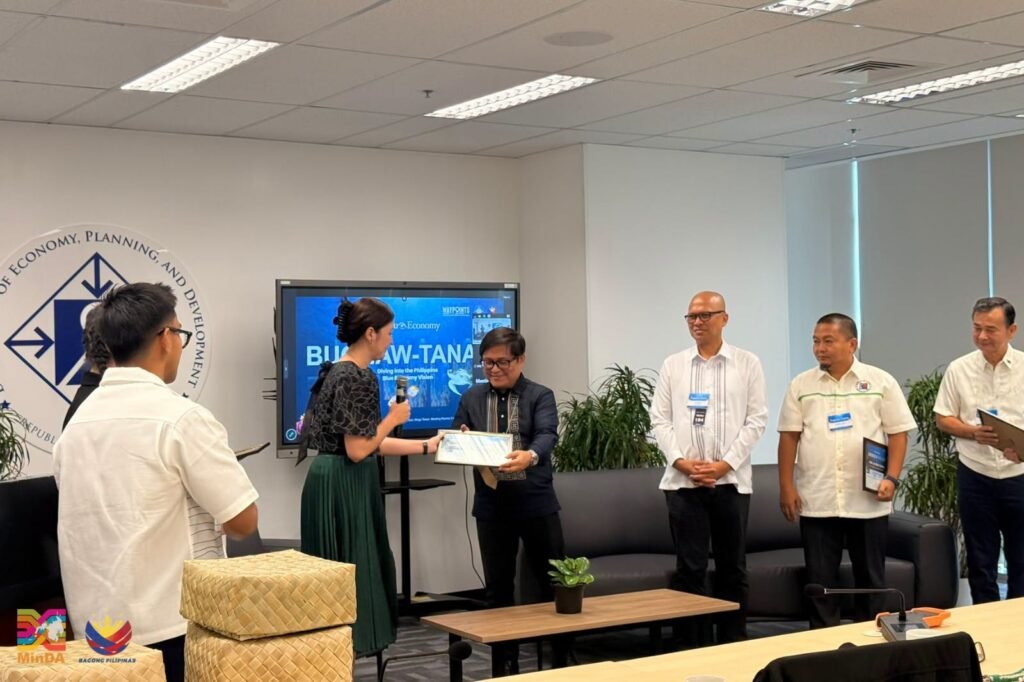
“For too long, Mindanao has been the food basket and resource base of the country, yet our farmers and fisherfolk have not fully benefited,” MinDA Deputy Executive Director Asec. Romeo Montenegro said during the Blue Economy Bughaw-Tanaw Forum on July 20 at the Department of Economy, Planning, and Development headquarters in Ortigas Center.
MinDA is pushing for local processing and stronger value chains so that fish, seaweed, and other resources are not simply shipped out as raw materials.
“By institutionalizing a Blue Economy strategy, we aim to close value chain gaps, promote local processing, and uplift coastal communities,” Montenegro said.
The push comes with a broader energy agenda. MinDA’s Mindanao Energy Transition Framework targets a 50 percent renewable energy mix by 2030, exceeding the national goal of 35 percent.
MinDA Chairperson Secretary Leo Tereso A. Magno said reliable energy is critical to developing local industries and strengthening food security, particularly in remote island communities.
“Energy security and food security must go hand-in-hand as we build a sustainable Blue Economy,” Magno said.
MinDA is also advocating the creation of a Mindanao Blue Economy Coordinating Council to align government efforts, while awaiting action on a proposed national Blue Economy law.
Its climate-resilient initiatives include the $10-million Water-Energy-Food Nexus Project in Sitangkai and Sibutu, Tawi-Tawi, which uses hybrid solar power to support a Level III water system and strengthen local food security and livelihoods.
In Surigao City and Dinagat Islands, MinDA and the Asian Development Bank are studying blue energy solutions that could expand power capacity for local nickel processing.
MinDA has completed its Mindanao Blue Economy Stocktake Report (2022–2023), aligned with the Mindanao Development Agenda 2023–2028, AmBisyon Natin 2040, and the BIMP-EAGA 2035 Vision.
The strategy supports the Marcos administration’s priorities on food security, renewable energy, and inclusive growth.
But for Mindanao’s coastal communities, the success of the Blue Economy will ultimately be measured not by the number of plans and frameworks, but by whether they translate into better incomes for fisherfolk, decent jobs for local workers, reliable power and water for island communities, and healthier seas.
Mindanao has long been a resource base for the country.
The challenge now is to ensure that more of the wealth generated from its waters and shores stays in the communities that depend on them.