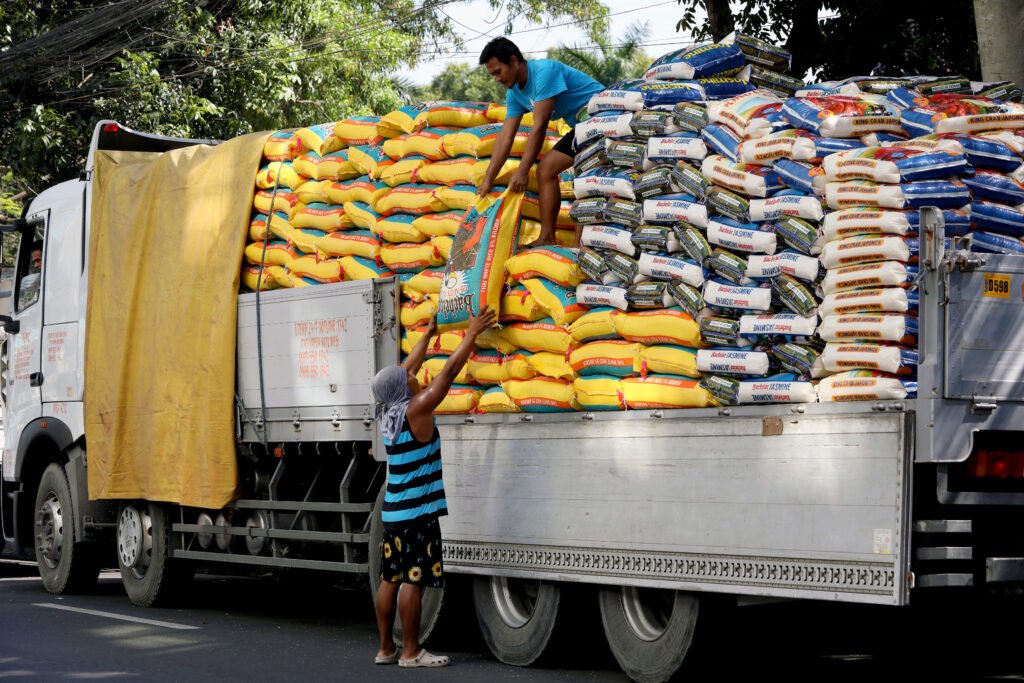
ALL RICE. Workers unload sacks of rice from a truck along Dagupan Street in Tondo, Manila on Wednesday (Feb. 7, 2024), the same day the Philippine Statistics Authority reported that the country’s unemployment rate hit an almost two-decade low in December 2023. The agency said agriculture, next to construction, contributed to the gain. (PNA photo by Yancy Lim)
MANILA(August 18) — The government collected more from rice import tariffs in the first seven months of the year, but the bigger story for Filipino families is not the nearly P13 billion collected—it is why the country continues to bring in millions of tons of rice from abroad.
From January to July, the Bureau of Customs (BOC) collected P12.8 billion in rice tariffs, 18 percent higher than the P10.78 billion collected during the same period last year.
At first glance, the increase looks like good news. More tariff revenues mean more money that can be directed to programs intended to strengthen the local rice industry.
But behind the numbers is a more complicated reality: the country imported substantially more rice this year.
BOC data showed that about 3.42 million metric tons (MT) of rice entered the country during the seven-month period, more than 25 percent higher than the 2.69 million MT imported during the same period last year.
For ordinary households, this matters because rice remains a daily necessity. Any change in supply, import costs, exchange rates or domestic production can eventually affect the price paid at the market.
More imports as a buffer
Agriculture officials said the higher imports were partly intended to protect the country’s food supply against threats to domestic production, particularly extreme weather and possible El Niño conditions.
The strategy is straightforward: bring in more rice while global supplies are available and prices are relatively favorable.
The Bureau of Plant Industry reported that eligible traders and importers applied to bring in 931,646 MT of rice in July alone, the highest monthly volume so far this year. Nearly five million MT of rice imports had been applied for from January to July.
Global prices have also become more attractive to importers. Vietnam fragrant rice, the most in-demand imported variety, averaged $457.30 per MT from January to July, down 6 percent from the same period last year, according to the UN Food and Agriculture Organization.
A weaker peso, however, worked in the opposite direction.
The average exchange rate used for rice imports during the period was around P60.10 to the US dollar, compared with P57.08 a year earlier. Because imported commodities are paid for in dollars, a weaker peso can increase the peso value of imports and, consequently, the tariffs collected.
Where does the tariff money go?
This is where the issue becomes important for farmers and consumers alike.
Rice tariffs are a major source of funding for the Rice Competitiveness Enhancement Fund (RCEF), which is guaranteed P30 billion annually for programs designed to modernize the local rice industry.
If collections fall short of P30 billion, the Department of Agriculture’s regular budget covers the difference. If collections go beyond P30 billion, the excess remains earmarked for programs supporting the rice industry.
That means every imported sack of rice carries a bigger policy question.
Are the revenues generated from imports actually helping Filipino farmers become more productive and competitive?
For consumers, the hope is that increased imports and lower global rice prices will help keep retail prices manageable.
For farmers, the concern is different. Cheap imported rice can provide consumers with relief, but local producers must still compete with foreign rice while dealing with rising production costs, extreme weather and limited access to technology and infrastructure.
The P12.8 billion collected so far is significant, but tariff collection itself is not the measure of whether the country’s rice policy is working.
In fact, higher collections can partly reflect higher import volumes and a weaker peso—not necessarily a stronger domestic rice industry.
For communities that depend on rice farming, the more important question is whether these revenues are reaching the programs that can increase farm productivity, reduce production costs and improve farmers’ incomes.
For consumers, the question is equally direct: Will all this importing and tariff collection eventually mean rice that is affordable and reliably available?
The government may be collecting more from imported rice. But the long-term goal should be to ensure that Filipino families are not permanently dependent on foreign rice to keep their tables supplied.
The real success of the tariff system will be measured not by how much the government collects, but by whether those billions help build a stronger local rice industry capable of feeding the country despite climate shocks, currency swings and volatile global markets.