MANILA (August 6) — The government has formally set the rules for expanding early childhood care and development nationwide, but the success of the program will ultimately depend on whether local governments can turn the new policy into functioning centers, adequately trained workers and services that reach children in the poorest communities.
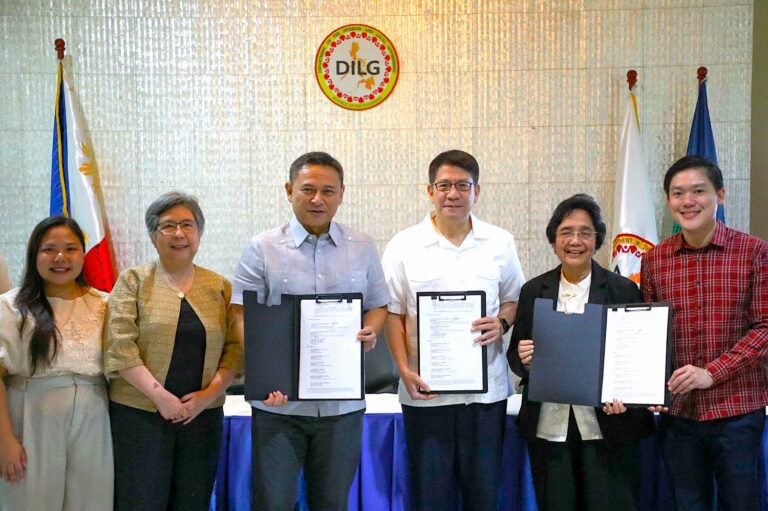
The Department of the Interior and Local Government (DILG) and Department of Education (DepEd) on Wednesday signed the implementing rules and regulations (IRR) of Republic Act No. 12199, or the Early Childhood Care and Development (ECCD) System Act, marking the start of nationwide implementation of an integrated system covering children from birth to 8 years old.
Interior Secretary Jonvic Remulla and Education Secretary Sonny Angara led the signing at the Quezon City Reception House.
The law seeks to bring health, nutrition, early learning and child development services together instead of treating early childhood education as a concern of schools alone.
“Kung seryoso tayong baguhin ang kinabukasan ng Pilipinas, kailangan nating magsimula sa ating mga pinakabatang kababayan. Dito nagsisimula ang tunay na nation-building,” Angara said.
But translating that ambition into results will require more than another national framework.
₱1 billion for centers, but rollout is still uneven
One immediate test is infrastructure.
The government has allocated ₱1 billion through the Local Government Support Fund–Financial Assistance to Local Government Units (LGSF-FALGU) to establish Child Development Centers (CDCs) in low-income local government units.
Of that amount, ₱741 million has already been released to 247 beneficiary barangays as of July 2026.
Yet the construction pipeline shows how much remains to be done.
Only 14 CDCs have been completed, while 113 are still under construction and 106 are in procurement.
That means the bulk of the funded centers are not yet operational.
The numbers highlight one of the central challenges facing the ECCD reform: funding a program is not the same as delivering a service.
Procurement delays, construction timelines, staffing requirements and the ability of LGUs to sustain operations could determine whether the investment produces actual learning spaces for children—or remains largely a budget and infrastructure accomplishment.
LGUs become central to the reform
The IRR gives local governments a much bigger role in delivering ECCD services.
Under the new framework, LGUs are expected to institutionalize local ECCD offices, create plantilla positions for Child Development Workers and develop localized ECCD roadmaps aligned with the national strategy.
That could address a long-standing vulnerability in community-based early childhood services: programs may exist, but their quality and sustainability can vary depending on the capacity and priorities of individual LGUs.
Professionalizing Child Development Workers through permanent positions could strengthen the system, but it also creates a recurring financial obligation for local governments.
The challenge will be particularly acute for poorer municipalities that have limited fiscal space but may have the greatest need for early childhood services.
Investment before Grade 1
DepEd said the reform is built around the recognition that foundational learning begins well before children enter formal schooling.
Early literacy, numeracy, health, nutrition and holistic development during the first years of life can influence how children perform once they enter basic education.
Angara cited UNESCO data showing that investments in early childhood education can generate returns of up to 13 percent, through better health outcomes and economic gains.
The government is also positioning the ECCD reform within a broader push for foundational learning.
Earlier, Angara led the Philippine delegation to the 14th ASEAN Education Ministers Meeting in Singapore, where education ministers endorsed a Philippine-led ASEAN Declaration on Foundational Learning for consideration at the 49th ASEAN Summit in November 2026.
If adopted, the Philippines will lead the development and implementation of its roadmap.
The implementation gap
The new IRR provides a clearer structure for delivering ECCD services, but its biggest test will be whether the system can overcome the familiar gap between national policy and local implementation.
The government now has to ensure that CDCs are not only built but staffed, that Child Development Workers are properly compensated and trained, and that health and nutrition services actually reach children in low-income communities.
The involvement of DILG, DepEd, DSWD, DOH, CHED, TESDA, DA and the National Nutrition Council reflects the scale of the task. Early childhood development cannot be fixed by education policy alone when a child’s ability to learn is also shaped by nutrition, health, family income and access to basic services.
The ₱741 million already released and the 233 CDCs either under construction or in procurement provide a substantial starting point.
But the more important numbers will come later: how many centers are operational, how many workers have secure positions, how many children are actually reached, and whether children entering Grade 1 are arriving better prepared to learn.
For a reform covering Filipino children from birth to age 8, that is where the government’s investment will ultimately be measured—not in the signing ceremony, but in what happens inside communities and classrooms.