CAGAYAN DE ORO CITY (September 7) — For children in Northern Mindanao, every cancelled class means more than a lost day on the school calendar.
It can mean another lesson missed, another reading skill left undeveloped, or another gap in numeracy that becomes harder to close as they move to higher grade levels.
The Department of Education (DepEd) in Northern Mindanao is now trying to confront that challenge on two fronts: recovering learning lost through repeated disruptions while making schools safer amid recent security threats and shooting incidents.
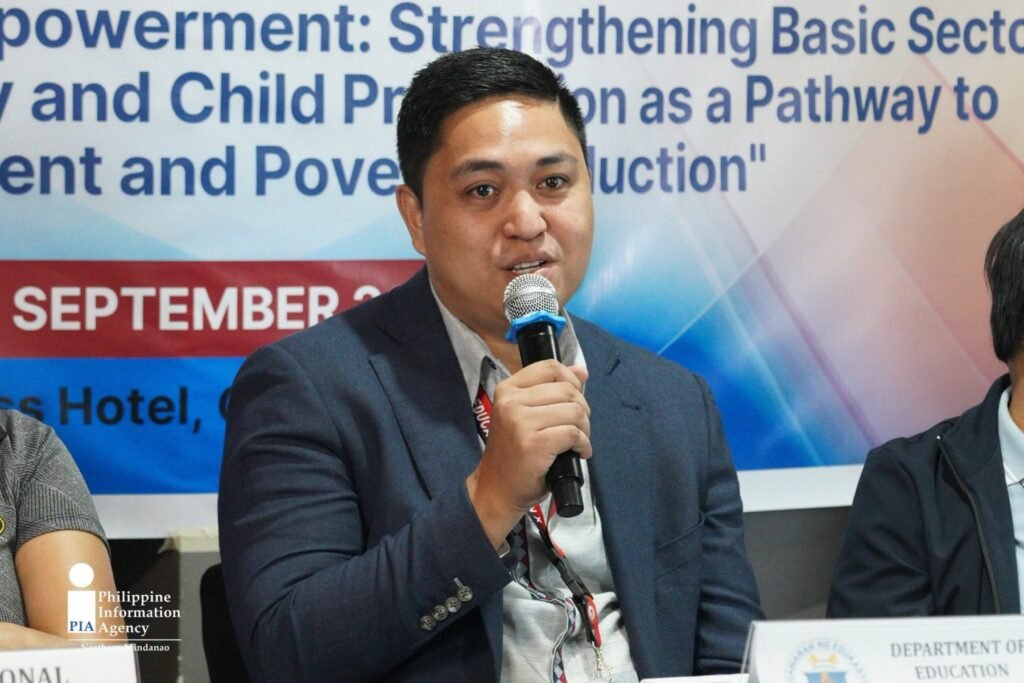
Ricardo Dragon, chief education supervisor of DepEd-10, said the agency is working to protect instructional time without compromising the safety and well-being of learners and school personnel.
“Especially nowadays, we’ve had a lot of disruptions of classes, not just because of recent threats and the shooting incidents with which we have strategized very well, because no other learner or student should be harmed by these incidents,” Dragon said during the Sept. 1 multisectoral dialogue on basic sector empowerment.
The challenge is particularly significant for children who were already struggling to keep pace with their peers.
Protecting a child’s right to learn
Under a child-rights approach, learning recovery is not simply about improving test scores. It is about ensuring that every child can exercise the right to quality education, regardless of whether learning has been disrupted by a pandemic, extreme weather, school closures or security concerns.
DepEd-10 is implementing a three-term block system to protect classroom contact time from being further reduced by extracurricular and co-curricular activities.
Sports meets, journalism competitions and other competitive activities are consolidated into breaks between academic terms rather than being scheduled during regular instructional days.
“DepEd has been implementing the three-term blocks so that we do not compromise the weekdays for activities like sports and other competitions that hamper the contact time,” Dragon said.
The measure recognizes a basic reality: children cannot recover learning they have not had sufficient opportunity to receive.
DepEd-10 is also implementing the Academic Recovery and Accessible Learning (ARAL) Program, which provides targeted tutoring and learning interventions for struggling learners.
The program is particularly important for children entering secondary school without adequate foundational competencies.
For these learners, the issue is not simply whether they can pass to the next grade. It is whether they have acquired the reading, comprehension and numeracy skills needed to participate meaningfully in school and eventually exercise their rights and opportunities beyond the classroom.
Safety without fear
But protecting children’s right to education also requires making schools places where children feel physically and emotionally safe.
Recent security threats have forced schools to strengthen their safety measures, including the enforcement of DepEd Order No. 6, series of 2026, which provides guidelines for a motivating and safe learning environment.
The measures include multi-level bag inspections by authorized personnel at school entrances and by class advisers before learners enter classrooms. Restrictions have also been imposed on unauthorized cellphone use during class hours.
DepEd-10 has coordinated with local government units and local police to provide additional personnel and security screeners on school campuses.
Such measures are intended to prevent violence and protect children from harm.
But a child-rights lens also raises another question: How can schools strengthen security without turning the learning environment into one defined by fear, suspicion or excessive control?
Security procedures must remain proportionate, respectful and child-sensitive. Children should be protected from violence without being treated as potential threats themselves.
The presence of security personnel and inspections may reassure some learners and families. For others, particularly children who have experienced violence or other traumatic events, heavily securitized school environments could add another source of anxiety.
This makes communication and child participation important. Learners need to understand why safety measures are being implemented, what their rights are during inspections, and where they can report concerns or seek help.
The children behind the numbers
The disruption of education is rarely experienced equally.
Children from families with fewer resources may have less access to learning materials, devices, reliable internet connectivity or private tutoring when classes are suspended.
Children with disabilities may face additional barriers to continuity of learning. Children in geographically isolated communities may find it more difficult to access alternative learning arrangements. Those already behind academically may fall even further behind when instructional time is repeatedly interrupted.
This is why learning recovery cannot rely solely on bringing children back into classrooms.
It requires identifying which children are being left behind, why they are falling behind and what support they need to catch up.
The ARAL program can play an important role, but its success will depend on whether interventions reach the children who need them most, whether teachers have sufficient support and resources, and whether progress is regularly monitored.
A safer school, a stronger child
For DepEd-10, protecting instructional time and strengthening school safety are not competing priorities.
Both are part of creating an environment where children can learn, develop and participate without fear.
The ultimate measure, however, should not only be how many classes are recovered or how many security personnel are deployed.
It should be whether children are learning, safe, heard and supported.
As Northern Mindanao schools navigate weather disruptions, learning gaps and security concerns, the challenge is to ensure that the measures taken in the name of protection do not inadvertently compromise another fundamental right: every child’s right to an education that is safe, inclusive and conducive to their development.
Because for children, recovering lost learning is not merely about catching up with a curriculum.