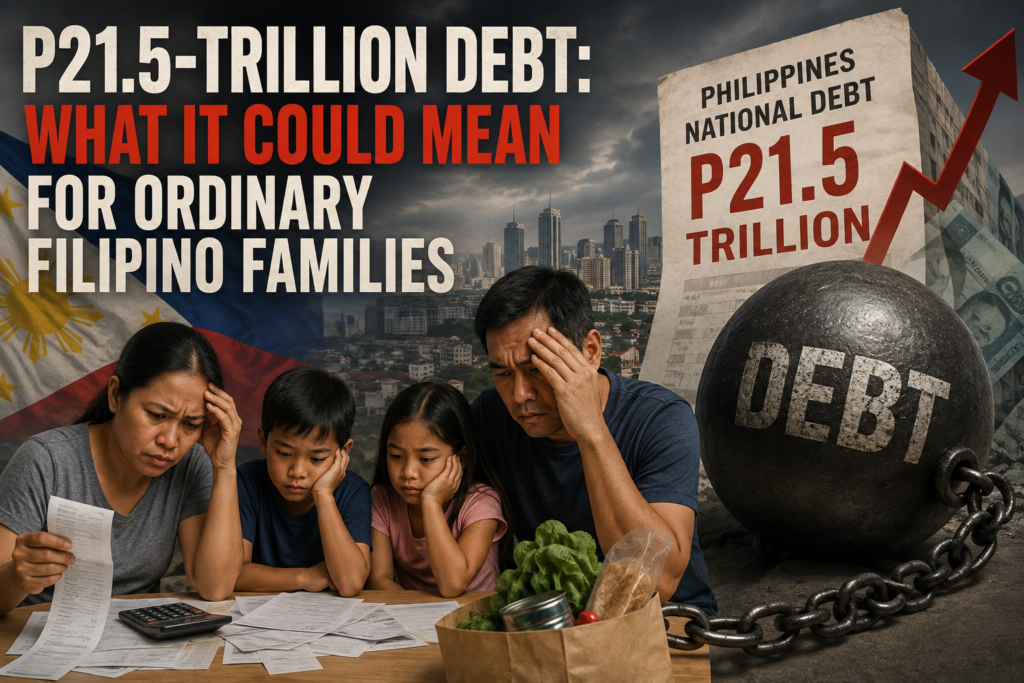
MANILA(August 12) — For most Filipino families, PHP21.48 trillion is a number too large to imagine.
But government debt does not remain inside government balance sheets.
Its consequences can eventually reach the household budget—through taxes, prices, public services, jobs and the government’s ability to respond when families need help.
The Department of Budget and Management expects the country’s outstanding debt to climb to PHP21.48 trillion by the end of 2027, up 8.7 percent from the revised PHP19.77 trillion this year.
At the same time, the government plans to borrow PHP3.3 trillion next year, almost 21 percent more than its revised 2026 borrowing program.
For ordinary families, the critical question is not simply whether the debt is “manageable.”
It is: What does all this borrowing mean for the money left in their pockets?
The peso’s decline has a household price
One reason the debt is rising is the weakening peso.
Budget Assistant Secretary Romeo Matthew Balanquit said many government loans were secured during the pandemic when the exchange rate was around PHP49.60 to the US dollar. With the peso now around PHP60, those foreign obligations cost more in peso terms.
The same currency problem can hit families from another direction.
A weaker peso can make imported fuel, food, medicines, machinery and other goods more expensive. Higher import costs can then filter into transportation, electricity, food and other household expenses.
So when government says the peso depreciation is increasing its debt burden, families may experience the same economic pressure in their grocery receipts and monthly bills.
More money for debt, less room elsewhere
The government’s projected debt service bill tells another part of the story.
Debt servicing is expected to reach PHP2.7 trillion in 2027, up 32.2 percent from PHP2.05 trillion this year.
Of that, PHP1.11 trillion will go to interest payments alone.
Interest does not build a classroom, hire a nurse or put food on a family’s table.
It is the cost of borrowing.
Of course, debt payments cannot simply be eliminated. The government must honor its obligations to creditors.
But every peso committed to debt service competes, within the overall budget, with other demands such as education, health care, housing, social protection, agriculture and disaster response.
For a low-income family, a reduction or delay in any of those services can mean paying out of pocket.
The debt-to-GDP ratio isn’t the whole story
The government points out that its debt-to-GDP ratio is expected to decline from 64.9 percent this year to 64.4 percent in 2027 and eventually to 63 percent by 2030.
It also notes that the ratio remains below the 70-percent benchmark.
But a national ratio can conceal what families actually experience.
A government can remain below a technical debt threshold while households struggle with expensive food, high electricity bills, costly transportation and stagnant incomes.
The question should therefore go beyond “Are we still below 70 percent?”
It should also ask: Are Filipinos getting enough economic and social returns from every peso borrowed?
Good debt—or expensive debt?
The government says it is borrowing mainly for infrastructure, development and other productive investments.
That can be a reasonable use of public debt.
A new transport system that cuts commuting time, reliable irrigation that raises farm income, or infrastructure that brings businesses and jobs to poor communities can eventually generate benefits greater than the cost of borrowing.
But borrowing becomes harder to defend when projects are delayed, overpriced, poorly planned or fail to deliver measurable benefits.
For ordinary taxpayers, the standard should be simple:
If families will eventually help pay the debt, they should also be able to see and feel what the debt built.
The future bill starts today
The government is projecting a budget deficit of 5.1 percent of GDP in 2027, gradually declining in succeeding years.
Yet gross borrowing is expected to reach PHP3.65 trillion in 2028 and PHP3.55 trillion in 2029.
That means the country will continue borrowing heavily even as it tries to bring down its deficit.
For families already living paycheck to paycheck, the concern is not an abstract debt ceiling.
It is whether government finances will eventually translate into higher taxes, fewer services, higher prices or slower economic growth—or whether today’s borrowing will produce better jobs, stronger public services and higher incomes.
The Philippines may still be within the government’s preferred debt limits.
But limits are not the same as comfort.
And for a family deciding whether to buy rice, pay the electricity bill, refill the motorcycle or settle a child’s school expenses, the real measure of the economy is not the debt-to-GDP ratio.