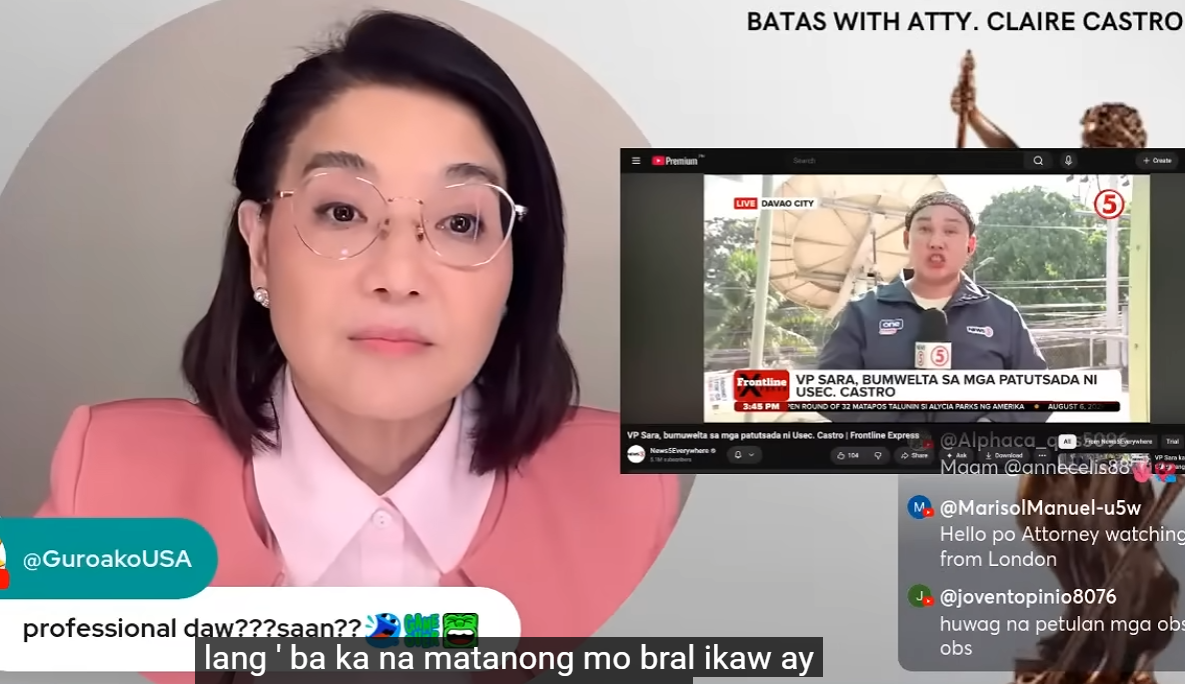
DAVAO CITY (August 8)— A social media exchange between Palace Press Officer and Presidential Communications Office Undersecretary Claire Castro and News5 reporter Bryll Montalvo has drawn attention to the continuing conversation on press freedom, media neutrality, and the relationship between government officials and journalists.
The discussion stemmed from an episode of Castro’s vlog, “Batas with Atty. Claire Castro,” in which she commented on a News5 report by Montalvo titled, “VP Sara Bumwelta sa mga Patutsada ni USec. Castro.”
While reviewing the report, Castro addressed Montalvo directly, encouraging him to ask Vice President Sara Duterte additional questions regarding the issues raised in the news report.
“Bryll, you’re part of the mainstream media. Why don’t you ask her?” Castro said in the vlog.
She also remarked that, in her opinion, mainstream journalists should maintain neutrality and avoid giving the impression of political bias.
“If you’re truly part of the mainstream media, you should remain neutral. You shouldn’t make your bias obvious,” Castro said.
During the vlog, Castro further suggested that Montalvo appeared to be sympathetic to former President Rodrigo Duterte’s supporters, commonly referred to as “DDS” or Duterte Diehard Supporters.
Montalvo later responded through his Facebook account, posting only a brief message:
“Trabaho lang, walang personalan.” (“It’s just work, nothing personal.”)
The reporter did not directly address Castro’s observations about his reporting.
Media practitioners note that criticism of journalists by public officials is not unusual in democratic societies. Likewise, journalists routinely scrutinize government officials and public institutions as part of their constitutional role of informing the public.
Public officials, including government spokespersons, are likewise entitled to express their views regarding media coverage, particularly if they believe reports lack context or balance.
At the same time, advocates of press freedom emphasize that journalists must be able to perform their work without intimidation, harassment, or undue pressure, while remaining accountable to professional standards of accuracy, fairness, and independence.
Press Freedom and Responsibility
The Philippine Constitution guarantees freedom of speech and of the press, recognizing an independent media as an essential pillar of democracy.
Media organizations and journalism groups have consistently maintained that the credibility of a news report should be evaluated based on its factual accuracy, fairness, context, and adherence to ethical standards rather than assumptions about a journalist’s political beliefs.
Similarly, public officials have the right to respond to or criticize news reports, provided such responses do not undermine journalists’ ability to perform their duties independently.
The exchange between Castro and Montalvo reflects the dynamic relationship between government and the media—one in which both accountability and independence play important roles.
As government officials continue to communicate policies and journalists continue to scrutinize public affairs, maintaining mutual respect while upholding the principles of transparency, fairness, and press freedom remains essential to a healthy democratic society.
Whether one agrees with the Palace spokesperson’s criticism or the reporter’s approach, the incident underscores the continuing importance of protecting both the public’s right to information and the media’s responsibility to report accurately, fairly, and independently.