
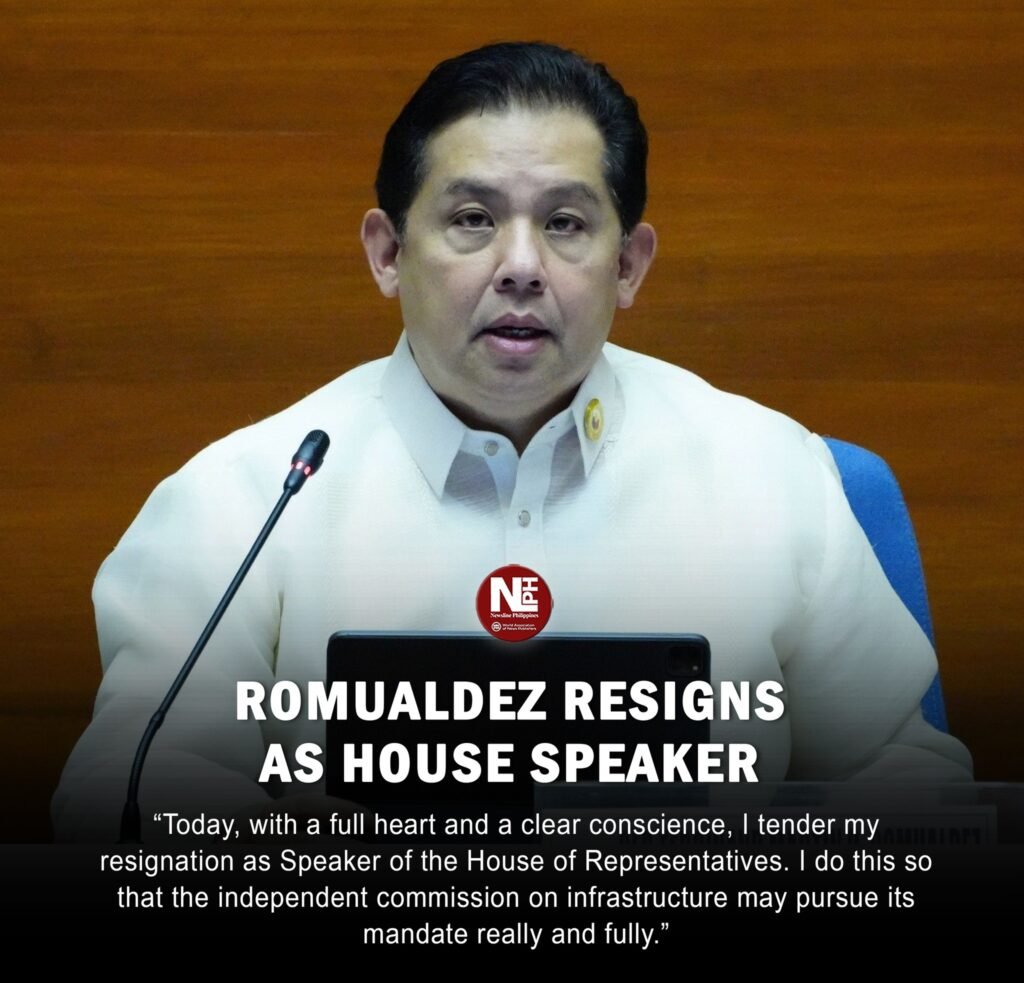
DAVAO CITY, Philippines (September 17) — After mounting pressures and loud speculations of impending political shake-up, Leyte Rep. Ferdinand Martin Romualdez resigned Wednesday as Speaker of the Philippine House of Representatives, stepping down amid mounting outrage over allegations of budget insertions and irregularities in the government’s flood control program.
Romualdez, a cousin of President Ferdinand Marcos Jr., announced his resignation in a nationally broadcast speech “I step aside so the Independent Commission can probe the scandal freely and fully without interference.”
The move reflects the depth of public anger over flood control projects, many of which remain unfinished or are criticized as substandard despite billions of pesos in allocations. Watchdogs allege that funds were funneled into politically connected contractors, creating what critics call a “pork barrel by another name.”
A Pattern Beyond the Philippines
The scandal resonates beyond Manila, drawing comparisons to corruption controversies in Asia where infrastructure funds have been exploited as political currency.
- Nepal has faced repeated controversies over road and hydropower projects, with anti-graft agencies probing inflated costs and political interference. In 2023, the country’s Office of the Auditor General flagged billions in “unaccounted expenditures” in public works, fueling street protests over government accountability.
- Indonesia, long wrestling with corruption in infrastructure, saw its Corruption Eradication Commission (KPK) expose systemic bribery involving flood control and road contracts. In Jakarta, poorly executed flood defenses collapsed in 2020, triggering public outcry and strengthening calls for transparency.
Observers say the Philippine scandal is part of a larger regional challenge: the use of public works budgets as political leverage while communities remain vulnerable to climate-driven disasters.
Domestic Fallout
Romualdez’s resignation shifts power dynamics in Congress, where rivals are now jockeying for the Speakership. His exit also tests the Marcos administration’s promise of transparency, as critics warn that the Independent Commission must be insulated from political pressure to be credible.
Analysts note that with midterm elections approaching in 2025, the scandal could reshape voter sentiment. “Flooding has become both a literal and political crisis,” said one Manila-based political scientist. “The public is angry not just about corruption, but about the government’s failure to protect them.”
Regional Lessons
Anti-corruption advocates argue that the Philippines should draw lessons from its neighbors. Indonesia’s KPK, despite facing political pushback, set a precedent for aggressive prosecution of officials tied to public works scams. Nepal’s civil society has demanded stronger auditing mechanisms and public participation in monitoring infrastructure spending.
In the Philippines, watchdog groups are now calling for similar reforms—tighter oversight on congressional insertions, open contracting, and stronger whistleblower protection
Timeline: The Flood Control Controversy
- 2023 – 2024
Billions allocated for flood control projects under the national budget, with significant congressional insertions. - Early 2025
Watchdog groups raise red flags over “ghost projects” and questionable contracts linked to flood control funds. - July 2025
Heavy rains trigger severe flooding in Luzon and Mindanao. Residents blame failed infrastructure and corruption. - August 2025
Media exposés reveal substandard flood control works and favored contractors tied to politicians. Public outrage grows. - September 2025
Independent Commission created to investigate irregularities. Civil society and lawmakers call for Speaker Romualdez to resign. - September 17, 2025
Leyte Rep. Martin Romualdez resigns as House Speaker, saying he is stepping aside to allow the investigation to proceed “freely and fully—without interference.”